
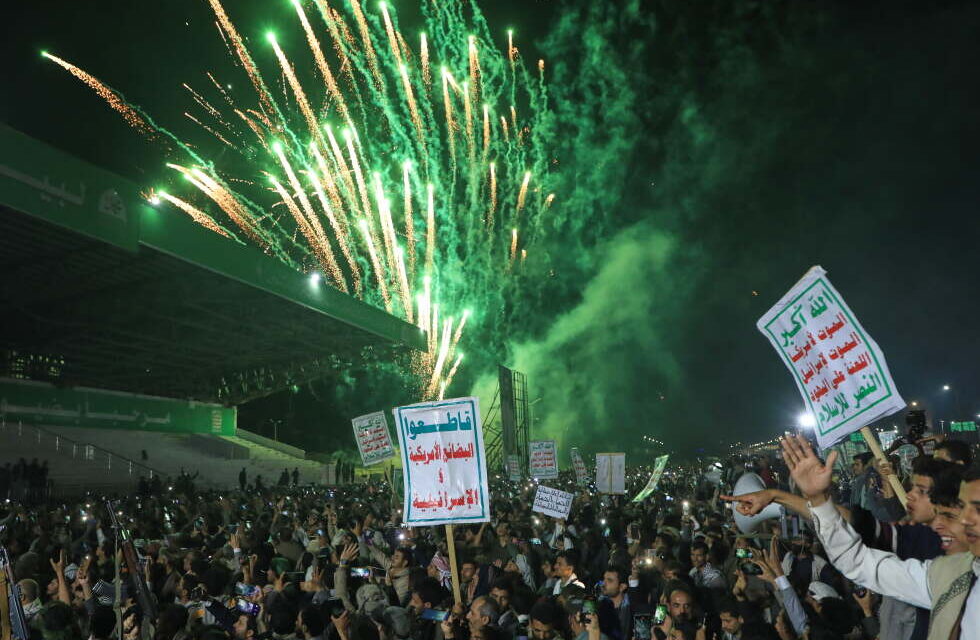
Fireworks burst over a rally in Sana’a, Yemen for Houthi insurgents and against the Saudi-led coalition government, July 20, 2026 (Osamah Abdulrahman/AP)
EA on TVP World and WION: A Return to US War on Iran?
When Security Is Mistaken for Legitimacy: Understanding Polls In Iran
UPDATES: US-Israel Wars, Day 145 — 3 US Soldiers Killed, 1 Missing in Jordan and Iraq
UPDATE 1338 GMT:
Iranian media report an oil tanker exploded in the Strait of Hormuz after colliding with a naval mine.
Authorities say the “violating tanker” struck the mine after leaving the route designated by Iran.
UPDATE 1332 GMT:
Donald Trump, his family, and his associates may gain financially if the Administration completes a deal permitting uranium enrichment for Saudi Arabia’s nuclear energy program.
Donald Trump Jr. and Eric Trump have investments in nuclear fuel companies. Trump’s media company is seeking a merger with a nuclear energy start-up. Cabinet officials and Trump donors have ties to nuclear energy companies.
UPDATE 0547 GMT:
Iran’s Government has criticized State TV for “censorship” of a speech of President Masoud Pezeshkian last week.
The Government Information Council accused State broadcaster IRIB of removing a section in which Pezeshkian said that, after Israel’s June 2025 war on Iran, the late Supreme Leader publicly rejected negotiations with the US but privately gave approval.
Pezeshkian said, “He ordered us to go negotiate. We started the talks based on his order.”
IRIB rejected the Government’s “accusations and improper attributions”.
UPDATE, JULY 26:
US officials say concerns over depleted air defense interceptors are the main reason why the Trump camp has held back from even wider attacks inside Iran.
Joint Chiefs of Staff chair Gen. Dan Caine advised that the military can launch major combat operations; however, interceptors are exhausted.
In late April, officials and internal documents indicated that the Pentagon had expended more than 1,200 Patriot interceptor missiles, at more than $4 million apiece, leaving inventories worrisomely low. The situation has worsened since then, military officials said last week.
A senior US official also cited doubts that the intensified campaign will pressure Iran into talks. They noted recent strikes have kept Iran united and focused on a foreign threat.
A “source familiar with the matter” said Vice President J.D. Vance, who has opposed the US war from its outset, also raised concerns.
For the second night in a row, the US did not carry out airstrikes inside Iran, following 12 consecutive nights of assaults.
Two officials said the decision stems both from a “willingness to provide more space for diplomacy and a recognition that — short of a return to major combat operations — the current level of US strikes has reached the limit of its effectiveness”.
They said many Trump advisors, including his son-in-law Jared Kushner favor the continuation of negotiations and economic pressure on Iran over a longer period of time.
UPDATE 1639 GMT:
US officials say Iran is adapting and enhancing the capabilities of a ballistic missile to evade air defenses better.
The Kheibar Shekan, with a range of 1,450 km (900 miles), is capable of reaching Gulf States and Israel.
Iranian forces have been using the missile in recent attacks on US personnel and positions in the region, varying the trajectory, speed, and maneuvering to hinder interception. Some missile models can perform last-minute maneuvers in the final stage of flight.
A US official said most Kheibar Shekans had been shot down, but some punched through defenses.
UPDATE 1253 GMT:
Yemen’s Saudi-backed Governing Council says its air force has carried out strikes on Houthi missile and drone launch sites and arms depots in the Marib and al-Jawf Provinces.
UPDATE 1250 GMT:
Iran’s Revolutionary Guards say they stopped four ships attempting to cross the Strait of Hormuz over the past 24 hours “after warning shots were fired by the IRGC Navy”.
UPDATE 1105 GMT:
Iranian officials say all 28 Indian crew have been rescued after on the Mozambique-flagged ship Disha was attacked as it entered Iran’s territorial waters.
The Disha was struck after crossing the perimeter of a US Navy blockade in the Gulf. Central Command said earlier today (see 0600 GMT) that it had fired upon and disabled a tanker.
The vessel has been on the US Treasury’s sanctions list for the past two years. It transports Iranian liquefied petroleum gas to Houthi-controlled areas of Yemen.
Mohammad Fathali, Iran’s ambassador to India, cautioned against foreign naval involvement in the Strait of Hormuz: “Experience has repeatedly demonstrated that the presence and intervention of extra-regional military forces have not enhanced security in the region; rather, they have contributed to heightened tensions and greater instability.”
UPDATE 1101 GMT:
Two ballistic missiles launched from Yemen towards Saudi Arabia have been intercepted, say Greek security sources.
The missiles targeted oil refineries in city of Yanbu in the west of the country. They were shot down by a Greek-operated air defense system.
UPDATE 0600 GMT:
The US military says it disabled a tanker attempting to evade the American blockade on Iranian ports.
Central Command said forces fired into the engine room after the vessel, heading for Iran, tried to run the blockade four times and did not comply with repeated warnings.
UPDATE, JULY 25:
Yemen’s Iran-backed Houthis have claimed their first missile attack on Saudi Arabia during the US-Israel Wars.
The group claimed a strike on Jizan in the south of the Kingdom.
Saudi Arabia, which backs the Yemeni Governing Council, reportedly carried out five airstrikes on and near the port city of Hodeidah in western Yemen on Friday. Two people were wounded.
The Saudis targeted telecommunications facilities and Kamaran island, which lies near the Bab al-Mandeb strait.
The Houthis posted: “The Saudi enemy’s targeting of civilian facilities in Hodeida and Kamaran island constitutes a dangerous escalation. We affirm that these recent crimes will not go unanswered.”
UPDATE 1445 GMT:
Jordan’s military says it intercepted seven Iranian missiles and six drones on Friday.
UPDATE 0611 GMT:
Two Chinese-owned supertankers carrying crude oil from Saudi Arabia have successfully exited the Bab el-Mandeb strait.
The supertankers crossed despite Yemen’s Houthis declared a blockade on Saudi ports on Wednesday.
UPDATE, JULY 24:
The US has carried out a 13th consecutive night of strikes inside southern Iran.
Explosions were reported in six provinces, including in the port cities of Bandar Abbas and Jask, and on Qeshm Island.
At least four people were killed and five injured in Khuzestan Province.
Iran’s military said it launched a new wave of drone attacks on US military facilities in Bahrain and Jordan.
Fuel storage tanks, equipment warehouses, and troop living quarters at the Sheikh Isa Air Base in Bahrain were targeted. The military claimed strikes on aircraft hangars, maintenance facilities, and accommodation sites at the Muwaffaq Salti base in Azraq, Jordan.
UPDATE 1632 GMT:
For the second time, the US House of Representatives has passed a war powers resolution directing Donald Trump to withdraw the American military from the war on Iran.
Four Republicans joined all Democrats for passage in a 214-208 vote.
The House and Senate approved a similar resolution last month. However, the Trump Administration has refused to observe the measure, saying it is unconstitutional.
UPDATE 1627 GMT:
The Trump Administration says its support of uranium enrichment for a Saudi Arabian nuclear program is contingent on Riyadh “normalizing” relations with Israel.
White House Press Secretary Karoline Leavitt said the kingdom must join the Abraham Accords.
Asked why the Administration did not mention the condition when the agreement was announced on Wednesday, Leavitt said this is “something that [Trump] has mentioned on numerous occasions”.
She said Trump has not spoken with Saudi Crown Prince Mohammed bin Salman.
UPDATE 1438 GMT:
Iran sent missile- and drone-related equipment to Yemen’s Houthis this month, say two Iranian sources, Yemen’s Information Minister, and a regional security analyst.
The equipment was accompanied by between 10 and 21 Revolutionary Guards commanders and military advisors on a Mahan Air flight from Tehran to Yemen on July 13.
The plane was originally bound for the Houthi-controlled Yemeni capital Sanaa, but it diverted to the Red Sea port city of Hodeidah after the airport was attacked by the Saudi-backed Yemeni Government.
UPDATE 1435 GMT:
The global price of Brent crude oil has broken the $100 per barrel mark (see 0941 GMT).
The price is now $100.26, a 6.5% increase today.
UPDATE 1000 GMT:
US intelligence is assessing whether Russia has provided targeting information or advanced drone technology to Iran for attacks on American personnel and positions in the Middle East, say “four people familiar with US intelligence”.
The sources said analysts have not yet reached firm conclusions. However, they note the effectiveness and precision of the Iranian strikes and Russia’s broader technical support for Tehran.
At least two CIA sites were struck in March. One was the CIA station in Saudi Arabia, in the US embassy in Riyadh, and the other in eastern Iraq. Some sources said additional CIA sites had been hit, but they did not disclose details.
Two Western officials in the Gulf who were briefed on intelligence reports said analysts thought the Saudi attack involved a pair of Russian-enhanced versions of Iran’s Shahed drones. One of the aircraft blew a hole through a vulnerable part of the embassy’s exterior and the second flew through the opening and detonated. No deaths or injuries were reported.
UPDATE 0941 GMT:
The global price of Brent crude oil has risen almost 5% today after Yemen’s Houthis attacked two Saudi tankers.
The current price is $98.44 per barrel. Last month the price fell to just above $70 amid hopes for a long-term US-Iran ceasefire.
UPDATE 0537 GMT:
The US carried out a 12th consecutive night of strikes inside Iran.
Central Command said the five-hour operation targeted maritime capabilities, missile and drone storage facilities, coastal surveillance sites, and air defense assets.
An Iranian official said two people were killed and 11 injured by a US strike on the Shalamcheh border crossing with Iraq in southwestern Iran.
Iranian Foreign Minister Abbas Araghchi warned:
Our defense doctrine is clear: eye for an eye….
Any aggression against Iran, including our infrastructure, will compel a powerful and decisive response.
Those who contribute to such aggression, whatever the kind of support, will also be considered as legitimate targets.
In their first strikes on shipping during the US-Israel War, Yemen’s Houthis said they attacked two Saudi oil tankers in the Red Sea, a day after declaring a maritime embargo on Saudi ports.
The master of the tanker Encelia reported a strike by an unknown projectile around 70 nautical miles south-west of Al Shuqaiq in Saudi Arabia, causing a fire.
Iran Revolutionary Guards said they stopped three oil tankers from passing through the Strait of Hormuz. They claimed a strike caused an explosion and fire on one, promptly the other two to turn around.
Kuwait’s air defenses responded to drone threats amid “Iranian aggression” early Thursday.
Iran said it fired on US forces in Kuwait’s Al-Adiri camp and Ali Al Salem airbase and the American bases at Arifjan and Doha.
The Guards also claimed an attack on a US base in Jordan which destroyed air defense systems, an aircraft hangar, and fuel tanks.
UPDATE, JULY 23:
Over the objections of Israel, the Trump Administration has signed a deal allowing Saudi Arabia to enrich uranium for a civilian nuclear program.
US Energy Secretary Chris Wright and Saudi counterpart Abdulaziz bin Salman, signed a “peaceful nuclear cooperation agreement” and a “bilateral safeguards agreement”.
The agreements are unlikely to include enhanced monitoring by the International Atomic Energy Agency, which is included in the 2015 nuclear deal between Iran and the 5+1 Powers (US, France, Germany, the UK, China, and Russia). The first Trump Administration withdrew from that deal in November 2018.
UPDATE 1803 GMT:
The head of Israel’s foreign intelligence agency Mossad, Roman Gofman, visited Washington two weeks ago to discuss the war on Iran, say “two sources with knowledge of the situation”.
The trip was Gofman’s first to the US capital since taking office. He reportedly sought to convince Donald Trump to bomb Pickaxe Mountain, near the Natanz uranium enrichment complex.
Trump has been threatening to bomb the site in recent days. Israel has fed claimed intelligence to the US that Iran moved centrifuges and uranium inside the mountain last year.
Gofman’s predecessor David Barnea told the Trump camp just before the war that if the US and Israel killed Iran’s leaders, the Iranian people would rise up and overthrow the regime.
UPDATE 1202 GMT:
Another four tankers changed their navigational course in the Red Sea today, with two signaling the Suez Canal as their new destination, as Yemen’s Houthis warned it will attack vessels sailing to Saudi Arabian ports.
The International Chamber of Shipping confirmed that the Houthis have been sending radio warnings to ships.
UPDATE 1158 GMT:
The global price of Brent crude oil has risen to $94.46, with another 4% increase today.
UPDATE 0915 GMT:
Speaking from Washington after talks with US officials including Donald Trump, Lebanese President Joseph Aoun said Hezbollah’s disarmament is only possible if Israel ends its occupation of southern Lebanon.
Aoun told an audience with legislations and Trump Administration officials:
The Lebanese model deserves protection not for Lebanon alone but for the region and because it is based on the same foundation upon which your nation was built. Aoun said at the event attended by members of the US Congress and officials from the Trump administration.
Hezbollah can be disarmed only if we are truly sincere in taking the necessary steps – namely, if the occupation ends, the army gains full control throughout the country and the reconstruction programme is carried out solely by the state.
UPDATE 0838 GMT:
Iran has fired missiles on a US military position near Aqaba in southern Jordan.
Explosions were heard in Eilat at the southern tip of Israel, with videos showing plumes of smoke rising from the mountains between the two cities.
The Jordanian military said four of six Iranian missiles were intercepted, and the other two hit “remote uninhabited areas”. No injuries or damage were reported.
UPDATE 0827 GMT:
Iran has executed another participant in January’s nationwide protests over economic conditions, rights, and reforms.
Mehdi Khaneki was hanged on charges of “operational actions” that benefited Israel, the US, and hostile groups.
Iran, alongside China as the world’s leading executioner per capita, has killed dozens of detainees during the US-Israel War.
UPDATE 0618 GMT:
The UN says more than 400,000 people are still displaced in Lebanon, with many families unable to return home safely due to continued attacks.
Thousands of families in shelters say they are experiencing “worsening shelter conditions, reduced access to water and hygiene services, and limited opportunities to earn an income”, said the UN Secretary-General’s spokesperson Stephane Dujarric. “Many also said they are increasingly relying on borrowing funds to meet basic needs, including the purchase of essential medicines.”
Dujarric said residents had repeatedly attempts to return home, but had been turned back by “insecurity, damaged infrastructure, and limited access to basic services”.
UPDATE 0609 GMT:
Only three commodity vessels crossed the Strait of Hormuz on Tuesday, down from four on Monday, reports shipping analytics firm Kpler.
No very large crude carriers or liquefied natural gas tankers were visibly recorded transiting the Strait.
ORIGINAL ENTRY: The 3 1/2-month ceasefire in the US War on Iran has collapsed, with sustained attacks in the Strait of Hormuz, inside Iran, and across the region; the suspension of June’s Memorandum of Understanding; and no sign of a resumption of talks.
The US carried out an 11th consecutive night of strikes, with targets including aircraft hangars and drone storage sites. Explosions were reported across southern Iran and in the East Azerbaijan Province in the northwest.
Iranian authorities say US attacks in the past three weeks have killed at least 50 people and wounded more than 500.
Iran has responded by firing drones and missiles on Kuwait, Bahrain, and Jordan, including attacks on industrial areas and power and desalination plants.
The US confirmed that a third service member was killed by an Iranian attack on a base in Jordan last Friday. Since the launch of the war on February 28, 18 US service members have been slain and more than 500 wounded.
Yemen’s Iran-allied Houthi insurgency, which controls much of the country, threatened to enter the conflict. Denouncing a Saudi blockade of Yemeni airspace, the Houthis declared a naval blockade of the Kingdom and warned ships that they could be attacked in the Red Sea if they use Saudi ports.
The Houthis said six ships were forced to reroute. Monitors confirmed that three oil tankers, loaded with Saudi crude for China and India, turned around in the Red Sea and returned toward the Suez Canal.
Around 12% of the world’s global passes through the Bab al-Mandab Strait, which connects the Red Sea with the Gulf of Aden. Around 20% of maritime oil and gas transits the Strait of Hormuz, to the north of the Arabian Peninsula, which is controlled by Iran.
The global price of Brent crude oil stands at $92.26 per barrel, its highest mark since June 11.
The one public sign of diplomatic movement was the visit of Iranian Interior Minister Eskandar Momeni to mediator Pakistan. He met Pakistani Prime Minister Shehbaz Sharif, but no details were given of the discussions.
The Trump camp continued to back away from the Memorandum of Understanding’s clause for Iranian management of the Strait of Hormuz. US Secretary of State Marco Rubio said:
If we create a precedent in the Middle East where a nation-state can decide to control an international waterway, charge a toll, and blow up your ships if you don’t pay, we have created a very dangerous precedent that will repeat itself in other parts of the world, including this region.

Cheap, Accurate and Lethal: Iran’s Best Missile Is Getting More Dangerous: https://www.wsj.com/world/middle-east/iran-kheibar-shekan-missile-5776a6e4
“The Kheibar Shekan missile is the workhorse of Tehran’s arsenal—a cheap, mobile, accurate weapon with a range of at least 900 miles. And recently, Iran has been using it in complex attacks, proving itself to be an adaptable adversary for the U.S.”