
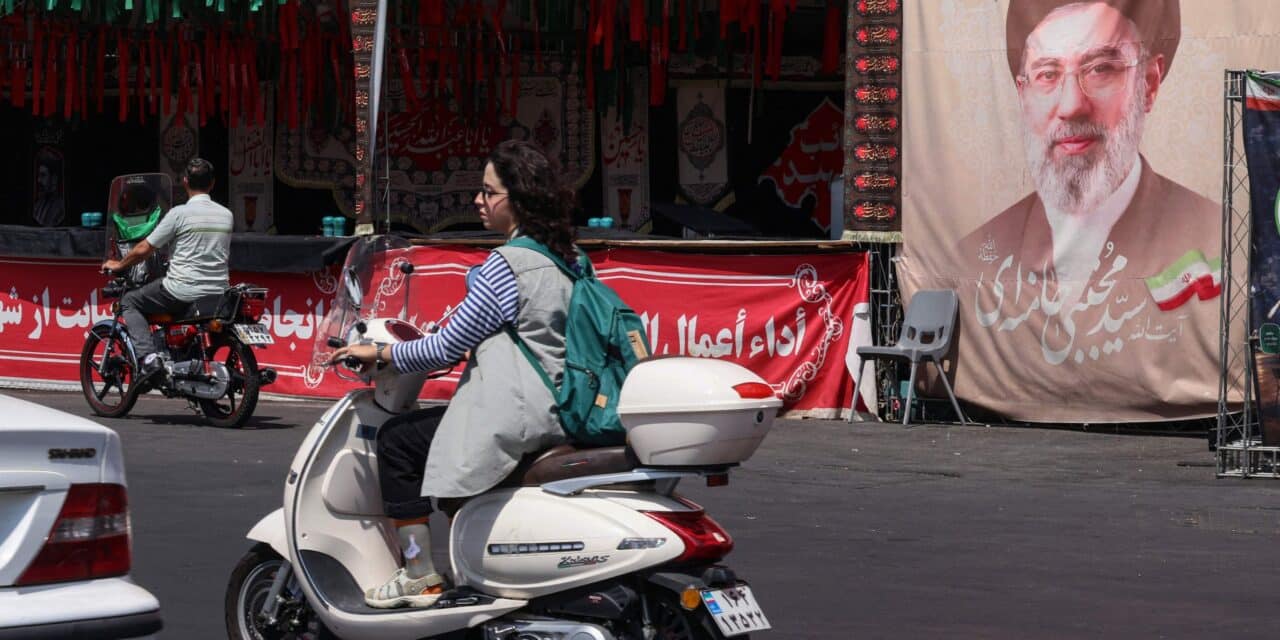
A woman rides a motorcycle past a banner of Iran’s Supreme Leader Mojtaba Khamenei in Valiasr Square, Tehran, Iran, July 19, 2026 (AFP)
What Iranians Think About Issues As They Go to the Polls
For governments that cannot be freely tested at the ballot box, legitimacy becomes one of the most difficult political questions to answer. This is especially true in the Islamic Republic of Iran, where restrictions on political competition, limits on independent research, and recurrent waves of protest have made it difficult to assess how citizens actually view the political order.
This matters far beyond academic debate. Assessments of the regime’s domestic standing influence international policy discussions on sanctions, nuclear diplomacy, regional security, and the prospects for political change. Opinion surveys are not just measurements of public attitudes, but are evidence of whether the Islamic Republic continues to command meaningful public support.
The debate surrounding IranPoll illustrates why this distinction deserves closer examination. The central issue is not whether IranPoll’s respondents conceal their political preferences, but whether the survey instrument is capable of measuring regime legitimacy in the first place.
The debate gained renewed attention in June 2026 with the publication of an analysis by Daniel Tavana, Kevan Harris, Chi Shun Fong and Amir Farmanesh. Rather than reporting on a new survey, they analyzed data collected through an IranPoll telephone survey to examine preference falsification under authoritarian rule. Are respondents overstating support for the Islamic Republic when questioned directly about politically-sensitive issues?
Instead of assuming either that respondents answer honestly or that they conceal their views, the authors attempt to estimate preference falsification empirically. Their results indicate that direct questions produce higher expressed support for the Islamic Republic than the indirect measure generated through the list experiment. Some respondents therefore appear reluctant to reveal politically-sensitive opinions openly.
Some commentators treated the results as evidence that, even after hidden preferences are considered, the Islamic Republic retains a base of public support. Such conclusions raise questions that go beyond the list experiment. If the experiment addresses one source of measurement error, it cannot resolve all uncertainties associated with polling under authoritarian conditions.
What The Questionnaire Measures
Most discussions of opinion polling begin with methodology: whether the sample is representative, whether respondents answer honestly, and whether sensitive opinions are concealed. These questions arise in authoritarian settings, where independent verification faces restrictions and respondents may perceive risks that cannot be measured directly. The June 2026 paper addresses one of these concerns by using a double-list experiment to estimate whether respondents overstate support for the Islamic Republic when questioned directly.
Expressed support for the Islamic Republic was higher in direct questions than in the double-list experiment. The authors of the June 2026 analysis interpret this gap as preference falsification.
However, interpretation of a survey also depends on the questions it asks. Sampling procedures, interview conditions and statistical techniques affect the quality of the data, but the scope of the conclusions is set by the questionnaire. A survey cannot provide evidence about political phenomena that it was not designed to investigate.
This point has received less attention in the debate around IranPoll. Even if each respondent answered honestly, would the questionnaire permit conclusions about the legitimacy of the Islamic Republic?
There are issues with the methodology. The analysis is based on a nationally representative telephone survey of 1,999 respondents, selected through random-digit dialling with one eligible individual chosen within each contacted household. It remains unclear whether both landline and mobile users were included, how the final sample was weighted and whether differential response rates affected demographic groups. Without this information, the relation between the realised sample and the population remains uncertain.
The geographical distribution of respondents is also documented at a level that leaves some questions unanswered. Although the survey distinguishes between provinces and between urban and rural areas, it does not indicate the districts or neighbourhoods in which interviews were conducted. That matters because political attitudes within large cities may vary across social environments that are not visible at provincial level.
The interview setting raises another problem. Telephone surveys conducted under authoritarian rule depend on respondents’ trust in the anonymity of the interview. No statistical adjustment can determine whether respondents felt secure when answering politically sensitive questions.
Even if respondents were assured that their answers would remain confidential, some may have questioned whether politically sensitive responses could be traced back to them. And in environments marked by political risk, respondents may evaluate not only the content of a question but also the consequences of answering it.
The questionnaire itself remains only partly visible. The paper discusses variables such as religiosity, national identity and fear of repression, but the full questionnaire has not been made public. Without the wording and sequencing of each item, framing effects or question-order effects cannot be assessed, especially on politically sensitive issues.
It is also unclear which topics were excluded. For example, it is not evident whether respondents were asked about political repression or the suppression of demonstrations that followed the January 2026 protests. If such items were absent, the survey offers a narrower basis for claims about political legitimacy than some interpretations suggest.
Across survey waves, IranPoll concentrated on sanctions, nuclear diplomacy, military deterrence, regional conflict, relations with the US and Israel, and the domestic consequences of international pressure. This continuity allows researchers to trace attitudes toward external pressure and national security over time. Questions concerning constitutional preferences, alternative political systems or evaluations of the institutional structure of the Islamic Republic appear less systematically.
These limitations do not require dismissing the paper’s findings. They define the kind of conclusions that can be drawn from them. Estimating preference falsification contributes to survey methodology, but it does not settle questions about sampling, interview conditions, or questionnaire design. Nor does it determine whether the survey was designed to measure political legitimacy.
Security Preferences, Nation, and Regime
Support for a security policy does not by itself identify the object of political support. A respondent may support a missile program, nuclear reconstruction, or sanctions resistance for reasons that concern the country, the state, a particular policy or the Islamic Republic as a regime. The questionnaire does not always distinguish among these objects.
Comparative politics distinguishes between the nation, the state, government and regime. These distinctions are often blurred in discussions of Iranian public opinion. A citizen may feel attached to Iran while rejecting the ideological foundations of the Islamic Republic. Another may support the state’s right to defend itself against external threats while favouring constitutional change. Others may approve of specific foreign-policy decisions while opposing the concentration of authority in unelected institutions.
The problem is visible in interpretations of security-related survey items. A finding that many respondents support the Islamic Republic’s ballistic missile program establishes support for that initiative. It does not establish whether respondents hold that view because they support the Islamic Republic, because they value deterrence, because they distrust foreign governments, because they identify the programme with sovereignty, or because several of these motives co-exist.
The same issue arises in relation to nuclear policy. After the Israel-US military strikes on the Islamic Republic’s nuclear facilities in 2025, IranPoll reported support for rebuilding the program and, for the first time, majority support for the Islamic Republic acquiring nuclear weapons. These findings were often interpreted as evidence that external military pressure had increased support for the Islamic Republic, but attacks on strategic infrastructure may be experienced as attacks on Iran rather than as attacks on the Islamic Republic. Under such circumstances, support for rebuilding strategic capabilities may express national solidarity, strategic calculation, or distrust of foreign governments without implying confidence in the constitutional order.
Opposition to sanctions follows the same logic. Sanctions affect households through inflation, declining purchasing power and economic insecurity. Opposition to sanctions may co-exist with dissatisfaction toward the Islamic Republic. It may also co-exist with criticism of the policy decisions that contributed to sanctions. The survey response alone cannot establish which reasoning is at work.
Support for a security policy should not automatically be treated as support for the political order responsible for implementing it. Conversely, criticism of the Islamic Republic should not be read as support for foreign military pressure or strategic concessions. These are distinct questions. Opinion surveys can address them, but only when their questionnaires distinguish between them.
External Conflict and National Solidarity
External conflict makes the distinction between national security and political legitimacy harder to observe. When a country is attacked, concerns about territorial integrity and national defence may move ahead of domestic political divisions. This pattern is often described as a rally-around-the-flag effect. It should not be equated automatically with increased confidence in political institutions.
The military confrontation involving the Islamic Republic, Israel, and the United States in 2025 belongs in this context. Attacks on Iranian territory and strategic infrastructure could be expected to increase support for restoring military capabilities. The question is what respondents meant by that support. Some may have interpreted the attacks primarily as attacks on Iran. Others may have understood them as attacks on the Islamic Republic. Still others may have focused on the strategic consequences rather than the political symbolism.
The survey records support for a policy response. It cannot determine whether that response reflects nationalism, strategic calculation, distrust of foreign governments, support for the Islamic Republic, or a combination of motives. The statement that respondents supported rebuilding strategic capabilities is supported by the survey. The statement that they therefore expressed greater support for the Islamic Republic requires evidence that the questionnaire does not provide.
This caution is reinforced by other indicators. Over the past two decades, Iran has experienced protest movements, declining electoral participation, labour unrest, emigration and economic decline. External conflict does not erase these developments. Citizens may regard deterrence as necessary while remaining critical of the institutions that govern them.
Protests, Elections, and Opinion Surveys
The distinction between security preferences and political legitimacy also explains why surveys, protest movements and electoral behavior may appear to point in different directions. They do not measure the same phenomenon.
Iran has experienced several episodes of anti-government mobilization: the Green Movement in 2009; the protests of 2017-18 and 2019; the Woman, Life, Freedom movement after the death of Mahsa Amini in 2022; and demonstrations that spread after the January 2026 protests. Participation in such movements is a demanding form of political action. Demonstrators are not simply citizens who oppose the government; they are citizens willing to express opposition publicly despite the risk of arrest, imprisonment, and violence. Protest movements therefore reveal the existence of organised dissent, but they cannot establish the distribution of political attitudes across the whole population.
Opinion surveys measure something else. They seek to capture attitudes among respondents who may never participate in demonstrations, who may avoid political activity or who may hold combinations of views that do not fit a simple pro-government or anti-government distinction. Differences between surveys and protest behavior do not necessarily mean that one source is unreliable. They may reflect the fact that each source observes a different part of political life.
Electoral participation provides another kind of evidence. Turnout in recent parliamentary and presidential elections has fallen to low levels, suggesting disengagement from formal political institutions and limited confidence in the electoral process. That evidence says less about attitudes toward sanctions, deterrence, or regional security. Likewise, support for a security policy does not explain why many citizens may avoid elections whose outcomes they regard as constrained.
Other indicators, including labor unrest, strikes, emigration and economic decline, also reveal forms of dissatisfaction with political and economic conditions. None measures the same phenomenon as an opinion survey. Each contributes to an account of the relationship between society and the Islamic Republic. The problem arises when one indicator is expected to answer questions that belong to another.
Political legitimacy cannot be inferred from protest participation alone, from electoral turnout alone, from migration patterns alone, or from survey responses alone. IranPoll is one source within a broader evidentiary field.
Comparing Pollsters
The legitimacy issue is highlighted in an examination of both IranPoll and the pollster GAMAAN.
IranPoll has concentrated on sanctions, nuclear diplomacy, military deterrence, regional security and relations with external powers. GAMAAN devotes more attention to political legitimacy, constitutional preferences, religion, secularisation, compulsory hijab, democratic reform and alternative visions of Iran’s political future.
These differences determine what each survey can show. A respondent may oppose compulsory hijab while supporting the Islamic Republic’s missile programme. Another may favour constitutional reform while rejecting foreign military intervention. Someone else may express little confidence in the Islamic Republic while believing that sanctions have harmed ordinary citizens more than political elites. The combinations show why political attitudes cannot be reduced to a single dimension.
IranPoll and GAMAAN should be understood as examining different aspects of Iranian public opinion. Where their questions overlap, comparison can be used. Where they diverge, the differences often reflect the objectives of the questionnaires rather than proof that one project is reliable and the other is not. Foreign policy, national identity, constitutional preferences and regime legitimacy are related, but they are not interchangeable.
Recognizing Complexity in Political Life
The June 2026 paper contributes to the study of survey research under authoritarian rule by indicating that respondents may answer politically sensitive questions differently depending on how those questions are asked. However, this does not establish that the underlying questionnaire measures political legitimacy.
This distinction defines both the strengths and the limits of IranPoll. The surveys provide longitudinal evidence on attitudes toward sanctions, deterrence, nuclear diplomacy and external threats. They provide a more limited basis for assessing the legitimacy of the Islamic Republic because the questionnaires devote less systematic attention to constitutional preferences, institutional trust, and alternatives to the existing order.
Once this is recognized, the apparent contradiction between IranPoll, protest movements, declining electoral participation, and other survey projects is less pronounced. These sources do not necessarily contradict one another because they do not measure the same dimensions of political life.
Protest movements reveal willingness to engage in collective action under conditions of risk. Elections provide information about participation in formal institutions. Surveys record stated attitudes under specific methodological conditions. Each source captures one part of the relationship between society and the Islamic Republic.
The question is therefore not whether IranPoll is correct or incorrect in general. It is whether the conclusions drawn from its surveys correspond to the questions the surveys were designed to answer. Read in that way, IranPoll offers evidence on how Iranians perceive foreign policy and national security — but questions concerning political legitimacy require evidence that extends beyond any single survey.

Iran shows it can withstand US attacks and deliver deadly counterstrikes: https://edition.cnn.com/2026/07/20/world/live-news/iran-war-trump?post-id=cmrslynq6000j3b6rr6h1673g
“Read in that way, IranPoll offers evidence on how Iranians perceive foreign policy and national security — but questions concerning political legitimacy require evidence that extends beyond any single survey.”
Election turnout is usually the best measure of legitimacy. The last election cycle had a turnout of 40-50% which represents the base of support for the Islamic Republic in line with the “47%” figure inferred by the researchers. This corresponds broadly with the size of the religious community in Iran.