
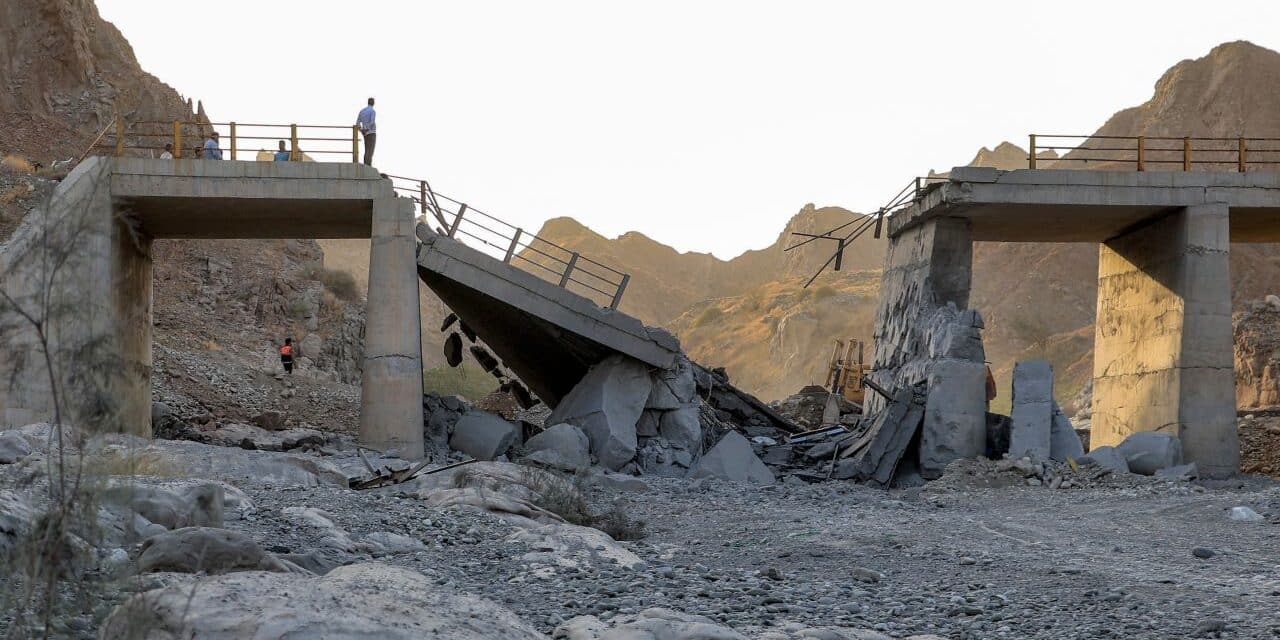
A bridge damaged by a US strike on the road beteween Roudan and Bandar Abbas in southern Iran, July 18, 2026 (Amir Hossein Khorgooei/ISNA/AFP/Getty)
EA-Byline Times VideoCast: US-Iran — “Uncontained War” Spreads Across Middle East
UPDATE, JULY 30:
I rejoin Pakistan TV on Wednesday night to assess the interaction between US strikes, Iranian retaliation, and the spread of “uncontained war” across the Middle East.
I explain that the Trump camp still does not have a tactic, let alone a strategy, to conclude its war on Iran. The Iranian regime has survived, but there is no longer a Memorandum of Understanding for talks. And attacks have spread from the Gulf States and Lebanon to Iraq and Egypt.
I also talk about the dynamic between the Trump Administration and Israel, with the Netanyahu Government now concentrating on a “zone of occupation” in southern Lebanon as well as Gaza.
The other guest is Eric Lob of Florida International University.
Watch from 4:07:
UPDATE, JULY 24: I joined Pakistan TV on Thursday night to analyze the escalating strikes in the Strait of Hormuz, inside Iran, and across the region.
Dr. Muqtedar Khan of the University of Delaware examine the demise of the Memorandum of Understanding as the Trump camp, trying to escape terms favorable to Iran, try to break Iranian control of the Strait of Hormuz.
We evaluate why that tactic is likely to be futile with the effect on the global economy compounded by the threat of Yemen’s Iran-allied Houthis to the Bab al-Mandeb strait at the exit of the Red Sea.
I assess that the Trump camp will have to return to talks — but when?
UPDATE, JULY 21:
I spoke with Poland’s TVP World on Tuesday about the effective end to the 3 1/2-month ceasefire in the US War on Iran.
With ten consecutive nights of US attacks inside Iran, as well as Iranian strikes on vessels in the Strait of Hormuz and retaliation on Jordan and Gulf States, I evaluate the root cause: the Trump camp’s refusal to accept the Memorandum of Understanding’s provision for Tehran’s management of the Strait.
I explain how the region and the world are facing a halt in negotiations but a conflict that is still short of all-out war: a “stable instability”.
ORIGINAL ENTRY, JULY 20: I joined India’s WION on Sunday to analyze if the escalation of clashes between the US and Iran means the 3 1/2-month ceasefire, as well as June’s Memorandum of Understanding, is finished.
I highlight how the focal point is still Iran’s control of Strait of Hormuz, with the Trump camp trying to break it and refusing to accept the Iranian management set out in the MoU.
With the expansion of US attacks and Iran’s retaliation, I consider how there might be a step-by-step return to war — but how there is no apparent endpoint for the Trump Administration.
Watch from 4:04:

Pentagon Withheld Dozens of U.S. Military Injuries in Iran War: https://www.nytimes.com/2026/07/20/us/politics/troops-injured-jordan-iran-war.html
Nearly 100 U.S. service members injured in Iranian strikes this month: https://www.cbsnews.com/news/iran-injuries-us-service-members/
U.S teeters on all-out war: https://www.washingtonpost.com/national-security/2026/07/19/us-teeters-return-all-out-war-with-iran-after-more-troops-killed/
U.S. Aircraft Take Heavy Losses as Iran Strikes Key Bases Across the Middle East: https://militarywatchmagazine.com/article/ui-aircraft-heavy-losses-iran-strikes-bases
” The Black Hawk damage in Jordan is only one component of wider aviation losses sustained during the conflict. Open-source reporting and official statements have documented the destruction or damage of MQ-9 Reaper drones, transport aircraft, helicopters, aerial tankers, and airborne warning aircraft across several bases. These included the reported destruction of at least one F-15E fighter on July 19. The U.S. Armed Forces have sought to minimise losses by dispersing aircraft away from major facilities.”