
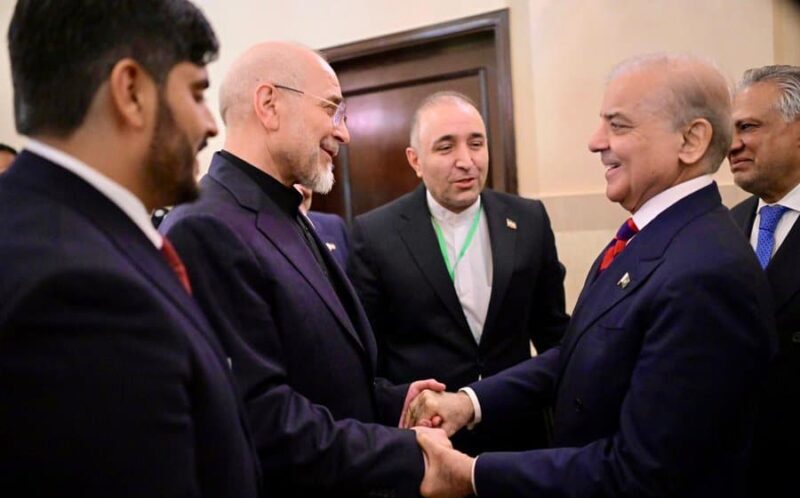
Pakistan Prime Minister Shahbaz Sharif (2nd from R) greets Iran Parliament Speaker Mohammad Bagher Ghalibaf (2nd from L), Islamabad, April 11, 2026
EA on International Outlets: A Fragile US-Iran Ceasefire
UPDATE, APRIL 18:
I joined India’s WION on Friday morning to answer the question, “Who has the upper hand?”
It is important to cut through the statements of both the Iranian regime and the Trump regime: no one wins in a war.
Iranians certainly haven’t won, given the damage they have taken. The Trump camp certainly have not won, given Iran’s counter-attacks and control of the Strait of Hormuz.
People in Lebanon have not won with the Israeli attacks.
I then review the issues in the US-Iran talks. I explain how a landing point is a return to the 2015 nuclear deal, limiting Iran’s uranium enrichment, but “the Trump camp won’t do that because that was an agreement under the Obama Administration”.
I also detail the connection between the talks and the 10-day ceasefire of Israel’s assault on Lebanon.
Watch from 3:24:
Iran's pressure forces Israel-Lebanon truce?
Report: Iran threatened to strike Israel if truce not announced
Professor of International Politics at University College Dublin, Scott Lucas joins @BislaDiksha with more insights pic.twitter.com/zRMvLNgtmz
— WION (@WIONews) April 17, 2026
UPDATE 2015 GMT:
I joined Pakistan TV’s Sana Maqbool on Friday night to evaluate the statue of the US-Iran talks and of the 10-day Israel-Lebanon ceasefire.
I also consider Iran’s announcement that it is “opening” the Strait of Hormuz to commercial ships, explaining how this is just to demonstrate Tehran’s control of the waterway.
The conclusion? While Israel’s attacks on Lebanon may culminate in an agreement allowing the Israelis to expand their zone of occupation, there is still a considerable gap between the Trump camp and the Iranian regime that has survived the attempts to eliminate it.
The combined pressure of the Strait of Hormuz being controlled by Iran and the effect on oil and gas prices has reinforced the domestic aversion to the war.
It means the Trump folks are going to look for a way out. That may be the Americans allowing Iran to have a civilian nuclear program, claiming it’s very, very limited, and then Trump will come in and say, “I’ve ended another war.”
Watch from 7:47:
UPDATE 1711 GMT:
I joined a panel on India’s News 9 on Tuesday to evaluate the outcome of the first Trump-Iran “talks about talks” in Islamabad, and to consider next developments in the US-Israel Wars on Iran and Lebanon.
The other analysts are Professor Swaran Singh and Maj. Gen. Sudhakar Jee. I also take apart the disinformation of Israeli activist Elie Pieprz.
A 20-year freeze vs a 5-year pause: #US and #Iran trade proposals on #Nuclear restrictions. A deal within reach, but timelines tore it apart. @kartikeya_1975 @epieprz @ScottLucas_EA @sudhakar_jee @SwaranSinghJNU https://t.co/10s41ans5P
— News9 (@News9Tweets) April 14, 2026
UPDATE 1323 GMT:
I joined DW News on Sunday morning for a 17-minute deep dive into the US-Iran “talks about talks”, the lack of progress, and what happens next.
I explain how the Iranians retain leverage as the Trump camp ponders how to loosen Tehran’s grip on the Strait of Hormuz.
That will return the Trumpists to their dilemma: do they continue talks or do they pursue ground operations?
I also emphasize that Iran does not have a nuclear weapon. However, with Tehran’s potential to pursue one, “Trump Administration faces going back to a 2015 agreement that they ripped up”.
Watch from 2:05:
ORIGINAL ENTRY: During US-Iran talks in Islamabad on Saturday, I spoke with international outlets about the prospects for an end to the US-Israel Wars on Iran and Lebanon.
I emphasized that the meeting in Pakistan was “talks about talks” rather than pursuit of a deal, given the gap between Iran’s 10-point proposal and an earlier 15-point US ultimatum. The best outcome would be an agreement for further discussions and an extension of the two-week ceasefire, which expires on April 21.
I review the key issues, including Iran’s ballistic and missile programs, its links with groups across the Middle East, and Tehran’s demands for an end of sanctions and compensation for war damage. I point to the priority for the US of ending Iran’s leverage with control of the Strait of Hormuz.
Listen to Pat Kenny Show on Dublin NewsTalk
In a 17-minute chat, I analyze the chaotic shift of an angry and frustrated Donald Trump from “Iranian civilization will die tonight” to acceptance of talks with Tehran.
I consider why the US media “normalize” Trump’s crazed outbursts as a supposed diplomatic strategy:
At some point you have to hold your hand up, if you’re a proper analyst or journalist, and say, “No, you don’t bring in a false equivalence to say there is some logic that didn’t exist in the first place.”
There is no logic here. There is just the ranting of a man who probably does have mental issues — and happens to be President of the United States.
I explain the 25th Amendment, which could remove Trump from office, and why it is unlikely to be used.
I consider the relationship between the Trump Administration and Israel’s Netanyahu Government. Then I go in depth into the talks in Islamabad.
I also explain how and why Melania Trump made an unexpected statement about the scandal of the late paedophile Jeffrey Epstein, “setting herself at a distance from her husband”.
Watch India’s NDTV
I joined a panel to evaluate the positions of the Trump Administration and the Iranian regime, why these are “talks about talks”, and how there is still no clear agenda for discussions.
Watch from 2:46: