
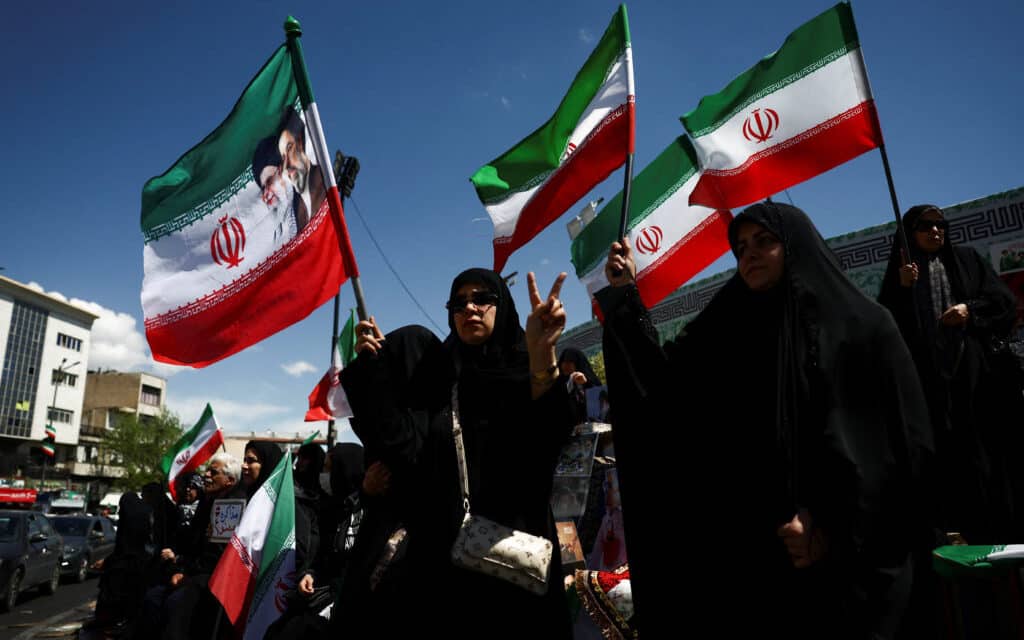
Supporters of Iran’s regime gather after the announcement of a two-week ceasefire in the US-Israel War, Tehran, April 8, 2026 (Majid Asgaripour/WANA)
Q&A: Why Israel Attacks Lebanon Despite US-Iran Ceasefire
Ceasefire? Israel Kills 254 in Lebanon as US and Iran Trade Verbal Punches
UPDATE 1355 GMT:
I joined Pakistan TV on Friday afternoon to anticipate developments in the US-Iran talks.
I explain why Donald Trump flipped from threats to end Iranian civilization to embrace of discussion, primarily because of Tehran’s leverage over the Strait of Hormuz, and I evaluate the gaps between the Trump and Iranian positions.
The other guest is analyst Michael Kugelman.
Watch from 25:11:
UPDATE, APRIL 11:
I joined a panel on India’s News 9 to preview today’s US-Iran talks in Islamabad.
The other guests are Ambassador Meera Shankar and Professor Swaran Singh.
I evaluate, “Can Israel’s attacks on Lebanon derail this process?”, and whether Israel will listen to anyone trying to curb its assault.
You have an Iranian regime which is refusing to surrender. You have a Trump camp which has handed them the diplomatic initiative.
And then you have the Israelis trying to upend the process.
I also consider the effect inside Iran, with the regime able to maintain its crackdown on those seeking political and social rights.
Watch from 6:24:
UPDATE 1648 GMT:
I chatted with Politics Uncensored’s Ali Milani about the fragile US-Iran ceasefire, upcoming talks in Pakistan, and Israel’s ongoing assault and quest for occupation in Lebanon.
The 12-minute discussion starts with the question, “Did Donald Trump lose this war?”
Listen from 36:18:
UPDATE 1441 GMT:
I joined Poland’s TVP World on Thursday morning to examine the fragility of the US-Iran ceasefire, amid Israel’s expanding attacks on Lebanon.
I talk about the confusion in the Trump camp as the White House tries to walk back Donald Trump’s acceptance of negotiations based on Iranian terms.
I look at long-term effects on oil and gas supplies and markets.
And I go beyond Iran and the Middle East to examine the damage to Russia’s invasion from Ukraine’s counter-attacks against oil terminals and ports.
Can that Ukrainian and European security be defended against another threat — the camp of Vice President J.D. Vance, supporting hard-right politicians like Hungary’s Viktor Orbán to undermine Europe?
ORIGINAL ENTRY: Hours after the announcement of a two-week ceasefire in the US-Israel War on Iran, I appeared on international outlets to analyze why the Trump camp backed away from its threat that “the Iranian civilization will die tonight”.
But I also consider the shakiness of the halt, as Israel continues its assault on Lebanon and the White House and Iran quarrel over the terms for negotiations.
Watch France 24
I explain Trump’s retreat and the Administration not daring to put in ground troops. I make clear that he agreed to negotiate on the basis of Iran’s 10 points.
However, given that the Trump camp is unlikely to accept those terms, I evaluate the prospects for any talks.
If the Trumpists show up in Pakistan, will they negotiate? Or will they try to reclaim their advantage by demanding an end to Iran’s civilian nuclear program and limits on ballistic missiles, returning us to the position of late February?
I decline to predict, “How long will this go on?”
We have to lay out the key points about the damage and instability that has been caused and ask, “Can this be limited in the long term?”
Listen to RTE Radio 1
I joined host David McCullagh on Wednesday morning to establish how the Trump camp switch from all-out assault to ceasefire and to consider if this a long-term halt to attacks.
I also explain why Iranians who want political and social change have been set back by the US-Israel War.
The other analysts are BBC correspondent Orla Guerin and geopolitical strategist Aidan Meagher.

The U.S. and Israel have already lost the war in Iran: https://www.theglobeandmail.com/opinion/article-the-us-and-israel-have-already-lost-the-war-in-iran/
“Make no mistake: the deal seals the strategic defeat of the U.S.-Israel alliance in Iran. This war will be remembered as yet another episode of powerful countries falling into the trap of asymmetric warfare, in which the mightiest militaries invariably fail to translate tactical gains into strategic victories.”
US military bases in Gulf ‘useless’ after Iranian strikes: https://www.middleeasteye.net/news/us-military-bases-gulf-useless-after-iranian-strikes-experts-say
“The bases around the region are suffering real damage, and I think it’s very unlikely that we’re ever going to go back and put our Fifth Fleet back in Bahrain. It’s too vulnerable. So in a sense, the entire purpose of ‘America’s Middle East’ has come crashing down and we don’t have an alternative way yet of articulating or thinking about what might replace it.”
Iranian lego song clip dedicated to secretary of war crimes pete kegsbreath
https://www.youtube.com/watch?v=NMQ4rIncFJw
New lego animation song from Iran
Powerful lyrics:
“Your government is run paedophiles”
“They order you to die for israel”
https://www.youtube.com/watch?v=5G9DNx7xIIc
Iran’s military attacks on Gulf states: https://www.nbcnews.com/data-graphics/iran-war-drones-missile-strikes-military-attack-capabilities-rcna263382
Missile attack: 1,372
Drone attacks: 4,415
Total attacks: 5,787
A new low for the mullah state, holding khamenei’s 40th memorial in a church instead of traditional muslim mosque ceremoney, or was he faking to be muslim…
https://www.iranintl.com/en/202604092687
Oops, somebody jumped the gun, his corpse is still on the ground, somewhere….
“I talk about the confusion in the Trump camp as the White House tries to walk back Donald Trump’s acceptance of negotiations based on Iranian terms.”
You know, just as the regime doesn’t convince anyone with its talking points, you don’t either with your “democrat” partisan commentary. You just discredit yourself as an objective reporter. Did Joe Biden have clear and concise communications in his dealings with this regime?
Now, go ahead, delete this post.
Iran’s Asymmetric Counterair Campaign: Attacking the U.S. Air Force’s Nests and Eggs: https://warontherocks.com/2026/04/irans-asymmetric-counterair-campaign-attacking-the-u-s-air-forces-nests-and-eggs/
“Iran is the first adversary to execute a sustained asymmetric counterair campaign against U.S. forces, but it is unlikely to be the last. The proliferation of long-range precision strike — the military revolution the United States once led — has put the enabling layer of American airpower within reach of more adversaries. The United States is woefully unprepared for this new era, in which sanctuaries are gone, attrition can exhaust defenses, and persistent surveillance makes concealing high-value assets increasingly difficult…… Lacking advanced fighters or bombers, it relies on ballistic missiles, one-way attack drones, and a deep understanding of U.S. air operations as a system. By targeting the enablers, Iran cannot achieve air superiority, but it can impose enough interference to degrade American operations, raise their cost, and constrain what they accomplish — all without ever overcoming or even challenging U.S. airborne overmatch.”
DT agreed to the version in farsi or english? There are fundamental differences between the two versions. Half of farsi versions are none starters for the US, and those are major sticking points for regime supporters.
The war with Iran causes the destruction and damage of 5,000 buildings in Israel: https://www.yaffaps.com/en/page-93852.html
Yedioth Ahronoth reported on Wednesday that Iran has launched 670 missiles and 765 drones toward Israel since the start of the war. The attacks forced the evacuation of 6,305 Israelis from their homes in various areas in which over 5,000 buildings were damaged/destroyed. 7,183 Israelis have been injured. 25,000 claims for compensation were filed. The damage does not include military and security locations which are subject to intense censorship
And you don’t have an irgc and militia barak left standing…..
And then was your militants to speak of:
https://content.iranintl.com/52commanders/index.html