
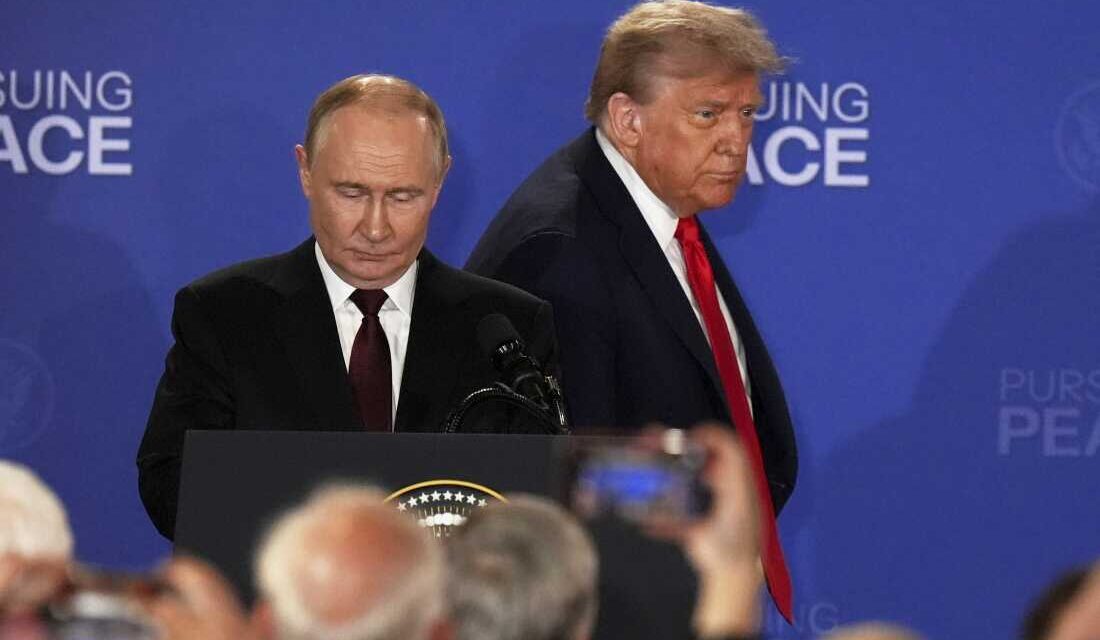
Vladimir Putin and Donald Trump at a joint press conference at Joint Base Elmendorf-Richardson near Anchorage, Alaska, August 15, 2025 (Jae C. Hong/AP)
EA-Ukraine VideoCast: From Resistance to Strength v. Russia’s Invasion
Friday’s Coverage: EU €90 Billion Loan to Kyiv Released by June
UPDATE 0652 GMT:
Despite the US sanctions waiver, Russia’s maritime oil exports have plummeted because of Ukrainian drone strikes.
The Russian business newspaper Kommersant posted on Thursday that seaborne exports in mid-April 2026 fell to their lowest level since Summer 2024. The outlet added that exports could fall to their lowest level since 2023 by the end of the month.
The Center for Price Indices reported Russia reduced its seaborne oil exports by 16.1% to 291,000 tons from April 6 to April 12 due to Ukrainian strikes Exports through the Black Sea port of Novorossiysk dropped by 73.2% percent to total of 19,000 tons.
UPDATE 0651 GMT:
Ukraine’s air defenses downed 190 of 219 drones launched by Russia overnight, but 28 struck 17 locations.
UPDATE 0639 GMT:
Ukraine’s latest drone attacks have struck an oil depot in occupied Crimea and an oil refinery in southwest Russia.
Explosions rocked Crimea’s Sevastopol and nearby Novofedorivka. Locals reported intense air defense activity “from all positions”.
A large fine was subsequently seen in the port area of Kazachya Bay. Mikhail Razvozhayev, the Russian-installed head of Sevastapol, claimed a “tank with leftover fuel” was struck by a downed drone.
In Samara, the Novokuibyshevsk oil refinery was set afire.
Black smoke rises in Russia's Novokuybyshevsk after a drone attack on an oil refinery
The Novokuybyshevsk refinery is a Rosneft-owned facility in Samara Oblast (Volga region) that processes 8.8 million tons of crude annually and is located about 900 km from the war zone in… pic.twitter.com/rWaaAkmi6r
— Euromaidan Press (@EuromaidanPress) April 18, 2026
ORIGINAL ENTRY: The Trump Administration has extended the sanctions waiver on Russia’s maritime oil exports to May 16.
Last November, amid Moscow’s full-scale invasion of Ukraine, the Administration had imposed tough sanctions on Russia’s largest oil companies and secondary measures against companies who imported their products. In January and February, Russian revenues fell 47%.
But as global oil prices with the start of the US-Israel War on Iran on February 28, the Trump camp issued a 30-day waiver that expired on April 11. The Russian Government’s receipts from oil exports returned to the levels of early 2025, although they have been hampered by Ukrainian drone attacks on drones and oil terminals since then.
On Wednesday, Treasury Secretary Scott Bessent said the US would not be renewing the waiver, “That [applied to] oil that was on the water prior to March 11. So all that has been used.”
The renewed waiver applies to all Russian oil loaded by April 16. Vladimir Putin’s top economic advisor Kirill Dmitriev it “will affect over 100 million barrels of oil currently in transit”, bringing the total during the US-Israel War to 200 million.
In early March, Bessent said the waiver was a “narrowly tailored, short-term measure”. He insisted it “will not provide significant financial benefit to the Russian government, which derives the majority of its energy revenue from taxes assessed at the point of extraction”.
Zelensky: We Must Remove Remove Dangers in Strait of Hormuz
Earlier on Friday, Ukraine President Volodymyr Zelensky told an international conference considering secure passage through the Strait of Hormuz, controlled and used as leverage by Iran over the US-Israel War:
We all need to work together to remove the dangers in Hormuz in a way that helps protect freedom of navigation everywhere in the world. The decisions made now on Hormuz will shape what other troublemakers might think about causing problems – in other straits and on other fronts.
He emphasized that Middle Eastern countries must be involved, and called for military teams to meet as soon as possible. He noted that during Russia’s full-scale invasion, “Ukraine has gone through a very similar mission in the Black Sea.”
Kyiv broke the Russian blockade of its ports and the sea in 2023, damaging or destroying up to 1/3 of Moscow’s Black Sea fleet.