
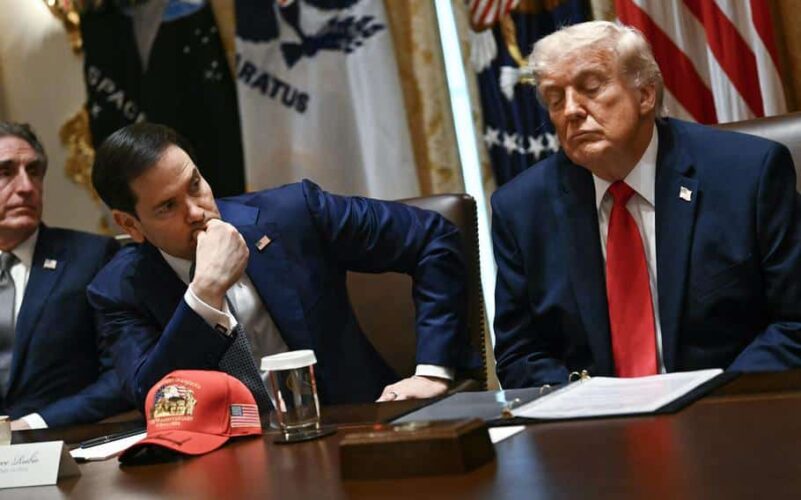
Donald Trump and US Secretary of State Marco Rubio at a Cabinet meeting in the White House, Washington D.C., May 27, 2026 (Kent Nishimura/AFP/Getty)
EA-Irish Independent Podcast: Will Marco Rubio Benefit from Trump’s Failing War on Iran?
UPDATES: US-Israel Wars, Day 92 — US-Iran Skirmishes As Draft Deal Circulates
UPDATE 1854 GMT:
At least four people have been killed by an Israeli airstrike on the town of Abbasieh near Tyre in southern Lebanon.
Rescue teams are continuing to search through the rubble for anyone who is missing.
UPDATE 1532 GMT:
Assessing satellite images, analysts estimate that Iran has dug out arsenals of long-range missiles buried by US and Israeli attacks since February 28.
The Iranians have unblocked at least 50 of 69 tunnel entrances struck by the US and Israel at 18 underground missile facilities. Roads have been repaired with craters filled, and at least two sites have been repaved.
Experts believe Iran still has around 1,000 missiles stored in the underground sites.
UPDATE 1530 GMT:
Lebanon’s Health Ministry has updated the toll to 3,412 people killed and 10,269 wounded by Israeli attacks since March 2.
UPDATE 1524 GMT:
Israeli forces have carried out new incursions into southern Syria, entering parts of Quneitra and Daraa Provinces, setting up temporary checkpoints, and searching civilians and vehicles for several hours before withdrawing.
Israel has established a zone of occupation in part of the south. Prime Minister Benjamin Netanyahu indicated on Sunday (see 1231 GMT) that operations would be expanded in Syria as well in Lebanon and Gaza.
UPDATE 1242 GMT:
Iran says it has restored gas production at three offshore platforms in the South Pars gas field, the world’s largest, that were forced to halt output because of Israel’s attack on oATEnshore facilities.
The chief executive of the Pars Oil and Gas Company, Touraj Dehqani said the three platforms in the Persian Gulf were not damaged. Output is being routed to other processing plants in the region while repairs continue at damaged facilities.
UPDATE 1231 GMT:
French Foreign Minister Jean-Noël Barrot has announced, “I have requested an emergency meeting of the United Nations Security Council because, while we recognise Israel’s right, like that of all countries, to self-defense…nothing can justify the continuation of Israeli military operations in Lebanon and its ever-deeper occupation of Lebanese territory.”
Israeli Prime Minister Benjamin Netanyahu hailed the expanding Israeli ground and air assault in southern Lebanon, cheering the seizure of Beaufort Castle near Nabatieh and promising more operations.
Israel occupied the strategic castle from 1982 to 2000.
Today, we have returned to Beaufort in a different way. We have returned united, determined, and stronger than ever.
The capture of Beaufort is a dramatic stage and a dramatic shift in the policy we are leading….We are taking the initiative, we are operating on all fronts – in Syria, in Gaza, in Lebanon.
UPDATE 1203 GMT:
The Israeli military has issued evacuation order to all residents south of the Zahrani River, north of the Litani River and around 40 km (25 miles) from the border.
“Anyone present near Hezbollah elements, facilities, or combat means endangers their life. Any building used by Hezbollah for military purposes may become subject to targeting!” the military commanded.
The Israeli attacked near the city of Tyre, including a strike near a hospital that wounded 13 staff and caused significant damage, and several southern villages. Civil defense workers in the Tyre region received phone calls from the Israeli army telling them to evacuate.
The Lebanese Health Ministry urged “the international community to put an end to the escalating and expanding Israeli attacks”.
UPDATE 0552 GMT:
The Trump Administration has asked for changes in the Iran framework deal covering traffic through the Strait of Hormuz and Tehran’s nuclear program, say a “senior US Administration official and another American source briefed on the matter”.
The senior Administration official declared:
There will be a deal. The imminence of it, we’ll see. We’re willing to wait so the President gets what he asks for. It could be a week. It could be less. It could be more. At the turn of the week, we hope to have something.
UPDATE, MAY 31:
Lebanese Prime Minister Nawaf Salam says Israel is pursuing a “scorched-earth policy” in southern Lebanon, as the Israelis expand airstrikes and ground operations to occupy more territory.
In a televised address, Salam warned of the “dangerous” escalation and called for “a swift and real ceasefire”. The scorched-earth policy and “collective punishment” is “destroying towns and villages, and forcing their inhabitants into exile”, he explained.
This will bring “neither security nor stability” to Israel, Salam said.
The Lebanese Health Ministry reports more than 3,371 people killed by Israeli attacks since March 2.
On Saturday, Israel reportedly captured the Beaufort Castle in its deepest incursion into Lebanon since 2000, seriously wounding two Lebanese troops in a drone strike. The ground operation has advanced beyond the Litani River, 30 km (19 miles) from the border.
The Israeli military said one of its soldiers was killed in combat.
Hezbollah fired rockets and drones on northern Israel, with opposition leaders — from Naftali Bennett on the right to Yair Lapid in the center — calling on the Netanyahu Government to make a “powerful response”.
The Israeli military said more than 25 munitions were launched on the north of the country on Saturday.
UPDATE 1721 GMT:
Some ships have managed to cross the blockaded Strait of Hormuz by turning off lights and navigation beacons, relying on US military guidance to avoid collisions, say shipowners and US officials.
The sources say the US advises the ships on when to go dark and how to handle threats from Iranian forces.
One ship that crossed this week was a Greek oil tanker carrying two million barrels of crude. Reportedly stuck in the Persian Gulf since early March, it traveled along the coast of Oman and is now en route to its destination in India.
However, fewer than five ships a day have gone dark through the Strait of Hormuz since March 2, according to the intelligence firm Kpler. It is unclear how many of those ships were guided by the US military.
Most ships traveled on the Iranian-sanctioned route through the Strait.
UPDATE 1018 GMT:
Mohsen Rezaei, a military adviser to Iran’s Supreme Leader, has posted on social media about Donald Trump’s latest indecision over the framework deal to end the US-Israel War.
Referring to talks interrupted by war last June and this past February, Rezaei said:
As predicted, the President of the United States is betraying diplomacy for the third time. By continuing the naval blockade and making excessive demands in negotiations, he has once again proven that he is not inclined toward negotiation and is pursuing other objectives.
UPDATE 0731 GMT:
The Israeli military has issued forced displacement orders to residents of seven towns in southern Lebanon.
Civilians have been warned to move north of the Zahrani River, just south of Sidon, ahead of airstrikes as Israel expands its zone of occupation.
Israel has reportedly struck the towns of Mefdoun, Ansar, Haboush, al-Jumaymah and Sarifa this morning.
ORIGINAL ENTRY: Uncertainty persists over a framework deal to end the US war on Iran, even though Donald Trump said he is about to “make a final determination” over the Iranian two-stage proposal.
Trump said he went into the White House Situation Room on Friday for the decision, but he never followed up after a two-hour meeting. A “senior administration official” said there was no outcome. Meanwhile, the deal that Trump described is different from the Iranian terms, mediated by Pakistan and Qatar.
Trump declared that the Strait of Hormuz, controlled by Iran soon after the launch of the US-Israel war on February 28, will be reopened. He said Tehran and Washington will coordinate over destruction of Iranian stocks of enriched uranium.
In fact, the first stage in Iran’s proposal is discussion of arrangements to oversee shipping through the Strait. In return, the US will lift its naval blockade of Iranian ports and gradually remove sanctions, $12 billion of Iranian assets held abroad will be unfrozen, and a 60-day ceasefire will be instituted.
Nuclear issues will only be discussed in a second stage. Iran has proposed “downblending” of its 60% uranium to a lower grade.
A series of Iranian officials knocked back Trump’s portrayal. Foreign Ministry spokesperson Esmaeil Baghaei said that exchanges of messages between Tehran and the Trump Administration continue, but no agreement has been finalized.
He emphasized that the Strait of Hormuz remains closed to hostile and military vessels, and that the future management of the Strait concerns only its coastal states, particularly Iran and Oman.
Baghaei added, “We have no discussions at this time regarding the details of issues related to enrichment or Iran’s enriched uranium.”
Citing “informed sources”, Iran Revolutionary Guards outlet Fars said Trump’s remarks about a potential framework deal were a “mixture of truth and lies”. A “senior Iranian source” told Reuters that the memorandum of understanding between Tehran and Washington does not include any nuclear-related issues.
Parliament Speaker Mohammad-Bagher Ghalibaf said Iran has “no trust in guarantees or words – only actions are the measure”. He thumped his chest:
We seize concessions not through dialogue, but with missiles; in negotiations, we merely make them understand. The winner of any agreement is the one who is better prepared for war from the day after.
A meeting in Washington between US Secretary of state Marco Rubio and Pakistan Foreign Minister Ishaq Dar ended without public comment.

Iran Missile Damaged Sensitive Israeli Intelligence Site: https://www.spytalk.co/p/exclusive-iran-missile-damaged-sensitive
“On the first day of the joint U.S.-Israeli war against Iran in late February, an Iranian intermediate-range ballistic missile evaded Israel’s heralded air defenses and heavily damaged a secretive geospatial intelligence facility inconspicuously located in a residential Tel Aviv neighborhood, SpyTalk has learned. The huge Feb. 28 blast in Tel Aviv’s historic Lev Ha’ir quarter, which demolished a residential apartment building and caused serious structural damage to several others nearby, was widely reported by both Israeli and international media. The blast also killed a Filipina caregiver. But the damage to the National Geodetic Institute, which was located just 50 feet away in one of the neighborhood’s apartment buildings, well within the missile’s blast radius, has gone unreported until now. It’s highly likely Israel’s military censors prevented any mention of the facility’s proximity to the blast site or the damage it suffered. The reports also did not mention any IDF casualties from the missile strike.”