
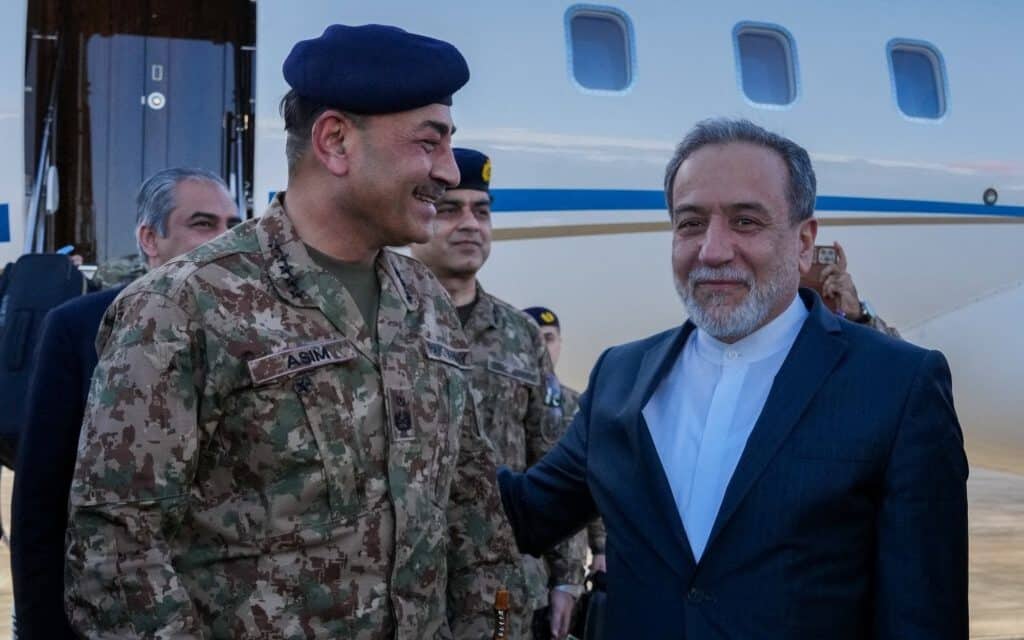
Iranian Foreign Minister Abbas Araqchi welcomes Pakistan army chief Asim Munir, who has been mediating a possible end to US-Israel War, Tehran, Iran, April 15, 2026
EA on International Outlets: Trump’s Visit to China Can’t Fix His War on Iran
UPDATE 1145 GMT:
I joined Pakistan TV’s Sana Maqbool on Friday evening to analyze Donald Trump’s indecision over the Iranian two-stage proposal to end the US-Israel War.
In the 15-minute chat, I navigate the back-and-forth of the Trump Administration over the deal, mediated by Pakistan and Qatar. On the one hand, the Trumpists face pressure from the homefront and the Gulf States to end their assault. On the other, they face criticism for conceding too much to Tehran and failing to achieve their war aims.
Trump has to reach a deal but he doesn’t want the deal that is on the table.
Watch from 4:15:
UPDATE 1119 GMT:
Alongside journalist Marian McKeone, I joined Today FM’s Matt Cooper for a detailed look at the negotiations over a framework deal to end the US War on Iran.
Setting out the latest version of the Iranian proposal, I note how the Trump camp is caught between pressure, at home and abroad, to end its assault and those who are criticizing a capitulation to Iran’s terms.
Listen to Discussion from 44:09
UPDATE, MAY 29:
I joined Australia’s ABC on Thursday to analyze Israel’s expanding war on Lebanon.
Watch Discussion from 6:49
I consider the Netanyahu Government’s justification that, amid a purported ceasefire, it has to strike Hezbollah. I note the civilian casualties, with the toll since March 2 nearing 3,500 killed, and the displacement of more than 1.2 million people.
And I ask, as Israel expands its zone of occupation in southern Lebanon as well as in Gaza, “Is this really an effort for a ‘Greater Israel’?”
UPDATE, MAY 27:
Alongside Pakistani diplomat Javed Malik, I joined Pakistan TV on Tuesday to evaluate the status of talks to end the US-Israel War on Iran.
We consider the Iranian proposal, particularly with respect to the Strait of Hormuz and a long-term ceasefire, and its relegation of the nuclear issue to a second stage.
Under pressure at home and from the Gulf States, will the Trump camp give way to an agreement leaving it in a worse position than it was in discussions with Iran on February 26, two days before the start of the war?
Watch from 2:15
UPDATE, MAY 26:
I spoke with BBC Radio Wales on Monday evening about the status of talks to end the US-Israel Wars on Iran and Lebanon.
To listen, you need to be in Britain or to use a VPN:
Listen from 1:17.30
I summarize Iran’s proposal, which has seized the initiative by putting the focus on the Strait of Hormuz rather than the Iranian nuclear program.
I explain the reality of that nuclear program, with Donald Trump removing limits on it with his shredding of the 2015 deal between Iran and the 5+1 Powers.
And I assess why the Trump camp may have no choice but to accept discussions based on Tehran’s terms. It has no feasible military option for “regime surrender”; it is facing domestic pressure from opposition to the war and economic damage; and Gulf States are pressing for an end to the assault.
ORIGINAL ENTRY, MAY 22: I joined Monocle Radio’s Emma Nelson on Friday morning to examine the state of an Iran proposal to end the US-Israel War.
I detail the Iranian terms, which focus on the Strait of Hormuz, sanctions, and a long-term ceasefire, leaving Tehran’s nuclear program to a later stage.
I explain why the Trump camp, with no apparent military options left for “regime surrender”, may have to accept negotiations on that basis.
I also note that Israel cannot continue its assault, including targeted assassinations, but may have to settle for a long-term occupation of southern Lebanon.
Listen from 12:20:

Satellite images reveal damage to Israeli military bases during Iran war: https://www.middleeastmonitor.com/20260522-despite-blackout-satellite-images-reveal-damage-to-israeli-military-bases-during-iran-war/
“According to the Hebrew newspaper Yedioth Ahronoth, an analysis of satellite images published by Soar showed damage to several Israeli military bases across the country following the latest round of fighting, before a ceasefire came into effect last month. Images from the Sentinel-2 satellite showed that the Ramat David Airbase was damaged in two areas during the war with Iran. The images indicated that one of the damaged areas appeared to be used for support vehicles and equipment, while the second area was used for refuelling and maintenance of fighter jets. The images also showed a sudden change to the ground surface in March near a building inside the Mishar Base, which belongs to Unit 8200 near Safed…..The images also showed damage at a defensive position inside the Nevatim Airbase. The analysis said the damage was clearly visible at a small defensive site inside the base on 25 March.”