
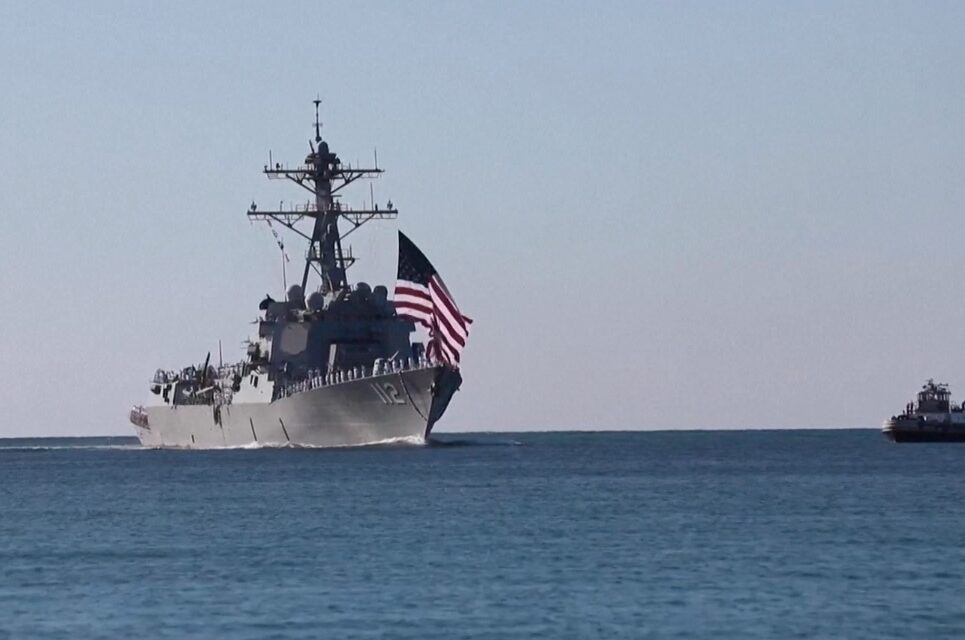
US Navy guided missile destroyer USS Michael Murphy --- now in the Strait of Hormuz, off the Iran coast --- at Pearl Harbor, Hawaii, February 3, 2022 (Reuters)
EA on International Outlets: US-Iran Talks in Islamabad
UPDATES: US-Israel War, Day 46 — “No Deal” in Trump-Iran Talks in Pakistan
Why Iran’s Ethnic Groups Matter Amid US-Israel War
UPDATE 1911 GMT:
Israel Prime Minister Benjamin Netanyahu has confirmed agreement to the 10-day ceasefire with Lebanon.
“We have the opportunity to make a historic deal with Lebanon,” Netanyahu said.
He emphasized that his key demand is the dismantling of Hezbollah.
A senior Hezbollah official said any ceasefire must not allow unrestricted movement for Israeli forces in Lebanon.
As long as the occupation remains on our land, Lebanon and its people have the right to resist by all means to force it to withdraw.
UPDATE 1658 GMT:
Lebanon’s toll from ongoing Israeli attacks has risen to 2,196 killed and 7,185 injured.
Two paramedics were critically wounded when Israeli forces targeted an ambulance in the town of Tebnine in the Bint Jbeil district.
UPDATE 1650 GMT:
Lebanese Prime Minister Nawaf Salam has welcomed a 10-day ceasefire with Israel.
As I congratulate all Lebanese on this achievement, I pray for the martyrs who fell, and affirm my solidarity with their families, with the wounded, and with the citizens who were forced to flee their cities and villages. I hold full hope that they will be able to return to them as soon as possible.
Reports in Israeli media say the Netanyahu Government's ministers expressed anger at hearing about the ceasefire from the media, and without having voted on the matter.
Prime Minister Benjamin Netanyahu has called an urgent meeting of the Security Cabinet.
He reportedly told ministers that he agreed to a ceasefire at Donald Trump's request, dismissing demands for an official vote: “When Israel’s greatest friend, President Trump, is acting alongside us in close coordination, Israel cooperates with him."
UPDATE 1642 GMT:
Donald Trump has declared that Israel and Lebanon will begin a 10-day ceasefire from midnight (2100 GMT).
He said he had spoken with Lebanese President Joseph Aoun and Israeli Prime Minister Benjamin Netanyahu.
An "Israeli security official" said Israel has no plans to withdraw its military from southern Lebanon during any halt of operations.
Over the past two hours, there have been about 50 Israeli strikes in the coastal region of southern Lebanon, south and southeast of Tyre.
Senior Hezbollah lawmaker Hassan Fadlallah said the group had been briefed on a possible ceasefire by Iran’s ambassador to Beirut.
He said Hezbollah's adherence to a ceasefire depended on Israel halting all forms of hostilities.
UPDATE 1451 GMT:
An "official source" has confirmed that Lebanese President Joseph Aoun rejected the Trump camp's request for a direct phone call with Israeli Prime Minister Benjamin Netanyahu on Thursday.
“The Lebanese President refused a direct call with Netanyahu and informed [US Secretary of State] Marco Rubio of this,” the official said. “The American side was understanding."
Aoun's office said he spoke by phone with Donald Trump: “President Aoun reiterated his thanks for the efforts Trump is making to achieve a ceasefire in Lebanon and to secure lasting peace and stability as a prelude to implementing the peace process in the region."
UPDATE 1242 GMT:
Lebanese President Joseph Aoun has said:
The ceasefire that Lebanon is calling for with Israel will be the natural starting point for direct negotiations between the two countries.
Lebanon is keen to de-escalate the situation in the south and across all Lebanese regions, so that the targeting of innocent and defenseless people — women, men and children — comes to an end, and the destruction of homes in Lebanese villages and towns ceases.
He did not confirm if he is speaking with Israeli Prime Minister Benjamin Netanyahu today.
Aoun said the withdrawal of Israeli troops from Lebanese territory “is an essential step towards consolidating the ceasefire” with the Lebanese army reploying toward the border with Israel.
The President spoke by phone with US Secretary of State Marco Rubio, who “affirmed his continuation of the ongoing efforts to achieve a ceasefire as a prelude to establishing peace, security, and stability in Lebanon”.
The Lebanese outlet claimed Aoun told Rubio that he will not speak with Netanyahu.
Meanwhile, Israel has destroyed the last bridge connecting southern Lebanon to the rest of the country.
An Israeli airstrike struck the Qasmiyeh Bridge over the Litani River, destroying it.
UPDATE 0915 GMT:
Pakistan’s Foreign Ministry says no dates have been decided for a second round of talks between the US and Iran.
A senior Iranian official said the visit of Pakistan military head Field Marshal Asim Munir visit “was effective in reducing differences in some areas”, but fundamental disagreements remain.
More hopes have been created for extending the ceasefire and holding a second round of talks.
The fate of Iran’s highly enriched uranium and the duration of Iran’s nuclear restrictions are among the highly disputed issues for which no solution has yet been found.
UPDATE 0854 GMT:
Lebanese officials have pushed back Donald Trump's declaration on social media that Israeli and Lebanese leaders will speak to each other on Thursday.
An official source in Lebanon said, “We are not aware of any planned contact with the Israeli side, and we have not been informed of any through official channels.”
Another official source said “there is no information” about a possible phone conversation between Lebanese and Israeli leaders or a second meeting between their ambassadors in Washington following Tuesday’s talks.
This morning the Israeli military issued another order ordering people in southern Lebanon to flee the area due to “ongoing” airstrikes, the second warning in 24 hours.
However, a member of Israel’s Security Cabinet, Galia Gamliel, said Prime Minister Benjamin Netanyahu will speak to Lebanese President Joseph Aoun today.
The conversation will take place “after so many years of a total disconnect in the dialogue between the two states, and this move will hopefully, in the end, lead to prosperity”, she said.
UPDATE 0535 GMT:
The US and Iran are in indirect talks over an extension of the temporary ceasefire beyond April 21.
The head of Pakistan's military, Field Marshal Asim Munir carried a message from the Trump camp to Tehran on Wednesday. The Pakistani delegation also included Interior Minister Mohsin Naqvi.
Pakistani Prime Minister Shehbaz Sharif set off on a four-day tour of Saudi Arabia, Qatar, and Turkey.
White House Press Karoline Leavitt said a second round of negotiations will “very likely” be held in Islamabad.
Iranian officials said Tehran is demanding an end to Israeli attacks on Lebanon as a precondition for the talks.
After a meeting with his Security Council on Wednesday night, Israeli Prime Minister Benjamin Netanyahu indicated in a video statement that he had not accepted a one-week ceasefire in Lebanon.
He said of the assault in the south of the country, “Our forces continue to strike Hezbollah. we are about to conquer Bint Jbeil. In parallel, yesterday I gave instructions to the IDF [Israel Defense Forces] to continue thickening the security zone.”
Lt. Gen. Eyal Zamir, the IDF Chief of Staff, vowed to eliminate Hezbollah’s presence south of the Litani River, about 30 km (19 miles) from the Israeli border.
I have ordered that all of the area of south Lebanon up to the Litani line be turned into a Hezbollah terrorist kill zone. We are advancing and striking Hezbollah and they are retreating.
UPDATE 0526 GMT:
The Trump camp is threatening to sanction buyers of Iranian oil, proclaiming its belief that Tehran's largest customer China will pause purchases.
“We have told countries that if you are buying Iranian oil, that if Iranian money is sitting in your banks, we are now willing to apply secondary sanctions,” Treasury Secretary Scott Bessent told reporters.
The Treasury had written to two Chinese banks and “told them that if we can prove that there is Iranian money flowing through your accounts, then we are willing to put on secondary sanctions”, Bessent explained.
The US imposed sanctions on more than two dozen Iranian individuals, companies, and ships in the network of petroleum shipping tycoon Mohammad Hossein Shamkhani.
Shamkhani is the son of Ali Shamkhani, the senior advisor to former Supreme Leader Ali Khamenei. Both were killed in US-Israel strikes on February 28, the first day of their war.
On Tuesday, the Treasury said it would not extend a temporary sanctions waiver that allowed the sale of 140 million barrels of Iranian oil at sea.
UPDATE 0520 GMT:
Four rescue workers have been killed in "triple tap" Israeli strikes near the town of Nabatiyeh in southern Lebanon.
The Israelis hit the first group of medics responding to a distress call from wounded civilians, a second group trying to assist their injured colleagues, and a third group arriving to aid the first two teams that had been targeted.
The Lebanese Health Ministry condemned the attacks as a “blatant violation” of international law.
UPDATE, APRIL 16:
China’s Foreign Minister Wang Yi has urged Iranian counterpart Abbas Araghchi to restore navigation in the Strait of Hormuz.
Wang told Araghchi by phone that Iran’s sovereignty and security in the Strait should be respected and safeguarded, but freedom and safety of navigation through the waterway should be guaranteed.
The situation was at a critical stage of transformation and the window for peace was opening, Wang said.
UPDATE 1728 GMT:
Israeli Prime Minister Benjamin Netanyahu’s Security Cabinet will convene on Wednesday night to discuss a possible ceasefire in Lebanon.
Citing an Iranian official, the Hezbollah outlet Al-Mayadeen said a one-week ceasefire will take effect in Lebanon from tonight.
Hezbollah MP Ibrahim al-Moussawi said diplomatic efforts by Iran and other regional countries could produce a ceasefire in Lebanon “soon".
The Iranians are exercising high pressure against the Americans and they have put their conditions that the Americans should include Lebanon in the ceasefire. If they don’t do it, they are going to continue their blockade of Hormuz. It’s the economic card.
The Iranians have opened up to several regional and international parties to achieve this goal.
UPDATE 1551 GMT:
The US military says it stopped nine vessels from sailing out of Iranian ports during the first 48 hours of its naval blockade.
Central Command insisted no ships broke the blockade.
During the first 48 hours of the U.S. blockade on ships entering and exiting Iranian ports, no vessels have made it past U.S. forces. Additionally, 9 vessels have complied with direction from U.S. forces to turn around and return toward an Iranian port or coastal area. pic.twitter.com/h4msgvaPTl
— U.S. Central Command (@CENTCOM) April 15, 2026
Tracking data from Tuesday indicated at least three ships sailing from Iranian ports crossed the Strait of Hormuz, although some vessels taking the route later turned back.
Shipping data indicates the US blockade has reduced the traffic through the Strait. Crossings had modestly recovered to 17 on Sunday. Within 24 hours of the blockade, daily crossings fell back to single digits.
Almost 1/3 of ships are now operating without automatic identity signals, more than double the pre-war baseline of 17%.
UPDATE 0908 GMT:
The Israeli military is continued its killing in southern Lebanon, as Hezbollah says it launched rockets at several areas in northern Israel.
Five people were killed by an Israeli airstrike on the town of Ansariyah. Civil defense teams and paramedics recovered four bodies after an Israeli raid in the Qadmus area.
Two people were slain by drone strikes on two vehicles on the Tyre-Beirut coastal highway, near the towns of Saadiyat and Jiyeh. The strikes were the closest to Beirut in a week, after Israeli attacks on the Lebanese capital killed more than 350 people on April 8.
Hezbollah said it targeted areas such Metula, Kfar Giladi, and Kiryat Shmona with rocket barrages.
UPDATE 0527 GMT:
The International Monetary Fund warns an escalation in the US-Israel Wars could push the world to the brink of recession.
The IMF's worst-case scenario is that repeated shocks to the energy market, with average oil prices at $110 per barrel in 2026 and $125 in 2027, will global economic growth to 2% from the current 3.1%.
The IMF's best scenario is a short-lived conflict and with oil prices at an $82 per-barrel average for the year.
The middle path envisions a longer conflict that keeps oil prices at about $100 per barrel this year and $75 in 2027, with global growth falling to 2.5%.
UPDATE 0517 GMT:
Citing leaked Iranian military documents, the Financial Times reports Iran secretly used a Chinese spy satellite to target American military bases across the Middle East during the US-Israel War.
The TEE-01B satellite, built and launched by Chinese company Earth Eye, was acquired by the Revolutionary Guards’ Aerospace Force in late 2024.
The Iranian military commanders directed the satellite to monitor major US military sites, the FT says, citing time-stamped coordinate lists, satellite imagery, and orbital analysis. The images were taken in March before and after drone and missile strikes on the sites.
UPDATE 0505 GMT:
The US military claims its naval blockade has shut down Iran's economy.
Declaring that it has “achieved maritime superiority in the Middle East”, US Central Command posted, "An estimated 90% of Iran’s economy is fueled by international trade by sea. In less than 36 hours since the blockade was implemented, U.S. forces have completely halted economic trade going into and out of Iran by sea.”
UPDATE, APRIL 15:
Lebanon’s Ambassador to the US said talks with Israel in Washington were “constructive", but the Israelis need to stop their attacks.
Nada Hamadeh Moawad said she “underscored the need to preserve our territorial integrity and state sovereignty”: “I called for a ceasefire and the return of displaced persons to their homes."
UPDATE 1900 GMT:
Israel's Ambassador to the US, Yechiel Leiter, said of today's US-brokered meeting with his Lebanese counterpart in Washington:
We discovered today that we’re on the same side of the equation, and that’s the most positive thing we could have come away with.
We are both united in liberating Lebanon from an occupation power dominated by Iran called Hezbollah.
He said the talks focused on a “long-term vision where there will be a clearly delineated border between our countries, and where the only reason we’ll need to cross each other’s territory will be in business suits to conduct business or in bathing suits to go on vacation".
Hailing the Lebanese Government for rejecting Hezbollah’s call to pull out of the talks, he said, “This is the beginning of a very strong, fortified and consistent battle against Hezbollah."
He added, "They expressed a strong will to this time disarm Hezbollah....The Lebanese government made it very clear that they will no longer be occupied by Hezbollah."
But he refused to say if Israel will heed Lebanese calls for a ceasefire, declared that the Netanyahu Government will do whatever is necessary to safeguard its citizens.
UPDATE 1857 GMT:
European Council President António Costa has criticized the Trump Administration's blockade of Iranian ports and the Strait of Hormuz.
“Blockade is never the answer,” he told CNN.
The President highlighted the video conference, led by France and the UK, of a coalition of countries on "defensive actions" in the Strait.
UPDATE 1319 GMT:
French President Emmanuel Macron is calling on the US and Iran to resume talks after speaking with Iranian counterpart Masoud Pezeshkian and Donald Trump on Monday.
Macron emphasized that a ceasefire must include Israel's attacks on Lebanon. He said the Strait of Hormuz should be reopened unconditionally and without restrictions as soon as possible.
Yesterday, I spoke with Iranian President Massoud Pezeshkian, as well as with U.S. President Donald Trump.
I urged the resumption of the negotiations suspended in Islamabad, the clearing up of misunderstandings, and the avoidance of any further escalation.…
— Emmanuel Macron (@EmmanuelMacron) April 14, 2026
Macron said France and the UK will host a conference in Paris on Friday. The gathering is for countries willing to contribute to a defensive multilateral mission to restore freedom of navigation in the Strait when security conditions allow.
UPDATE 0845 GMT:
Three Iran-linked tankers have passed through the Strait of Hormuz.
Because the three vessels were not heading to Iranian ports, they were not covered by the US blockade.
The Panama-flagged Peace Gulf, a medium-range tanker, is heading to Hamriyah port in the UAE. The vessel typically moves Iranian naphtha, an oil product used for making plastics and chemicals.
The US-sanctioned tanker Murlikishan is sailing to Iraq to load fuel oil. The vessel has transported Russian and Iranian oil.
The US-sanctioned, Chinese-flagged Rich Starry is carrying around 250,000 barrels of methanol, loaded at UAE’s Hamriyah, and heading to China (see 0638 GMT).
UPDATE 0749 GMT:
China's Foreign Ministry says the US blockade of Iranian ports is “dangerous and irresponsible behavior” which “further jeopardizes safety of passage through the Strait [of Hormuz]”.
Spokesperson Guo Jiakun said of Donald Trump's threat if Beijing provides military assistance to Iran, “If the US insists on using this as an excuse to impose additional tariffs on China, China will definitely take resolute countermeasures."
Guo said reports of China's provison of weapons to Iran, including shoulder-fired missiles, “are completely fabricated”.
UPDATE 0745 GMT:
Four sources say the US and Iran will return to Islamabad for talks later this week.
UPDATE 0653 GMT:
Arab officials say Saudi Arabia is urging the Trump camp to end its blockade of the Strait of Hormuz.
The Saudis fear Iran and its allies, Yemen's Houthis, could close the Bab al-Mandab Strait on the southern side of the Arabian Peninsula.
UPDATE 0648 GMT:
Iran Foreign Minister Abbas Araghchi briefed Gulf and European states on Tehran's offer over stockpile of highly enriched uranium and supervision of the Strait of Hormuz, made during weekend talks with the US in Islamabad.
Araghchi spoke with foreign ministers of Saudi Arabia, Oman, Qatar, France, and Germany. He emphasized that Iran did not regard the talks as exhausted.
The US reportedly asked for a 20-year moratorium on Iran's uranium enrichment. Tehran responded by offering a 5-year halt.
UPDATE 0643 GMT:
An Israeli soldier has been killed in combat in southern Lebanon.
The Israeli military said one reservist was moderately injured and two lightly injured. They were evacuated for medical treatment at a hospital.
UPDATE 0638 GMT:
A US-sanctioned tanker has tested the American blockade, travelling through the strait of Hormuz on Tuesday.
The Chinese-owned, Chinese-crewed tanker Rich Starry was blacklisted by the US in 2023 for helping Iran evade energy sanctions. It is not clear if it visited Iranian ports before its transit or is carrying cargo.
UPDATE 0627 GMT:
Iran has condemned the US blockade of its ports and the Strait of Hormuz.
Iran's UN Ambassador Amir Saeid Iravani wrote UN Secretary General António Guterres, “The imposition of a maritime blockade constitutes a grave violation of the sovereignty and territorial integrity of the Islamic Republic of Iran."
The “unlawful” blockade also “constitutes a serious violation of the fundamental principles of the international law of the sea”, Iravani said.
UPDATE 0619 GMT:
Hezbollah says it will not abide by any agreements from direct Lebanon-Israel talks, which begin this week in the US.
Wafiq Safa, a member of Hezbollah’s political council, said, “As for the outcomes of this negotiation between Lebanon and the Israeli enemy, we are not interested in or concerned with them at all."
In a televised address, Hezbollah leader Naim Kassem urged the Lebanese Government to pull out of the negotiations.
ORIGINAL ENTRY: The Trump camp imposed a blockade on Iranian ports on Monday while blustering over its next move in the 47-day US-Israel War on Iran and Lebanon.
US Central Command posted before the 5:30 p.m. (2 p.m. GMT) launch, “The blockade will be enforced impartially against vessels of all nations entering or departing Iranian ports and coastal areas, including all Iranian ports on the Arabian Gulf and Gulf of Oman."
The US will “not impede freedom of navigation for vessels transiting the Strait of Hormuz to and from non-Iranian ports," CENTCOM said.
Donald Trump proclaimed, without evidence, that 34 ships passed through the Strait of Hormuz on Sunday. Shipping monitors put the number at eight.
Trump also claimed, “We’ve been called by the other side...[who would] like to make a deal very badly."
Vice President J.D. Vance said there had been "some progress" in last weekend's talks in Islamabad but maintained Trumpist demands.
I really think the ball is in the Iranian court, because we put a lot on the table. We actually made very clear what our red lines were.
He said there was "no flexibility" on American control of Iran’s enriched uranium, and a verification mechanism to ensure no development of a nuclear warhead.
It’s one thing for the Iranians to say that they’re not going to have a nuclear weapon. It’s another thing for us to put in place the mechanism to ensure that’s not going to happen.
But Vance asserted, “They moved in our direction.” He said he thought Iranian negotiators, who included Parliament Speaker Mohammad Bagher Ghalibaf and Foreign Minister Abbas Araghchi, were “unable to cut a deal” and needed to get approval from others in Tehran.
US Considering 2nd Set of Talks with Iran
Privately, US officials were less strident than Trump. They cited internal discussions about a possible second meeting with Iran before the temporary ceasefire ends on April 21. They include consderation of dates, locations, and mediators.
“We need to be prepared to stand something up quickly should things head in that direction,” an official told CNN.
Another said, “There is continued engagement between the US and Iran and forward motion on trying to get an agreement.”
The sources said the US sought a 20-year moratorium on Iran’s uranium enrichment during the talks in Islamabad. Iran responded with a “single digit” timeframe, reportedly five years.
The US also wanted Tehran to “remove all highly enriched uranium from the country.” The Iranians said they would accept a “monitored process of down-blending”.