
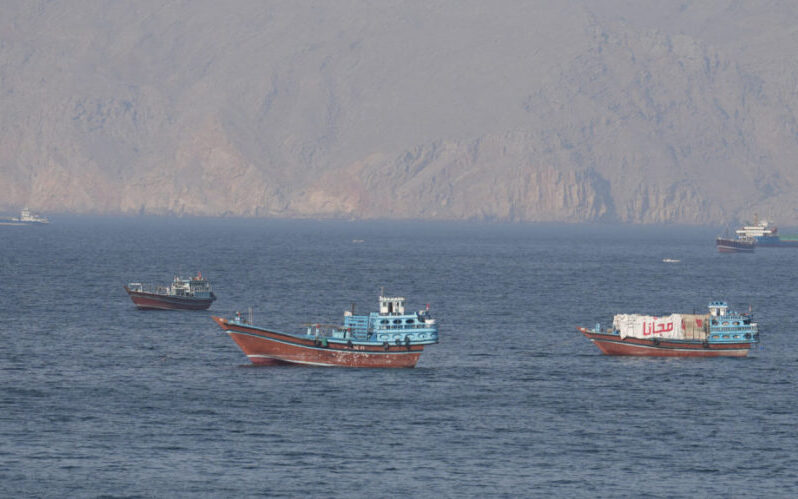
Ships and tankers in the Strait of Hormuz off the coast of Musandam, Oman, April 18, 2026 (Reuters)
EA on WION and TVP World: Iran Tightens Its Control of Strait of Hormuz
EA on International Outlets: After the US-Iran Talks in Islamabad
UPDATES: US-Israel War on Iran, Day 51 — A 10-Day Israel-Lebanon Ceasefire
UPDATE 1502 GMT:
EA understands, from an official close to the situation, that Iranian security personnel are in Islamabad.
While this is an indication that talks are imminent, no Iranian officials are in the Pakistani capital yet.
The Iranian and Pakistani Foreign Ministers have spoken by phone.
Foreign ministers of #Iran and #Pakistan held a phone call today, Monday, to discuss Iran-US negotiations and the regional situation. https://t.co/SmHQs7GKb6 pic.twitter.com/ZWfMu8wQnB
— Iran Nuances (@IranNuances) April 20, 2026
UPDATE 1454 GMT:
In a shift of position, a “senior Iranian official” has said Tehran is “positively reviewing” involvement in talks with the US, while stressing that no final decision has been made.
UPDATE 1328 GMT:
Only one ship crossed the Strait of Hormuz on Sunday and only three on Sunday.
More than 20 vessels, including five from Iranian ports, passed throught the Strait on Sunday, the highest total during the US-Israel War.
The pre-war average was more than 120 per day.
UPDATE 0845 GMT:
The UAE is negotiating with the Trump Administration over financial support if the US-Israel War on Iran continues.
Central Bank Governor Khaled Mohamed Balama discussed the possibility of a currency-swap line with US Treasury Secretary Scott Bessent and Federal Reserve officials in Washington last week.
Officials say the UAE fears the war is deterring investors and undermining its status as a global financial hub. They say the Trump camp’s decision to attack Iran has drawn the Emirates into a destructive conflict whose effects may escalate.
Emirati officials added that if the UAE runs short of dollars, it may be forced to use the Chinese yuan or currencies of other countries for oil sales and transactions.
UPDATE 0830 GMT:
China has expressed concern over the “forced interception” of an Iranian-flagged cargo ship by the US.
“The situation in the Strait of Hormuz is sensitive and complicated,” China’s Foreign Ministry spokesman Guo Jiakun said. He urged all parties to abide by the ceasefire agreement in a responsible manner, avoiding further escalation to “create the necessary conditions for normal transit through the Strait to resume”.
UPDATE 0819 GMT:
President Masoud Pezeshkian has said Iran is not committed to negotiations with the US in Pakistan on Tuesday, as “distrust of the enemy and vigilance in interactions are an undeniable necessity”.
However, he added, “War is not in anyone’s interest, and while resisting threats, every rational and diplomatic path should be used to reduce tensions.”
Foreign Ministry spokesman Esmail Baghaei said Iran has no plans for talks since the US has violated the two-week ceasefire agreement. He said Tehran cannot forget American attacks during previous diplomatic talks.
US proposals were “unserious” and its demands “unrealistic”, the spokesman said, declaring that Tehran does not believe in ultimata.
A “senior Iranian official” said Tehran’s “defense capabilities”, including its missile program, are not open to negotiation.
They said gaps between the two sides over Iran’s nuclear program have not narrowed.
UPDATE 0747 GMT:
On Saturday, before the US intercepted and boarded an Iranian cargo ship, passage through the Strait of Hormuz was at its highest level since the US-Israel War began on February 28.
More than 20 vessels crossed the Strait. Five of them, including three liquified petroleum gas tankers, loaded products from Iranian ports. The shipments included oil products and metals.
UPDATE 0630 GMT:
Iran has continued its executions of detainees on the pretext that they are working with Israel’s Mossad intelligence service to plan attacks inside the country.
Mohammad Masoum Shahi and Hamed Validi were hanged this morning. They were charged with “enmity against God” and cooperation with hostile groups.
UPDATE, APRIL 20:
Oil prices have risen amid tensions in the Strait of Hormuz and uncertainty over a second set of US-Iran talks in Islamabad.
In early trading on Monday, Brent crude surged 5.8% to $95.64 per barrel. West Texas Intermediate rose 6.4% to $87.90.
UPDATE 2242 GMT:
Tehran’s joint military command Khatam al-Anbiya says the US violated a ceasefire by firing at the Iranian-flagged cargo ship Touska, sailing from China to Iran, in the Gulf of Oman.
A spokesman said, We warn that the armed forces of the Islamic Republic of Iran will soon respond and retaliate against this armed piracy by the US military.”
The US military confirmed that the destroyer USS Spruance fired “several rounds” as it intercepted the Touska. Marines then boraded the vessel.
U.S. forces operating in the Arabian Sea enforced naval blockade measures against an Iranian-flagged cargo vessel attempting to sail toward an Iranian port, April 19.
Guided-missile destroyer USS Spruance (DDG 111) intercepted M/V Touska as it transited the north Arabian Sea at… https://t.co/iyzOQd93C3 pic.twitter.com/HwU4XS48Oq
— DOW Rapid Response (@DOWResponse) April 19, 2026
UPDATE 2044 GMT:
A French ship has been damaged by an attack in the Strait of Hormuz.
The shipping company CMA-CGM said the vessel “was the subject of warning shots yesterday”. Its “crew is safe and sound”.
UPDATE 2037 GMT:
The UK military has escalated its threat assessment for the Strait of Hormuz and the Persian Gulf to Critical, the highest possible risk level.
The United Kingdom Maritime Trade Operations center, citing a “high level of activity by naval forces in the region”, said the current environment creates a severe “risk of attack or miscalculation” for all commercial shipping.
UPDATE 2024 GMT:
Donald Trump says a US destroyer intercepted an Iranian-flagged cargo ship, which was then boarded by Marines, in the Gulf of Oman.
Trump said the USS Spruance enforced the American blockade on Iranian ports by firing on and seizing the US-sanctioned Touska, “nearly 900 feet long and weighing almost as much as an aircraft carrier”.
UPDATE 1729 GMT:
The White House has reversed yet again, saying that Vice President J.D. Vance is heading the US delegation to Islamabad for the second set of talks with Iran.
But Iranian State media say Tehran has rejected the discussions, citing “Washington’s excessive demands, unrealistic expectations, constant shifts in stance, repeated contradictions, and the ongoing naval blockade, which it considers a breach of the ceasefire”.
UPDATE 1359 GMT:
Donald Trump now says that Vice President J.D. Vance will not lead the US delegation in the second set of talks with Iran.
US Ambassador to the UN Mike Waltz and Energy Secretary Chris Wright had said (see 1311 GMT) that Vance was going to Pakistan’s capital Islamabad on Monday night.
Trump claimed the Secret Service could not accompany Vance: “It’s only because of security. JD’s great.”
UPDATE 1311 GMT:
Donald Trump says US representatives will travel to Pakistan’s capital Islamabad on Monday night for the second set of talks with Iran.
Vice President J.D. Vance will again lead the American delegation, said Mike Waltz, the US ambassador to the UN, and Energy Secretary Chris Wright.
Trump said real estate developer Steve Witkoff and his son-in-law Jared Kushner will also return to the talks.
UPDATE 1308 GMT:
Iranian media say two tankers were turned around by Iran’s military as they tried to pass through the Strait of Hormuz.
The vessels, sailing under the flags of Botswana and Angola, were forced to change course after “unauthorised transit” through the waterway.
UPDATE 0859 GMT:
Knocking back Donald Trump’s tweets, Iranian Deputy Foreign Minister Saeed Khatibzadeh says:
I can tell you that no enriched material is going to be shipped to United States. This is a non-starter, and I can assure you that while we are ready to address any concerns that we do have, we’re not going to accept things that are non-starters.
Khatibzadeh rejected a second set of talks with the US, saying it was maintaining “excessive” demands: “We are still not there yet to move on to an actual meeting because there are issues that the Americans have not yet abandoned their maximalist position.”
President Masoud Pezeshkian chided, “Trump says Iran cannot make use of its nuclear rights but doesn’t say for what crime. Who is he to deprive a nation of its rights?”
UPDATE 0744 GMT:
Speaking with the Wall Street Journal, US officials depict a rattled, chaotic Donald Trump.
It was Good Friday afternoon in a nearly empty West Wing soon after the president learned that an American jet had been shot down in Iran, with two airmen missing. Trump screamed at aides for hours. The Europeans aren’t helping, he said repeatedly. Gas prices averaged $4.09. Images of the 1979 Iranian hostage crisis — one of the biggest international policy failures of a presidency in recent times — had been looming large in his mind.
Trump demanded that the military immediately rescue the two airmen of the downed F-15E jet fighter, but the officials needed to establish how to carry out the difficult mission in the mountains of southwest Iran.
A “senior administration official” said aides kept Trump out of the room as they received minute-by-minute updates “because they believed his impatience wouldn’t be helpful”.
UPDATE 0708 GMT:
Iran Speaker of Parliament Mohammad Baqer Qalibaf has emphasized, “It is impossible for others to pass through the Strait of Hormuz while we cannot. If US does not abandon this blockade, transit through Strait of Hormuz will certainly be restricted.”
He said he forced Donald Trump’s representatives to pull back a US warship in the Strait.
We dealt decisively with a US attempt at minesweeping, viewing it as a ceasefire violation. I told the US delegation in Islamabad that if their minesweeper moved an inch further, we would fire. They requested 15 minutes to order a withdrawal, and they complied.
UPDATE 0607 GMT:
An Israeli reservist was killed and nine others wounded by an explosive device in southern Lebanon on Saturday.
During battalion operations, an engineering vehicle drove over a bomb that had been planted by Hezbollah, said the Israel Defense Forces.
One soldier was seriously wounded.
After the blast, the IDF struck several targets in the area.
UPDATE 0604 GMT:
UN Secretary General António Guterres has condemned Friday’s attack on peacekeepers in Lebanon which killed a French soldier and injured three others.
I strongly condemn Saturday’s attack on @UNIFIL_ during which one French peacekeeper was killed & another three were injured.
I extend my deepest condolences to the family, friends & colleagues of the fallen peacekeeper, and wish a full & fast recovery to the injured…
— António Guterres (@antonioguterres) April 18, 2026
UPDATE 0557 GMT:
Israeli forces are demolishing homes in Bint Jbeil and other border towns in southern Lebanon, reports Lebanese state media.
Bint Jbeil is about 5 km (3.1 miles) north of the Israeli border, There was heavy fighting between Israeli forces and Hezbollah in the town before a 10-day ceasefire took effect at midnight on Thursday.
UPDATE 0553 GMT:
Commenting on talks with the US, Iran’s Parliament Speaker Mohammad Bagher Ghalibaf said on Saturday that gaps remain over nuclear issues and the Strait of Hormuz.
“We have had progress but there is still a big distance between us,” he told State media. “There are some issues on which we insist….They also have red lines. But these issues could be just one or two.”
He added, “We are still far from the final discussion.”
UPDATE 0548 GMT:
At least 3,468 people in Iran have been killed by the US-Israel War, says the State-run Foundation of Martyrs and Veterans Affairs.
The US-based Human Rights Activists News Agency said on April 7 that at least 3,636 people had been slain, including 1,701 civilians. Among them were at least 254 children.
ORIGINAL ENTRY: Iran has tightened its grip on the Strait of Hormuz, restricting the transit of all shipping until the US lifts a blockade on Iranian ports.
Amid a two-week temporary ceasefire in the US-Israel War, Tehran said on Friday that it would allow passage to commercial vessels, provided they used predetermined routes and obtained permission from the Revolutionary Guards’ Navy.
But on Saturday, politicians, officials, and commanders said the arrangements are withdrawn because of the blockade imposed by the Trump camp last week.
Around 25% of the world’s maritime oil traffic and 20% of maritime gas pass through waterway between Iran and the Gulf States. The Strait is just over 30 km (18.6) miles at its narrowest point.
On Saturday, two Guards gunboats fired on a tanker. 20 nautical miles northeast of Oman. At least two merchant vessels were hit by gunfire.
Earlier, a convoy including four liquefied petroleum gas carriers and several oil product and chemical tankers tried to pass through the waterway. There is still no word whether it was successful.
Iran’s Parliamentary Speaker Mohammad Ghalibaf jabbed at Donald Trump’s declaration that the Strait had been completely freed by Iran: “The President of the United States made seven claims in one hour, all seven of which were false. They did not win the war with these lies, and they will certainly not get anywhere in negotiations either.”
He reiterated the conditions on passage: “Whether the Strait is open or closed and the regulations governing it will be determined by the field, not by social media.”
Later in the day, the Supreme National Security Council confirmed restrictions on passage “until the end of the war is definitively concluded”. As long as the US blockades Iranian ports, this is “a breach of the ceasefire [which] will prevent the conditional and limited reopening of the Strait of Hormuz”.
Iran’s military declared, “This strategic waterway is under the strict management and control of the armed forces.”