

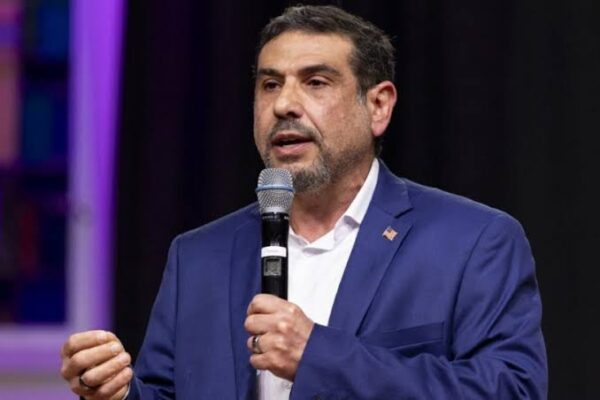
Nabeela Syed, who won a seat in the Illinois State Legislature
From Security to Mobilization: British Muslims Must Not Be Played
In Search of Conviction: Why the UK Can’t Produce A Mamdani (Yet)
From Abdul El-Sayed’s historic Senate victory in Michigan to Adam Hamawy’s Congressional win in New Jersey to Nabeela Syed’s State-level success in Illinois, Muslim candidates challenged attempts to define them through religion in the US midterm elections. Their campaigns offer a lesson for British Muslim politics: confronting prejudice matters, but so does listening, building relationships, and working for the common good.
In Michigan, which Trump carried in 2024, Abdul El-Sayed defeated Republican Mike Rogers to become America’s first Muslim senator. Trump questioned his loyalty and made unfounded allegations concerning extremism, while Rogers raised unsubstantiated claims about the Muslim Brotherhood. The calculation appeared straightforward: make El-Sayed’s religion a greater political liability than failed Republican policies. It did not work.
The contrast with the Democrats’ 2024 Presidential defeat is striking. Trump’s campaign denigrated immigrants, belittled transgender rights and declared that Democrats were obsessed with being “woke”. Kamala Harris was not campaigning exclusively on cultural questions, but she struggled to separate her promises of change from the Biden Administration’s record.
By 2026, circumstances had reversed: Trump was governing, and Democrats could scrutinize his decisions. El-Sayed demonstrated the value of refusing to let provocations and prejudice displace the economic and social priorities.
Groceries, Healthcare, and War
A physician and former Detroit health director, El-Sayed campaigned on Medicare for All, taxation of billionaires, reduction of corporate influence and the tackling of household costs. When opponents attacked his Muslim identity, he challenged their allegations and then returned to the financial pressures on Michigan’s families.
At an October campaign event, he declared, “My name and my faith are not the reason you can’t afford your gas.” He extended the argument to food, healthcare, and housing. If Trump decided that a Muslim candidate’s name was a pressing national concern, changing it was not going to reduce anybody’s grocery bill.
El-Sayed connected domestic concerns with foreign policy. Speaking with Jon Stewart, he argued that money supporting Israeli policies in the West Bank could instead benefit communities in western Detroit. Rather than confining his position to Palestinian solidarity, he linked overseas expenditure to taxpayers’ priorities at home.
Crucially, his campaign reached beyond Muslim and Arab American communities, taking in churches, synagogues, and smaller towns. Rather than allowing opponents to construct his identity, he presented himself through his professional experience and personal story. He embraced Barack Obama’s endorsement despite previously criticising his Presidency. His priority was defeating Trump’s Republicans, not winning arguments within his own tribe; collaboration mattered more than the ideological purity of student politics.
His campaign was not without controversy, particularly concerning Israel, political associations and comments about a synagogue attack. Nor did his victory establish that his technique had overcome prejudice. However, in the end religious attacks did not prevent him winning a competitive statewide election.
In New Jersey, Adam Hamawy, a former US Army combat surgeon who volunteered in Gaza, won a House seat by campaigning on healthcare, economic concerns, and foreign policy. In Illinois, Nabeela Syed defeated Republican Darby Hills to win a State Senate seat, building on a legislative record on prescription costs and consumer protection.
Syed’s campaign did not face sustained religious attacks. Instead, the emphasis was on her record. That yields another lesson, as New York Mayor Zohran Mamdani, elected last November, must show that promises of affordability are carried out in office. Representation matters; what representatives subsequently achieve matters just as much.
Egyptian-American surgeon Adam Hamawy won New Jersey’s 12th Congressional District in the US House of Representatives
British Muslims: Civic Strength, Political Weakness?
El-Sayed, Hamawy and Syed were not simply Muslim candidates winning elections. They are politicians who happen to be Muslim, seeking to deliver for everyone. Thus the question for British Muslims: given our considerable contribution to society, why do we sometimes struggle to translate that civic strength into wider political influence?
Achievements are hardly in short supply. In Nottingham, Muslim-led charity Himmah distributed 11,176 emergency food parcels in 2025, helping people regardless of faith. Its Muslim-Jewish Salaam Shalom kitchen demonstrates cooperation across religious differences. Cardiac surgeon Asif Hasan received a Pride of Britain Lifetime Achievement Award for three decades transforming children’s heart surgery at Newcastle’s Freeman Hospital. In Oldham, Najma Khalid received a Muslim News Award for Excellence for supporting disadvantaged women and strengthening community cohesion.
These are examples of British Muslims contributing through charities, public services and volunteering. We are not outsiders seeking admission to British society. We have been part of its fabric for generations.
Yet charitable achievement and political influence are different things, and service needs no political recognition. The question is whether we are as effective at building relationships and shaping policy as we are at serving communities.
Too much of our political engagement remains reactive. A politician makes an inflammatory statement; an organization issues a condemnation; meetings are requested; and assurances exchanged before attention moves to the next controversy. Occasionally, another statement follows expressing disappointment with the first response — we have become rather accomplished at issuing statements.
Such interventions can be necessary. Racism, Islamophobia, and anti-Muslim hatred cannot simply be ignored, and public pressure can achieve change. However, condemnation alone is not a strategy, just as a ministerial meeting does not demonstrate influence. Did policy change? Was funding secured? Were institutions held accountable?
Political maturity requires face-to-face conversations with people who do not share our affiliations, causes, or assumptions. We cannot broaden our influence by speaking exclusively to those who agree with us, even when disagreement within the community may be treated as disloyalty. There is no single British Muslim political identity, nor should anyone claim a monopoly on representing us.
Disagreement does not automatically make somebody racist or bigoted. Genuine prejudice must be confronted, but questioning a strategy or approaching an issue differently is not necessarily hostility. Sometimes we must agree to disagree: cooperation on one issue need not require unanimity on everything else. Political engagement should not resemble a membership club requiring agreement with every position taken by those already inside.
This is not about compromising principles. Persuasion requires listening as well as speaking, rather than conversing exclusively among the converted. El-Sayed humanized political debate through experience, professional credibility, and shared concerns rather than letting opponents define him.
British Muslim organisations already possess powerful human stories. We should tell them beyond responses to hostile headlines. Working with others on poverty, healthcare, housing, and public accountability need not begin with agreement on every political grievance. Nor should shared faith, community standing, or agreement over Palestine shield politicians or organizations from scrutiny of competence, integrity or delivery.
There is no contradiction between being proudly Muslim and recognizing that our political views differ. Faith may unite us in belief, but does not oblige agreement on every politician or strategy. If we challenge those who portray Muslims as monolithic, we should not reinforce that assumption ourselves.
In the US, El-Sayed, Hamawy, and Syed must now translate electoral success into results. Their victories have not ended Islamophobia, but identity need not determine political outcomes. Winning attention is one achievement; turning it into meaningful change beyond those already converted is another.
In the UK, we need to take up that challenge.
