
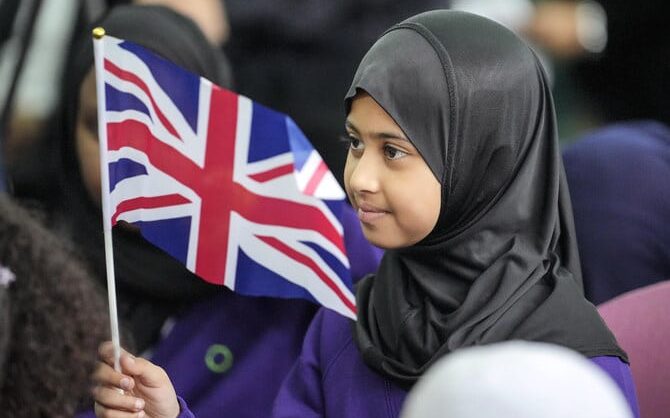
Are British Muslims Prepared for Challenges to UK Security?
In mid-October, Gen. Roly Walker, the Chief of the UK General Staff, told 700 soldiers at Catterick Garrison that there is “extreme jeopardy in the world at the moment” and that “our citizens have got to consent to sacrifices to prioritize defense and security”. For all in Britain, his words should be a warning.
This week the UK Government launched its “Be Ready” campaign, urging households to keep three days’ supply of water, food and cash, ready for challenges from storms and cyberattacks to disruption by what Defence Secretary Wes Streeting called “hostile state actors or terrorists”.
The government’s Defence Investment Plan is backed by £298 billion ($397 billion) over four years. Public opinion remains unconvinced. Ipsos found that 48% of Britons can think of no circumstances in which they would take up arms for the country, even as 51% back higher defense spending. The case for sacrifice still has to be made.
A country that prepares for sacrifice must decide who will bear it, and how it will win their consent. Everyone in Britain shares in the social contract, and all should have a say in what the country asks of them.
That issue reaches every community in Britain, and it carries particular weight for British Muslims, the youngest of the country’s main faith groups. For two decades, public policy has often approached Muslims first as a security concern. A sudden shift from securitization to mobilization, with no conversation in between, serves no one.
Not everyone accepts that war is coming. Some believe consent is being manufactured for a decision already made. Others point to an arms industry that profits as talk of war grows. Still others recall Iraq, where the Chilcot Inquiry found the 2003 war was sold on intelligence “presented with a certainty that was not justified”, and ask why war should come before the cost of living and the National Health Service.
Many British Muslims share these doubts. They marched against the Iraq War and the genocide in Gaza alongside hundreds of thousands of other Britons of every faith. Much of the anti-war case is right. However, the same grievances that give it force can also be exploited, and a young community with real reasons for anger is easier to exploit than most.
From Securitization to Mobilization
British Muslims enter this period more exposed than most. A generation of Islamophobic and securitization policies has left many of us distrustful of the state and doubtful that we will be heard. That distrust matters because it leaves us open to pressure from others.
Our demographic profile and economic circumstances deepen that exposure. Our median age is 27, against 40 for the population. By 2035, the number of Muslims aged 16 to 24 is projected to rise by 19%, while the national total for that age group falls by 3%. Two in five Muslims in England live in the most deprived fifth of areas, twice the rate of the population as a whole.
Those conditions leave us open to competing demands. The state will want recruits while still viewing our communities with suspicion, and it will never be short of self-appointed community figures ready to front its message in return for access. Anti-war campaigners, meanwhile, want our numbers and our anger on the streets. But as the room for protest narrows, young Muslims who answer that call risk arrest and a criminal record in a climate where, too often, a Muslim name on a charge sheet is read as extremism.
The pressure will not come only from domestic institutions and campaigners. Hostile states look for any grievance to exploit. The far right wants someone to blame. When protests over crumbling schools swept France this autumn, Donald Trump blamed “out of control mass migration”. In Southport in 2024, false claims that a newly arrived asylum seeker was behind the killings set off riots in the town and beyond.
Young Muslims will feel these converging pressures most sharply. Recruitment campaigns will target them; organizers will rally them; and agitators will blame them. Without trusted institutions of their own and a clear sense of where they stand, they are left to choose between offers made on other people’s terms.
That is why British Muslims must be consulted before any mobilization, not after decisions have already been made.
A Contract That Runs Both Ways
Britain is our country, and for most of us it is the only home we have known. Muslims fought for it in the First World War, but we belong for more ordinary reasons. We live, work, raise families and pay our taxes here.
That belonging brings duties with its rights. The Tunisian thinker Rached Ghannouchi saw Western democracies as an “abode of covenant” (dar al-‘ahd), where Muslims live under a social contract which their faith obliges them to keep. A covenant binds both parties: we keep ours as active citizens, and the state keeps its own by treating us as equals. However, extremists on both sides, “confuse religion with citizenship”, when one is a bond with God and the other a bond with the country we share. He urged Muslims to move beyond the mindset of a minority to full civic engagement.
That engagement rests on equal citizenship, an ideal weakened by policies that have treated millions of British Muslims as a threat to be managed. In a post-colonial UK, the colonial habits of control and patronage have to be left behind. Partnership means a say before decisions are made and representation through bodies the community chooses. It means protection from being singled out, and the right to criticize policy, oppose a war, or object
to military service on grounds of conscience without being treated as suspects or seen as a fifth column.
That work begins with our own institutions, which should help young people see what is being asked of them, by whom, and who benefits. It clearly set out the British Muslim community’s position before anyone else does it for us.
Many young British Muslims are already questioning their place. They have grown up being treated as a threat. Now they are told their country may need them. Some wonder whether Britain is really theirs. We should tell them plainly that it is, and that belonging gives them the right to set terms as well as the duty to take part.
Our ask is clear: before any mobilization, British Muslims must be consulted, represented and treated as equal partners. We owe this country our part in its life. It owes us a say in what that part will be.
