
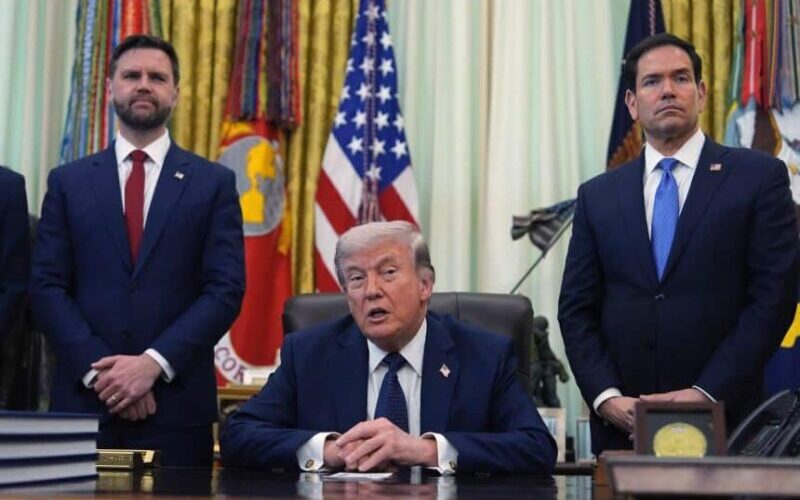
Donald Trump speaks as Secretary of State Marco Rubio (R) and Vice President J.D. Vance (L) listen in the Oval Office of the White House, Washington, D.C., April 23, 2026 (Mark Schiefelbein/AP)
UPDATES: US War on Iran, Day 195 — Americans Strike Iranian Oil Tankers
UPDATE 1502 GMT:
Israel has carried out another airstrike on Nabatieh al-Fawqa in southern Lebanon.
The Israeli army said it had destroyed the Ali al-Taher ridge in a blast that triggered a 4.1-magnitude tremor.
UPDATE 1455 GMT:
A military official from Yemen’s government has confirmed that Houthis have seized control of the country’s entire Red Sea coast.
The official said that all territory under government control “on the western coast has fallen”, after the Houthis seized Mayyun Island and the Greater and Lesser Hanish Islands in the Bab al-Mandeb Strait.
Houthi spokesperson Yahya Saree said maritime navigation remained safe for all shipping companies except Saudi vessels banned by the Yemeni group.
“We will continue to enforce blockade for blockade and escalation for escalation until the aggression stops and the blockade on our people is lifted,” Saree said.
UPDATE 0844 GMT:
Yemen’s Houthis have completed their seizure of the area around the Bab al-Mandeb Strait, taking over Mayyun Island in the Red Sea.
A Yemeni Government official confirmed, “Boats carrying armed Houthi fighters reached Mayyun Island after government forces withdrew from it yesterday.” The island divides the Strait into two shipping lanes.
An eyewitness says gunmen are “deploying along the Bab al-Mandab shore and are driving around in military vehicles”.
UPDATE 0549 GMT:
Israeli warplanes have launched airstrikes on the town of al-Mansouri and surrounding areas towards the town of Majdal Zoun in southern Lebanon.
The Israelis also struck the town of Nabatieh al-Fawqa and near the town of Qantara.
Israel claimed it destroyed tunnels used by Hezbollah in the strategic Ali al-Taher ridge.
UPDATE 0543 GMT:
The average price of US diesel has passed $6 per gallon for the first time on record.
The level broke the previous record of $5.85 a gallon set the previous week.
The current price of Brent crude oil has surged to $107 per barrel, approaching its level in the early weeks of the US-Israel War.
UPDATE 0537 GMT:
Only seven monitored vessels crossed the Strait of Hormuz on Thursday, down from 11 on Wednesday and below the 10-day average of 15.
Two Panamax ships exited the strait, one carrying fertilizer and the other sailing in ballast.
Five vessels entered the strait, including a Panamax vessel carrying dry bulk cargo; a Handysize vessel laden with steel; a Handysize vessel carrying grains; a medium-range tanker loaded with dirty petroleum products; and a Supramax vessel carrying dry bulk cargo.
Trump Administration officials claim vessels, including tankers, are crossing the Strait “dark” with their transponders turned on.
Before the US-Israel War on Iran on February 28, around 125 vessels crossed the Strait daily.
UPDATE, SEPT 11:
Donald Trump has rejected the request of Saudi Crown Prince Mohammed bin Salman for US strikes against Yemen’s Houthis, say two US officials.
The officials said the Crown Prince called twice, but the Administration does not intend to take direct military action against the Houthis at this time.
The Houthis captured the strategic port city of Mokha earlier this week, putting them in position to control the Red Sea coast of Yemen. That would enable them to tighten restrictions on the Bab al-Mandeb Strait and their blockade on Saudi ports.
The head of US Central Command, Adm. Brad Cooper, the commander of U.S. Central Command, traveled to Saudi Arabia on Thursday for urgent coordination meetings, said “two sources with knowledge of the matter”.
A “senior Trump administration official” said:
The United States is focused on protecting our core national security interests — such as ensuring freedom of navigation in the Red Sea — while empowering our regional partners to take the lead in managing and resolving regional security challenges.
We are in continuous dialogue with Saudi Arabia and the Republic of Yemen Government regarding regional stability.
UPDATE 2037 GMT:
More than 100 US military advisers are in Saudi Arabia providing intelligence and targeting for the Saudis in their military campaign against Yemen’s Houthis, say “five sources familiar with the operations”.
The US military personnel are part of a joint forces command established in recent weeks with around 200 troops, said a US official.
The US has helped Saudi Arabia use a targeting tool allowing military officers to see in real-time what is happening on the battlefield. Another source said the US is providing “geospatial” targeting support for strikes against the Houthis.
The sources emphasized that the US is not participating directly in strikes. The Americans are also not helping refuel Saudi warplanes or providing other operational support.
UPDATE 1400 GMT:
Israeli forces advanced into the village of Jamlah in western Dara’a Province in southern Syria, before pulling back towards the occupied Golan Heights.
On Wednesday, Israeli Prime Minister Benjamin Netanyahu visited Israeli soldiers occupying the south, a visit condemned by the Syrian government as “provocative and a blatant violation” of sovereignty.
UPDATE 1205 GMT:
Yemen’s Houthis have seized the port of Mocha, moving towards full control of the country’s Red Sea coast.
The Houthis are fighting Saudi-backed Government forces.
There were 276 fatalities from September 3 to 7. The Houthis also claim control of the inland city of Hays and the Khalid ibn al-Walid camp, the largest military base in the region.
The commander of the Yemeni government forces, Maj. Gen. Tareq Saleh, said he organized a strategic retreat south of Mocha to regroup in a secure location: “The armed forces in the western coast paid a heavy price – martyrs and wounded – over the past days as they confronted the Houthi attack planned by Iran, and supported by it.”
UPDATE 0550 GMT:
Seven monitored vessels crossed the Strait of Hormuz on Wednesday, compared with 12 on Tuesday and below the 10-day average of 14.
Four vessels exited the waterway while three entered.
The Trump Administration maintained that some tankers are passing through the Strait with their transponders switched off.
UPDATE 0547 GMT:
Strikes are reported across the coastal area of southern Iran, including on Sirik and Minab County, and on Qeshm Island in the Strait of Hormuz.
UPDATE 0546 GMT:
Israel has shelled Wadi al-Hujeir and Wadi al-Salouqi in southern Lebanon overnight into dawn. Explosions are also reported in the town of al-Mansouri.
ORIGINAL ENTRY: US Vice President J.D. Vance, Secretary of State Marco Rubio, and other senior officials have privately warned Donald Trump that the War on Iran could last through his second term into 2029.
Officials told The Wall Street Journal of the warning that Iran can hold out against US economic and military warfare.
The assessments contrast with Trump’s public declarations. He said on Wednesday, “I think war is going to end immediately after the election because they can’t hold out any longer. They’re desperate to try and affect the election.”
A White House spokesperson insisted, “President Trump has destroyed Iran’s military capabilities and is crippling what’s left of its abysmal economy with the most powerful naval blockade in world history and crushing sanctions. Only President Trump knows what he will do and when.”
Vance has been opposed to the war since it was launched alongside Israel on February 2028. Rubio has been more hawkish, at least in public.
While there is still a nominal ceasefire, the confrontation has escalated this week with attacks in the Strait of Hormuz, inside Iran, and across the region. On Wednesday, Iran said it attacked 10 ships near the Strait after the US sank five Iranian oil tankers.
The Revolutionary Guards also fired missiles on bases in Jordan, damaging multiple US warplanes at the Muwaffaq Salti Airbase. One A-10 Warthog lost a wing and around eight F-15s sustained light damage.
The Guards said the war could end if the Trump camp stopped threatening the Islamic Republic and met Iranian conditions, including interference in its nuclear and missile programs; an Israeli withdrawal from Lebanon; an end to the blockade of Yemen; and the release of $24 billion in Iran’s frozen assets.
Amid the escalation, the global price of Brent crude oil rose above $100 per barrel for the first time since July. It currently stands at $101.03.

Iran Is Producing Ballistic Missiles Again: https://www.wsj.com/world/middle-east/iran-ballistic-missile-production-5538af12?st=ETRGn9&reflink=article_copyURL_share
“Iran has resumed its production of ballistic missiles using stockpiled components and working in underground facilities, officials from the U.S. and Middle East familiar with the matter said, eroding what the U.S. and Israel have touted as a major achievement of the war. Despite heavy attacks on its missile sites and industrial facilities during the initial phase of the war, Iran has been busy assembling liquid-propellant missiles, which have to be fueled just before launch, as well as solid-propellant missiles, which can be stored ready to fire, some of the officials said.”
‘They blew the hell out of Bahrain,’ : https://www.theepochtimes.com/world/navy-evaluating-future-at-key-middle-east-base-following-iran-war-damage-acting-secretary-6085663
“For years, the Navy has managed its Middle East fleet operations out of Naval Support Activity Bahrain. Iranian forces began targeting the base after U.S. and Israeli forces launched strikes on Iran on Feb. 28…..They blew the hell out of Bahrain,” acting Navy Secretary Hung Cao said in an interview with The Epoch Times on Sept. 9, as he concluded a visit to a shipyard in Philadelphia.”