
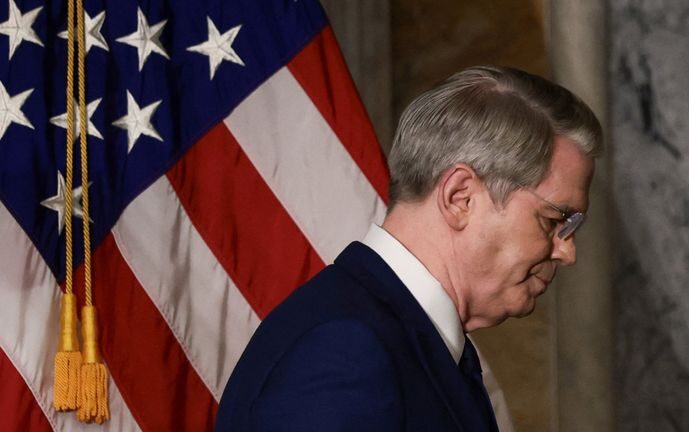
US Treasury Secretary Scott Bessent after his address to reporters, August 24, 2026 (Sky)
EA on Pakistan TV: Last Chance to “Break” Iran? The Trump Camp’s Economic Warfare
UPDATES: US War on Iran, Day 179 — Can Trump Camp Break Iranian Control of Strait of Hormuz?
UPDATE 1732 GMT:
Israeli infantry is advancing in southern Lebanon despite a purported ceasesfire.
The Israelis are carrying out detonations along the riverbank of Zawtar al-Gharbiyeh. They are bombing are residential areas south of the Litani River, and moving into residential areas in the village of Majdal Zoun.
Israeli forces also fired artillery shells at the village of al-Mansouri in the Tyre district, and at forested areas in the villages of Ayta al-Jabal and Beit Yahoun in the Bint Jbeil district. Fires have spread to residential properties in the village of Haddatha, consuming nearby olive groves.
UPDATE 1727 GMT:
A tanker has been struck while transiting “inbound in the Strait of Hormuz”. reports the UK Maritime Trade Operations center.
The attack occurred 12 nautical miles to the north of the port of Khasab in Oman. Authorities are investigating the incident, which did not cause any “casualties or environmental impact”.
UPDATE 1719 GMT:
Senior US military officials have warned Defense Secretary Pete Hegseth that the full-scale war against Iran is unsustainable, sources have told The Washington Post.
The unnamed officials said a continued assault would strain military readiness and compromising American capability to respond to other threats around the world. The warning was conveyed by the chiefs of the Army, Navy, and Air Force, accompanied, accompanied by other top officers in an August 14 document.
The military’s position is that the war has been “too much for too long”.
UPDATE 0715 GMT:
The monitor Tanker Trackers says the seven-day daily average of crude oil exports via the Strait of Hormuz was 3.8 million barrels per day.
During the 25-day period of the US-Iran Memorandum of Understanding in June and July, the daily average was 9.8 million bpd. Before the US-Israel War, it was around 20 million bpd.
UPDATE, AUG 30:
Around 6,000 seafarers and 400 ships are still trapped in the Persian Gulf, six months after the launch of the US-Israel War on Iran.
Iran seized control of the Strait of Hormuz days after the start of the war, preventing the vessels from crossing the waterway.
At least 70 attacks on international shipping have been verified, with 19 seafarers killed.
UPDATE 1349 GMT:
Israel has carried out two airstrikes on the town of al-Mansouri in southern Lebanon.
Another Israeli air raid occurred near the town of Zawtar al-Gharbiyeh.
UPDATE 0712 GMT:
Two Israeli officials say Iran’s move to close the Strait of Hormuz in early March was initiated by Revolutionary Guards naval commander Gen. Alireza Tangsiri.
In the 72 hours after the launch of the US-Israel War on February 28, Iran announced it was closing the Strait and warned it would attack tankers that tried to transit. Behind the scenes, Tangsiri ordered the deployment of naval mines in the international shipping lane.
The Israeli officials did not indicate why they did not anticipate the order.
Tangsiri was killed three weeks later by an Israeli airstrike on Bandar Abbas in southern Iran.
UPDATE 0529 GMT:
US officials tell The Wall Street Journal of their concern over the depletion of US munitions in the War on Iran, citing the US’s ability to deter potential threats from China and Russia.
US inventories in Europe of PAC-3 Patriot air defense interceptors and ATACMS missiles are “beyond critical”, say the officials.
UPDATE, AUG 29:
Hezbollah leader Naim Qassem has again rejected the agreement between Israel and the Lebanese Government for a purported ceasefire.
“We are against the framework agreement and call for its downfall,” Qassem said in a televised address.
Israel has maintained its occupation of part of southern Lebanon, continuing daily attacks, despite the “ceasefire”. It has not withdrawn forces except from two “pilot zones” to be overseen by the Lebanese military.
“The framework agreement is illegitimate, unlawful, humiliating, destructive to Lebanese sovereignty,” Qassem said. “We do not agree to the ‘pilot zones’ or to what comes from them.”
He called for the implementation of a November 2024 ceasefire proposal.
The next round of Israel-Lebanon talks is planned for early September.
UPDATE 0928 GMT:
After a meeting in Tehran with Qatar’s Prime Minister, Iran Foreign Minister Abbas Araghchi has said putting diplomacy back on track is not impossible but it “hinges on US understanding of one simple fact: Pressure doesn’t work.”
Hailing “creative discussions” with the Qatari mediator Sheikh Mohammed bin Abdulrahman Al Thani, Araghchi said the Trump camp should “build trust, speak respectfully, acknowledge our rights, and uphold commitments”.
UPDATE 0617 GMT:
Israeli forces carried out a massive bombing in the town of al-Mansouri in southern Lebanon at dawn.
The Israelis targeted the town of Houla and the Wadi al-Salouqi valley with artillery shelling and machine-gun fire.
UPDATE 0612 GMT:
Only seven monitored commodity vessels crossed the Strait of Hormuz on Thursday, down from 17 on Wednesday and below the 10-day average of 15.
Among the seven vessels that transited were two medium-range tankers, one very large gas carrier, one Ultramax vessel, one intermediate tanker, and two chemical tankers.
Four of the vessels were exiting the Strait, including the two chemical tankers, the medium range and intermediate tanker. The VLGC, Ultramax, and the other medium-range tanker were entering the Strait.
Seventeen commodity vessels transited through the Bab el-Mandeb to the south of the Arabian Peninsula, with six vessels entering and 11 exiting.
UPDATE, AUG 28:
The US Navy has transferred money from its payroll and other sources to cover the cost of the Trump camp’s War on Iran, according to documents and The Guardian’s interviews with Navy officials, contractors and defense analysts.
A Pentagon memorandum warns that there are “shortfalls in payroll” accounts due to the “raiding” to fund combat operations. A Navy official confirmed, “The money for payroll was robbed to pay for overseas contingencies and is being backfilled by money that hasn’t been spent. They are backfilling payroll so we get enough money in our paycheck.”
An official and a navy contractor said non-emergency maintenance on shore-based facilities has been deferred.
The Navy’s budget for 2026 is almost $300 billion. The Trump Administration has asked Congress for emergency funding of $67 billion for the military operations.
In mid-May, Chief of Naval Operations Adm. Daryl Caudle told Congress:
The FY ’26 budget didn’t bake in Epic Fury. I do fear that I’ll have to start making decisions in the July timeframe on how I do force generation. That could make differences between how I do exercises, how I do routine operations in order to make sure that I…have the funds necessary to continue the war effort for Epic Fury.
UPDATE 1552 GMT:
A newlywed woman has been killed and several people wounded by an Israeli airstrike on the town of Arab Salim in southern Lebanon.
UPDATE 1007 GMT:
Iran’s inflation has surged for the 18th consecutive month, with the year-over-year rate reaching 84.4% in August.
Monthly inflation in urban areas is 3.7%. Vegetables and legumes rose 8.7%, dairy and eggs 7.8%, and housing rent 6%.
The 12-month rolling inflation rate rose by 3.7% from July to 65.1%.
UPDATE 0952 GMT:
“Informed sources” say the Strait of Hormuz remains mined, defying the claims of Donald Trump and his inner circle.
The sources says the mine-clearing operation by the US Navy has been hampered by sea currents displacing the explosives.
US Central Command insists international shipping lanes through the Strait pose no threat to vessels, as the Trump camp tries to break Iran’s control.
UPDATE 0823 GMT:
Ten monitored ships crossed the Strait of Hormuz on Wednesday, up from eight on Tuesday but below the 10-day average of around 15.
Two medium-range fuel tankers, a liquefied petroleum gas carrier, a Panamax-sized tanker, and three handymax-sized tankers entered the Strait from the Gulf of Oman. A medium-range fuel tanker, a bitumen tanker and a bulk carrier exited the waterway into the Gulf.
US officials maintain that tankers are crossing the Strait “dark” with their transponders off.
Nineteen commodity vessels passed through Bab el-Mandeb on Wednesday, down from 24 on Tuesday.
Six tankers exited, including a very large crude carrier.
UPDATE 0519 GMT:
The Prime Minister of Qatar, the mediator seeking an end to the US War on Iran, is visiting Tehran.
Qatari officials said Sheikh Mohammed bin Abdulrahman bin Jassim Al Thani hopes to de-escalate tensions and create a platform for dialogue.
The visit follows that of the military head of Pakistan, the other mediator, and the Foreign Minister of Oman, in talks with Iran over the Strait of Hormuz.
Iranian and Omani officials says they have agreed on a framework for a temporary shipping route in the Strait.
The global price of Brent crude has falled to $87.24 a barrel, amid hopes that the talks can reopen the Strait.
UPDATE 0512 GMT:
Israeli warplanes have launched two waves of attacks targeting the strategic Ali al-Taher hill in southern Lebanon.
Concussion missiles caused powerful explosions echoing across the region, with heavy columns of smoke rising.
The warplanes had carried out more overnight strikes on the area between the towns of Eastern Zawtar and Mayfadoun.
The Israeli military also raided the village of Taranja in northern Quneitra Province in southwest Syria. They searched a house before withdrawing.
UPDATE, AUG 27:
A tanker has been hit by an unknown projectile in the Strait of Hormuz, causing a fire that was later extinguished, reports the UK Maritime Trade Operations center.
All crew members are safe and accounted for, and no environmental impact is reported.
UPDATE 1426 GMT:
The Iranian military is threatening foreign journalists.
Brigadier-General Abolfazl Shekarchi, the spokesperson for Iran’s armed forces, said, “Media outlets like BBC, Iran International, and Radio Farda are directly connected to Mossad, the CIA, and enemy intelligence organizations.”
He said individuals employed by the organizations “can even be included in the list of potential military targets because, in our view, these are not media outlets”.
UPDATE 0759 GMT:
US Secretary of State Marco Rubio is telling foreign counterparts in recent days that the Trump camp is not expected to initiate new strikes against Iran “for the time being”, say “a US official and a second source with knowledge of the matter”.
Rubio is emphasizing the Trump plan for economic warfare against Iran announced on Monday.
Rubio did not rule out strikes if Iran attacks first.
Another US official said this is the expected Trump policy until after November’s elections, when a renewed military campaign could be on the table.
UPDATE 0557 GMT:
Israeli forces continued attacks across southern Lebanon despite a purported ceasefire.
An Israeli tank fired shells on the town of al-Mansouri, south of Tyre. Forces carried out explosions on the outskirts of the town of Sarbine in the Bint Jbeil district.
Warplanes carried out nighttime strikes on al-Qantara in the Marjayoun district. Artillery shelling targeted the outskirts of Haddatha at dawn.
UPDATE 0552 GMT:
“US officials with direct knowledge” claim the US Navy has cleared mines from the Strait of Hormuz.
For months US Navy underwater drones systematically scanned the area and identified more than 100 objects suspected of being mines, which private contractors were then brought in to remove or detonate, the officials said.
They asserted that it is now safe for vessels to transit the Strait in both directions under US Air Force protection.
UPDATE 0545 GMT:
At least three Indian oil refiners and a major global energy firm plan to stop using vessels on Iran’s new blacklist, including for ship-to-ship transfers, say “four sources with direct knowledge of the matter”.
The sources cited security concerns after Tehran listed the 45 ships, which it said had broken its rules for crossing the Strait of Hormuz. Iranian officials say they will take action against any vessels transferring loads with them.
The Iranians are trying to disrupt the Omani route along the south of the Strait. The Trump Administration is encouraging tankers, travelling “dark” with transponders turned off, to move oil through the waterway.
The Persian Gulf Strait Authority said the cited vessels could be detained and have their cargoes confiscated, with fines for their owners.
UPDATE, AUG 26:
Five monitored commodity vessels transited the Strait of Hormuz on Tuesday, up from four on Monday but below the 10-day average of 15.
Two tankers carrying liquefied petroleum gas and one tanker carrying bitumen exited the Gulf via the Strait, while two empty product tankers entered the waterway from the Gulf of Oman.
US officials claim ships travelling “dark”, with transponders turned off, are moving 8 to 10 million barrels of oil per day via the waterway.
Before the US-Israel War, around 135 ships and 20 million barrels of oil transited the Strait daily.
Tuesday’s transits through the Bab el-Mandeb into the Red Sea, to the south of the Arabian Peninsula were at 31 commodity vessels versus 29 on Monday, in line with the 10-day average.
UPDATE 0620 GMT:
The US State Department has renewed its offer of up to $10 million and relocation for information on five Iran Revolutionary Guards commanders, including commander-in-chief Ahmed Vahidi.
UPDATE 0611 GMT:
Pakistan Interior Minister Mohsin Naqvi says talks with Iran in Tehran made “significant progress” to resolve the US War.
Naqvi, who accompanied Pakistani military head Gen. Asim Munir in the talks, said they focused on measures to prevent further escalation, reopen the Strait of Hormuz, and speed up the termination of the conflict.
“The Iranian President candidly shared his government’s perspective and we had a very constructive exchange on the issues involved,” Naqvi posted.
Iran President Masoud Pezeshkian said, “The US needs to change tone and approach in its engagement with Iran, because relying on bullying will only complicate the processes.”
Mohsen Rezaei, the Secretary of the Supreme National Security Council, echoed, “The US must change its behavior and take practical steps regarding the implementation of the terms of the Memorandum of Understanding.”
UPDATE 0602 GMT:
Sources say then-Director of National Intelligence Tulsi Gabbard warned Donald Trump, days before the start of the US-Israel War, that the killing of the Supreme Leader would bring in a more hardline regime.
Gabbard, who left her post at the end of June, said the regime would close the Strait of Hormuz and attack US forces and allies in the region. It would be more inclined to pursue nuclear weapons.
Other top officials including Vice President J.D. Vance issued similar warnings, the sources said. However, Trump was convinced by top Pentagon officials that success was likely.
In early April, Trump asked a friend whether he should “bomb the shit” out of Iran, but the friend advised urged him to end the conflict. The Trump Administration agreed to a ceasefire days later.
ORIGINAL ENTRY: Unable to force the surrender of Iran’s regime with military attacks — and unwilling to return to talks to end its 6-month war — the Trump camp has declared economic warfare to break Tehran.
US Treasury Secretary Scott Bessent announced Operation Economic Outcast for an “unprecedented campaign” against Iran “and its enablers” on Monday.
We are launching an economic onslaught against Iran’s financial connections around the globe. Our objective is to sever every economic lifeline that sustains this tyrannical regime until Tehran stands alone.
Bessent said sanctions will target “five of Iran’s most vital lifelines that it exploits in other countries — digital assets, technology, gold, aviation, and shipping”.
The Office of Foreign Asset Control was blacklisting more than 60 entities, individuals, and vessels. “You will see a major financial institution being sanctioned by the end of this week over Iran,” he said.
However, the Treasury Secretary said wider sanctions will not take effect