
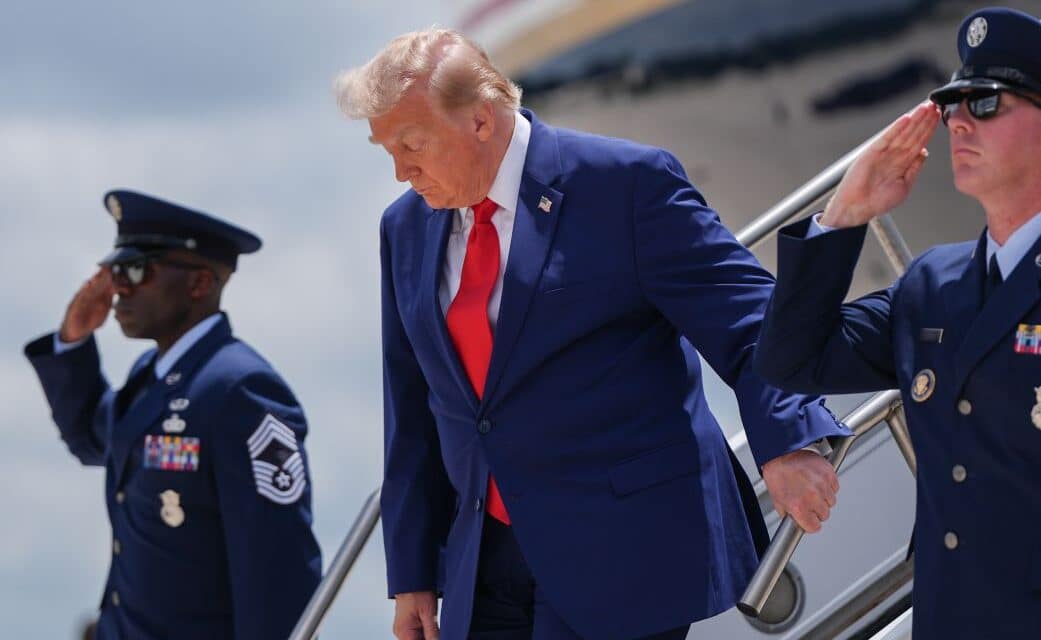
Donald Trump arrives on Air Force One at Dobbins Air Reserve Base, Marietta, Georgia, July 22, 2026 (Julia Demaree Nikhinson/AP)
UPDATES: US War on Iran, Day 150 — The Ceasefire Collapses
UPDATE 1701 GMT:
Iran’s semi-official Mehr news agency. says at least four members of the Revolutionary Guards were killed in the joint Saudi-US attack inside Iraq.
UPDATE 1650 GMT:
A drone has hit a US-owned gas storage tanker at a Mediterranean port in Egypt.
The explosion was “at the LNG terminal during cargo discharge operations”, said port services firm Inchape. “Local authorities responded promptly. The vessels involved have been safely relocated outside the port area.”
Port operations are expected to resume tonight at other berths and terminals.
UPDATE 1046 GMT:
Amnesty International has condemned Iran’s escalation of executions, including of participants in January’s nationwide protests.
At least five protesters were hanged in the past week, including Amir Hossein Safari and Abolfazl Sepahi on Tuesday despite demonstrations outside the prison.
In 2026, authorities have executed at least 26 people convicted in connection with the January protests and another 26 on politically-motivated charges.
At least 60 detainees, including three people arrested as minors, are at risk.
“The Iranian authorities are unleashing a horrifying wave of executions and death sentences to punish and suppress dissent and project an image of strength and absolute control,” summarized Heba Morayef, Amnesty’s regional director for the Middle East and North Africa.
UPDATE 1042 GMT:
After dropping over the past three days amid hopes of an end to US-Iran attacks, the global price of Brent crude oil has risen 4.5% on Wednesday.
Brent stands at $87.59 per barrel.
UPDATE 0836 GMT:
China is in talks with Yemen’s Iran-backed Houthis for its tankers to pass through the southern Red Sea without being attacked, say “six sources with knowledge of the matter”.
The Houthis declared a blockade on Saudi ports last week. However, at least Chinese tankers have since loaded crude from the ports and passed through the Bab el-Mandeb strait.
Chinese officials cleared each vessel individually with the Houthis, with both sides informing Iran.
UPDATE 0731 GMT:
Iraq’s Popular Mobilization Forces say US-Saudi attacks have killed at least 20 of its fighters and wounded 32 others across seven provinces.
The PMF said the casualty toll was preliminary and could rise after field assessments. Buildings, vehicles, and military equipment were damaged.
The attacks hit PMF positions in the Provinces of Baghdad, Wasit, Nineveh, Basra, Kirkuk, Karbala, and Diyala.
UPDATE 0626 GMT:
Thirty-seven commodity vessels passed through the Bab al-Mandeb strait on Tuesday. The daily total was the highest since July 19, when Yemen’s Iran-backed Houthis declared a naval blockade of Saudi Arabia in the Red Sea.
Twenty ships entered Bab al-Mandeb, while 17 exited.
UPDATE 0615 GMT:
Iran has reportedly rejected Oman’s plan to split control of the Strait of Hormuz.
Iran’s Deputy Foreign Minister Kazem Gharibabadi said Tehran will not agree to the next stage of negotiations with the US unless Oman backs Iran’s proposal putting most of the Strait under Iranian control. He said the Omani plan “doesn’t address Iran’s security concerns”.
The inbound shipping lane must be entirely under Iran’s control, while part of the outbound lane may remain under Oman’s control. If they accept this proposal, we will move on to the next stage.
An Iranian official declared that the US and Saudi Arabia are trying to pressure Oman to advance their “unrealistic plans” over the Strait.
A US official responded, “The Strait is an international waterway, and Iran cannot control or restrict transit through it….[Iran] is overreaching with unreasonable demands.”
UPDATE, JULY 29:
The US military says Iran launched missile barrages at American forces in the Middle East, breaking a four-day pause in attacks.
The Iranians reportedly targeted a US base in Jordan. US Central Command said all missiles were intercepted. The Jordanian army echoed, “Air defenses this morning dealt with five missiles coming from Iran targeting the Kingdom’s territory.”
CENTCOM warned that further attacks on American troops or Saudi Arabia’s energy infrastructure will trigger retaliatory strikes.
Iraq’s Iran-backed Popular Mobilization Forces said the US and Saudi attacked targets in Iraq, killing several people and wounding others.
The attacks followed accusations that Iran-supported Iraqi militias fired drones on Saudi oil facilities on Monday. The Islamic Resistance in Iraq, an umbrella group for the militias, called the Saudi claims “fabrications”. They implied that the attacks were carried out by Yemen’s Houthis, also backed by Tehran.
Iraqi Prime Minister Ali al-Zaidi ordered security agencies to investigate the attacks. He said Baghdad is committed to “preventing Iraqi territory from being used as a route or launching point for any attack targeting brotherly or friendly countries”.
Iran’s Revolutionary Guards claimed they halted three oil tankers crossing the Strait of Hormuz with Tehran’s permission.
UPDATE 1913 GMT:
Israeli Prime Minister Benjamin Netanyahu has spoken of an “excellent” meeting with Donald Trump in the White House.
The meeting “reflected a complete partnership, bilateral support, and an understanding of the shared goal of ensuring that Iran does not acquire a nuclear weapon”, Netanyahu said. “There was an opportunity to exchange views and make important arrangements for the security and future of Israel.”
The White House described the gathering as “positive and productive”.
UPDATE 1825 GMT:
The US military says it has redirected 18 commercial vessels, disabled two, and boarded two as part of its renewed blockade against Iran.
UPDATE 1811 GMT:
A satellite image has shown smoke billowing from Saudi Arabia’s Jazan oil refinery after Saturday’s attack by Yemen’s Iran-backed Houthis.
Houthi military spokesman Yahya Saree said the group successfully struck Aramco sites in both Jazan and Yanbu.
The Jazan refinery, which processes 400,000 barrels of oil a day, was damaged badly enough that Aramco shut it down on July 27, according to the consultancy IR.
UPDATE 0938 GMT:
Iran’s government says 12 bridges and two tunnels were destroyed in the 12 days of US attacks that ended last Thursday.
Spokesperson Fatemeh Mohajerani said private property suffered “very extensive” damage, including “fishing boats, which were the only source of livelihood and employment for fishermen in the region”.
Bushehr Airport in southwest Iran is inoperable and “requires complete reconstruction from the ground up”. The Bushehr Meteorological Centre “which is completely of a civilian nature, has almost nothing left of it”.
A lengthy article in New Lines magazine by Fateme Karimkhan details the effect of the damage to ports, fishing communities, and infrastructure. Iman, a 47-year-old fisher and vendor from Bandar Abbas, says:
Fortunately, we weren’t at the fish market when it was attacked. But when they struck the pier, the fishing boats belonging to these poor fishers suffered enormous damage. Many boats were destroyed and can’t be repaired. Many others have also been affected because the pier itself has been destroyed.
But the problem isn’t just these recent attacks on the fishers’ docks. The problem is that when there’s a war, the sea becomes unsafe, and the number of days when you can go out to fish drops dramatically.
Mohajerani also said Iran had lost 230 million cubic meters of gas production capacity.
UPDATE 0740 GMT:
Iran’s semi-official news agency Tasnim has posted a video encouraging the assassination of Melania Trump.
The video shows images of Trump traveling in her motorcade and visiting locations around New York City. It names designer stores where she shops and gives her — publicly available — Secret Service codename “Muse”.
The propaganda clip declares that she is “suitable for operations by global freedom fighters”, suggesting a nerve agent to poison clothing she might purchase.
The video also warns the Trumps’ 20-year-old son, “This is just the beginning. Barron Trump, wait for us.”
Last week, billboards appeared around Tehran reading, “Blood for blood” with the deaths of Donald Trump and his other children as well as Melania and Barron.
On February 28, the first day of their war on Iran, the US and Israel assassinated Supreme Leader Ali Khamenei, his wife, his daughter-in-law, and other family members. The Supreme Leader’s son and successor Mojtaba Khamenei was seriously injured and has not been seen in public since.
UPDATE 0721 GMT:
Iranian Foreign Minister Abbas Araghchi has held separate phone calls about the Strait of Hormuz with his Omani and Saudi counterparts Badr Al-Busaidi and Faisal bin Farhan.
Iranian State media said the conversations “stressed the need to strengthen cooperation and advance joint diplomatic efforts to establish stability in the region and eliminate the insecurity imposed on the Strait of Hormuz due to the aggressive actions of the United States”.
UPDATE 0543 GMT:
Iran has executed two more participants in January’s nationwide protests.
Abolfazl Sepahi and Amir-Hossein Safari were accused of killing police officers in Isfahan on January 18.
Protesters gathered through the night but could not prevent the hangings because of a heavy security presence. They stayed after dawn to mourn the two men.
At least 24 detainees associated with the demonstrations have been hanged during the US-Israel War. Human rights groups documented the killed of more than 7,000 people during the protests and are investigating another 12,000.
UPDATE 0540 GMT:
The price of Brent crude oil has fallen another 1% this morning amid the pause in the US war on Iran.
Brent is at $87.32 per barrel, its lowest mark since July 20.
UPDATE, JULY 28:
Israeli Prime Minister Benjamin Netanyahu will meet Donald Trump in Washington at 11 a.m.
Trump will see Ukraine President Volodymyr Zelensky at the White House 90 minutes earlier.
No press appearance has been arranged so far for either meeting.
Trump and Netanyahu will attend a memorial service at the National Cathedral for Republican Sen. Lindsey Graham, a staunch supporter of Israel, at 2 p.m.
Their last meeting was on February 11 in the White House, as Israel tried to persuade the Trump camp to break off talks with Iran. The US-Israel War, beginning with the assassination of Iran’s Supreme Leader and dozens of officials and commanders, followed 17 days later.
Israeli officials say Netanyahu, seeking a return to war, will present Trump with fresh intelligence on Iran’s military and nuclear recovery efforts.
UPDATE 1714 GMT:
Yemen’s Iran-backed Houthis say they have fired drones on a number of “sensitive” crude oil supplies and transport sites linking eastern Saudi Arabia to the Red Sea city of Yanbu in the west of the kingdom.
Houthi spokesperson Yahya Saree said the attacks were in response to Saudi drone incursions into Yemeni airspace.
The Saudi Defense Ministry said “a number of drones”, launched from Iraqi territory, were intercepted. It affirmed the kingdom’s “legitimate right to defend itself and its capabilities and its retention of the right to respond at the appropriate time and place”.
UPDATE 1706 GMT:
The UN High Commissioner for Human Rights, Volker Türk, notes that Israeli forces have razed entire villages south of the Litani River in southern Lebanon.
Speaking to the media in Beirut, Türk said the area is no longer habitable. The widespread Israeli violations of international humanitarian law may amount to “war crimes”.
He said of the residents:
They were displaced in ’24, were displaced again and again in ’26. So there is a deep sense of exhaustion and despair…that I felt from people [and] anxiety about what the future brings.
The High Commissioner added, after after visiting a destroyed residential building in a densely populated area in Beirut:
The principles of distinction, precaution and proportionality were absolutely not respected in this case, and that really needs to be brought to light.
We need to tell the truth about this, and we need to bring the human side of conflict into the spotlight, which also means, yes, there are issues around accountability because people should not get away with the committing of crimes.
UPDATE 1702 GMT:
US Central Command says forces have redirected 17 commercial vessels transiting the Strait of Hormuz, disabled two, and boarded two in the blockade of Iranian ports.
UPDATE 1052 GMT:
Iran’s Foreign Ministry spokesperson Esmaeil Baghaei says, “At present, we are not engaged in any negotiations with the United States.” He denied reports that Tehran had requested talks.
UPDATE 0907 GMT:
Only 11 commodity vessels passed through the Bab el-Mandeb strait on Sunday, the lowest level in months, after Yemen’s Iran-backed Houthis threatened attacks on ships using Saudi Arabian ports.
Seven vessels were oil tankers, three of them entering the Red Sea. Two of the tankers are very large crude carriers heading to the port of Yanbu to load Saudi crude while the third is a Russian-linked ship.
The four vessels that exited the Red Sea on Sunday included the Hong Kong-flagged VLCC New Explorer, carrying 2 million barrels of Saudi and Emirati crude ,for eastern China’s Ningbo port; a tanker carrying 1 million barrels of Russian crude for China; and a tanker with about 750,000 barrels of Saudi crude onboard for Pakistan.
The Hong Kong-flagged VLCC New Pearl, carrying 2 million barrels of Saudi crude, is exiting the Red Sea for eastern China’s Zhoushan port. It is the fourth Chinese supertanker to leave since the Houthis declared their naval blockade.
UPDATE 0847 GMT:
The Pentagon has admitted that 207 US personnel were wounded, in addition to four killed, since July 7; however, they have done so on a separate webpage labeled generically as “overseas operations casualties”.
Last week the Department of Defense removed the four slain soldiers — three killed by Iran’s retaliatory attacks on a base i Jordan and the other by the detonation of an Iranian drone in Iraq — from its website. The Pentagon faced criticism, including from families of those killed.
Sean Parnell, the chief Pentagon spokesman, insisted that the number of US troops injured since July 7 was fewer than 100.
The official number of US casualties during the start of the war on Iran on February 28 is 18 killed and 624 wounded.
UPDATE 0605 GMT:
Iranian State media claims six ships have been prevented from using an “illegal and unsafe” route to cross the south of the Strait of Hormuz.
The ships reportedly had turned off their navigation and positioning systems. One suffered an accident, and the others returned to the Persian Gulf under “decisive Iranian management”.
UPDATE 0556 GMT:
The global price of Brent crude oil has fallen almost 5% amid the Trump camp’s retreat from wider strikes on Iran.
Brent is at $92 per barrel this morning.
ORIGINAL ENTRY: The Trump camp has retreated in its War on Iran, pulling back from wider attacks after almost two weeks of assaults and the apparent demise of June’s Memorandum of Understanding.
The Americans have not struck since Thursday night, following 12 consecutive nights targeting military sites and infrastructure across Iran and Iranian islands.
US officials said the main reason for the pullback is concerns over depleted air defense interceptors, needed to protect Gulf States and Israel against Iranian retaliation.
In late April, officials and internal documents indicated that the Pentagon had expended more than 1,200 Patriot interceptor missiles, at more than $4 million apiece, leaving inventories worrisomely low. The situation has worsened since then, military officials said last week.
As Donald Trump and senior advisors convened on Friday, Joint Chiefs of Staff chair Gen. Dan Caine advised that the military can launch major combat operations but interceptors are exhausted.
Before the meeting, the commander of US Central Command, Adm. Brad Cooper, recommended the halt of US attacks until the Trump Administration was prepared to escalate. He said current operations have largely reached the limits of their effectiveness.
A “source familiar with the matter” said Vice President J.D. Vance, who has opposed the US war from its outset, also raised concerns.
A senior US official also cited doubts that the intensified campaign will pressure Iran into talks. They noted recent strikes have kept Iran united and focused on a foreign threat.
Sources said many Trump advisors, including his son-in-law Jared Kushner favor the continuation of negotiations and economic pressure on Iran over a longer period of time.
Claims are circulating that Kushner and real estate developer Steve Witkoff are in contact with the Iranians, both directly and through mediators. Both sides have reached an informal understanding of “quiet for quiet”.
Iran’s military confirmed on Sunday that it has halted retaliatory attacks. Meanwhile, its officials met Omani colleagues in Muscat to discover a possible arrangement to manage the Strait of Hormuz.
The latest cycle of violence was spurred by the Trump camp’s attempt to pull out of the Memorandum of Understanding’s provision for Iranian management of the waterway.
Iran fired on vessels trying to cross the Strait without Tehran’s permission, using a route along the Omani coast. The US responded with strikes, escalating them to include bridges and railway infrastructure as well as military targets.
On Sunday night, trying to cover up his retreat, Trump blustered on social media with AI-generated images. They included US jets blowing up Kharg Island, the hub in the northern Persian Gulf for more than 90% of Iran’s maritime oil exports, and his raising of the American flag on an Iranian ship.