
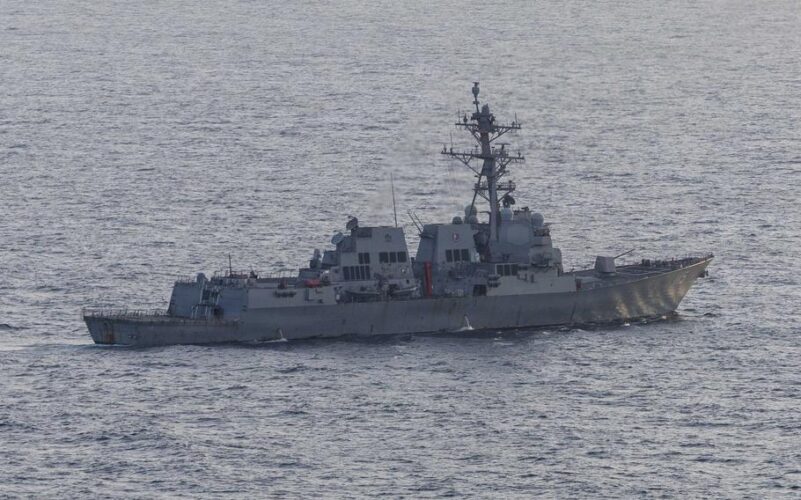
The destroyer USS Rafael Peralta on patrol in the Arabian Sea, April 2026
EA on Pakistan TV: “Limbo” in Talks to End US War on Iran
EA on FirstPost and France 24: US-Iran Talks — J.D. Vance “Tries to Put Lipstick on a Pig”
UPDATES: US-Israel Wars, Day 120 — Iran Seizes Advantage After Switzerland Talks
UPDATE 1402 GMT:
Defying the Trump camp, Iran and Oman are proceeding with plans to collect payments from ships transiting the Strait of Hormuz, according to “an Iranian official and four diplomats with knowledge of the matter“.
Oman recently delivered a formal proposal to the US and other Western countries for shipping companies to pay service fees. A “person familiar with the US position” confirmed that American negotiators had received the Omani proposal and said they intend to discuss concerns.
The proposal is partly modeled on arrangements in the Straits of Malacca and Singapore, an Asian waterway where a private foundation collects voluntary contributions for safe navigation.
A “regional diplomat” said payment would be voluntary, but the Iranian official said it is obligatory.
UPDATE 1240 GMT:
Donald Trump’s envoys, son-in-law Jared Kushner and real estate developer Steve Witkoff, are in Qatar capital Doha but not will not meet Iranian representatives.
Iran’s Foreign Ministry said its delegation will hold talks with Qatari officials tomorrow about Iranian frozen assets.
UPDATE 0606 GMT:
Transit through the Strait of Hormuz has declined since last Wednesday, amid security concerns and uncertainty over the management of the waterway.
Last Wednesday, 70 vessels crossed. The number dropped to 54 on Thursday, 48 on Friday, 38 on Saturday, and 22 on Sunday.
Before the US-Israel War, around 130 to 140 ships passed through the waterway daily.
UPDATE, JUNE 30:
Omani Foreign Minister Badr bin Hamad Albusaidi says Oman “does not support imposing transit fees” on ships crossing the Strait of Hormuz.
However, in an interview with French radio, the Minister said charges for “maritime, environmental and navigational services…can be discussed voluntarily with the beneficiary countries and companies”. He said “some services may include enhancing navigational safety, protecting waters from pollution, and increasing preparedness to deal with accidents or emergencies.”
Albusaidi cited” existing models, such as the Straits of Malacca and Singapore”.
Iran is seeking a management system with Oman for the Strait which will include the collections of fees from ships. The US is seeking a transit zone across the Strait along the Omani coast, even before completion of the Memorandum of Understanding with the Iran, to move hundreds of ships out of the waterway.
Earlier, Iran’s Deputy Foreign Minister Kazem Gharibabadi criticised comments by French President Emmanuel Macron, who said Paris is working with Oman on demining the Strait of Hormuz.
Gharibabadi said demining is solely Iran’s responsibility and “we fundamentally do not permit such a thing”.
Iranian Foreign Minister Abbas Araghchi and French counterpart Jean-Noël Barrot subsequently spoke by phone about the implementation of the Memorandum of Understanding.
Omani Foreign Minister Albusaidi supported Tehran: “Responsibility for ensuring the strait and internationally recognised shipping lanes are free of any mine-related hazards primarily rests with Iran.”
UPDATE 1755 GMT:
Iran has repeated that it is not meeting Trump representatives, including real estate developer Steve Witkoff and Donald Trump’s son-in-law Jared Kushner, in Qatar on Tuesday.
Foreign Ministry spokesman Esmaeil Baghaei said no meetings have been scheduled with the US in coming days. The Iranian delegation will visit Doha but will focus on “implementing the provisions of the memorandum of understanding”.
He said the visit of the American representatives has no connection with the visit of the Iranian delegation.
UPDATE 1700 GMT:
Israeli Defense Minister Israel Katz has pointed to a long-term occupation of southern Lebanon.
Katz claimed Israel has “no territorial ambitions in Lebanon” but said the Israel Defense Force will not withdraw “a millimeter” until Hezbollah is disarmed.
Katz told reporters that the Israeli military is unlikely to withdraw from areas beyond the two small “pilot zones” where the Lebanese army can take over.
“People should not hold their breath wondering where the next place will be from which Israel will withdraw in Lebanon,” he summarized.
He maintained this was accepted by the Trump Administration and is anchored in the military annex to the framework agreement signed between Israel and Lebanon last week. He said that when he met US Central Command head Adm. Brad Cooper, they agreed that “the IDF will not withdraw from the three security zones — in Lebanon, Syria, and Gaza”.
Katz added that the Lebanese army will not “suddenly become lions charging at Hezbollah”, so the IDF’s presence in Lebanon will be “long-term”.
The Defense Minister said it was “clear that the Shiite villages along the line of contact had to disappear”. In the western and central sectors of southern Lebanon, “there is almost 100% destruction in the villages along the line of contact”, while in the eastern sector, “73% of the villages are destroyed”.
He boasted that around 600,000 “Shiites from the villages in southern Lebanon” have fled, and another 700,000 have been displaced from Beirut’s southern suburb of Dahiyeh.
In contrast, Lebanon President Joseph Aoun said, after a meeting with Adm. Cooper, that he emphasized “the Lebanese state’s determination to extend its authority through its armed forces all the way to the international southern border”.
UPDATE 1103 GMT:
Iranian Deputy Foreign Minister Kazem Gharibabadi said, countering US officials, that no technical talks between Iran and the US are planned for this week.
He said consultations with Qatar continue, but the American claims of talks in Doha are not confirmed.
The first round of technical talks will be held once conditions were in place and after agreement on the date and venue, Gharibabadi declared.
UPDATE 0927 GMT:
Iranian President Masoud Pezeshkian says that, with the lifting of US sanctions in the Memorandum of Understanding, $6 billion of Iran’s $12 billion of frozen assets in Qatar will be released.
UPDATE, JUNE 29:
A US official said Iran and the US have agreed to halt attacks, and will meet again on Tuesday in Qatar.
US officials and a “source with knowledge of the details” said the talks were originally planned for Switzerland, but attacks in the Strait of Hormuz and on the southern coast of Iran moved them to Doha. The topic has been changed to the situation in the Strait.
“We decided to stop all the kinetic activity,” a US official said.
Iranian officials said technical talks were cancelled on Sunday because of US strikes, which followed Iran’s drone attacks on ships.
Mehdi Fazaeili of the Supreme Leader’s office added that Iran is verifying if some of its assets held abroad have been released: “One of the reasons is checking if we have access to the unfrozen funds, if there is no access then this condition has not been fulfilled.”
Another US official maintained that ”technical talks are slated to continue on all areas” and not just the Strait: “Both sides will stand down for now and vessels can move freely.”
UPDATE 1102 GMT:
Israel says one of its soldiers was killed overnight and another lightly wounded in a clash with Hezbollah in southern Lebanon.
The slain soldier was named as Capt. David Hazutt, 21, a platoon commander in the Golani Brigade./p>
UPDATE 0609 GMT:
Iran’s Revolutionary Guards say they fired drones and ballistic missiles early Saturday on the US 5th Fleet at Port Salman in Bahrain’s capital Manama.
The Guards’ Navy said US attack on the port of Sirik on the southern Iranian coast “does not solve the mystery of our dominance over the Strait [of Hormuz], but our firing at the violators reminds the rest of the vessels of the clear path of passage”.
The Navy declared, “The American bases in the region are a separate matter. They will experience hell in these days.”
The Bahraini military said it “intercepted and destroyed a number of projectiles used in these treacherous Iranian attacks”. The Kuwaiti Foreign Ministry expressed “its condemnation and denunciation of, in the strongest terms, the recurrence of Iran’s heinous aggression against the State of Kuwait”.
UPDATE 0603 GMT:
Hezbollah leader Naim Qassem has rejected a US-brokered framework agreement between Lebanon and Israel.
Under the agreement, announced Thursday, Israel is carrying out a minor withdrawal from its occupation of southern Lebanon. Israeli troops are leaves two “pilot zones”, north and south of the Litani River, to be replaced by Lebanese forces.
Qassem said the agreement is “humiliating” and a surrender of sovereignty.
UPDATE 0555 GMT:
Iran’s Foreign Ministry has said of American strikes late Saturday, “These brutal attacks…show that the US does not place the slightest value and credibility on its commitments, and breaking promises is part of its nature.”
UPDATE 2153 GMT:
The US has launched more attacks on Iranian sites.
Central Command said it is responding to an Iranian drone attack on a Panama-flagged vessel near the Strait of Hormuz with more than two-million barrels of crude oil.”
“US military aircraft targeted Iranian military surveillance infrastructure, communication systems, air defense sites, drone storage facilities, and minelayer capabilities,” CENTCOM said.
UPDATE 1106 GMT:
A tanker has been struck by an unidentified projectile in the Strait of Hormuz.
The vessel sustained damage to its bridge, but all crew were reported safe and no environmental damage has been reported.
UPDATE 1054 GMT:
The Bahraini Foreign Ministry says Iran has fired several drones at the country.
The Ministry expressed Bahrain’s “strongest condemnation of the targeting of its territory at dawn today by several Iranian drones, in flagrant violation of its sovereignty”, saying Iran’s attacks were “sabotaging peace efforts.”
ORIGINAL ENTRY: The US has renewed attacks on Iran following a drone strike on a cargo ship in the Strait of Hormuz.
The Americans targeted missile and drone storage locations and coastal radar sites in the first strikes since the declaration of a Memorandum of Understanding last week.
Iran did not claim responsibility for the attack on the M/V Ever Lovely, but US Central Command declared a “powerful response” while saying it will continue to enforce a tenuous ceasefire.
“The US military remains present and vigilant to ensure all aspects of the agreement with Iran are adhered to, obeyed, and in full force and effect,” CENTCOM proclaimed.
US Vice President J.D. Vance asserted, “Iran signed a ceasefire agreement. We have honored it. If they have disagreements about how the MOU is being applied, they can pick up the phone. But violence will be met with violence.”
The Iranian media reported strikes on the port of Sirik on the southern coast. Without acknowledging the attack on the M/V Ever Lovely, they said several warning shots had been fired from Sirik towards vessels that violated Strait of Hormuz regulations around five hours earlier. Two warning missiles were also launched from the nearby Karpan area.
The Revolutionary Guards claimed that after the American strikes, its navy “struck the locations where the terrorist US military is stationed in the region”. It warned, “The United States, by provoking various fronts, sought to violate this commitment, and the necessary response was given and will continue to be given. If the aggression is repeated, our response will be broader than this.”
The International Maritime Organization pauses efforts to evacuate hundreds of ships from the Persian Gulf. By Friday afternoon, 29 commodity vessels had crossed the Strait by Friday afternoon, following 57 on Wednesday and 42 on Thursday.
More than half used a route near the Omani coast, as the Revolutionary Guards warned, “The only authorized transit routes through the Strait of Hormuz are those designated by the Islamic Republic of Iran.”
Iran’s Persian Gulf Strait Authority added, “Any passage through routes outside the framework designated by PGSA will not be covered by safe passage guarantees and will not be entitled to insurance coverage or related liabilities.”
A Singapore-flagged container ship reported that it had been struck while using the passageway on Thursday.
The International Maritime Organization said 2,500 sailors were evacuated from the Strait of Hormuz during the 3 1/2 days it was open this week.
The IMO estimated 11,000 sailors had been stranded, while the International Transport Workers’ Federation said that the number was closer to 20,000.