
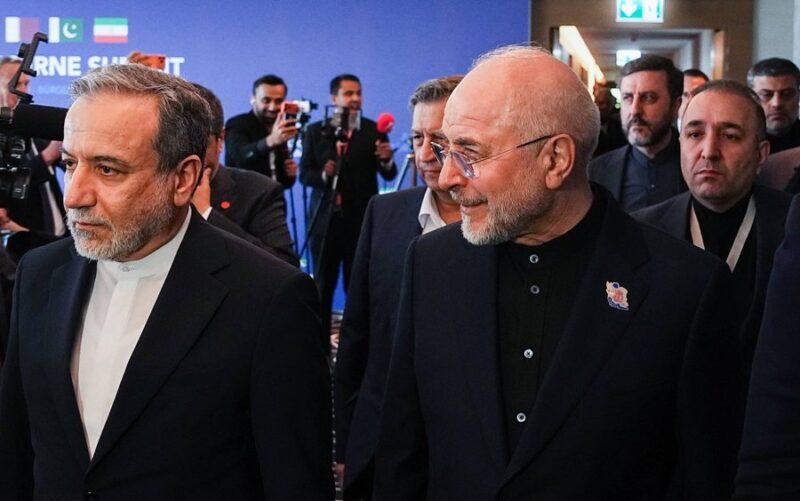
Iranian Foreign Minister Abbas Araghchi and Parliament Speaker Mohammad Bagher Ghalibaf arrive for talks with Trump officials in Switzerland, June 21, 2026
EA on FirstPost and France 24: US-Iran Talks — J.D. Vance “Tries to Put Lipstick on a Pig”
US-Israel Wars, Day 115 — Israel Attacks Break Brief Ceasefire With Hezbollah
UPDATE 2100 GMT:
US Central Command says it has conducted strikes against Iran following Tehran’s drone attack on a commercial vessel in the Strait of Hormuz.
CENTCOM said warplanes hit missile and drone storage locations and coastal radar sites.
Iran has not claimed responsibility for the attack on the M/V Ever Lovely.
UPDATE 1913 GMT:
Israeli and Lebanese representatives have signed a US-brokered agreement confirming Israel’s occupation of parts of southern Lebanon.
After four days of talks in Washington, the two sides held a signing ceremony for a minor Israeli withdrawal near the occupation zone around 10 km (6.2 miles) deep inside Lebanon. The occupied area is about 6% of Lebanese territory.
US Secretary of State Marco Rubio said the agreement was “the beginning of the beginning….This first step sometimes is the hardest one, but it’s an important one, and the one we’ve taken together.”
He gave no details, but an Israeli official said troops will only pull back from two areas beyond the zone of occupation established in April.
Israeli Prime Minister Benjamin Netanyahu said, “We will maintain [the buffer zone] until Hezbollah disarms and as long as there is a threat to the State of Israel.”
UPDATE 1713 GMT:
At least 42 commodity vessels crossed the Strait of Hormuz on Thursday.
The vessels included tankers carrying oil, gas, and dry bulk such as fertilizers. Ten entered the Gulf and 32 exited. Half used a southern passageway hugging the coast of Oman.
Another 29 commodity vessels crossed the Strait by Friday afternoon, 10 coming into the Gulf and 19 leaving. Seventeen used the Omani route, despite a Singapore-flagged container ship reporting that it had been struck while using the passageway on Thursday.
On Wednesday, 57 vessels crossed the Strait, the highest daily number since the US-Israel War was launched on February 28.
Iran’s Revolutionary Guards said Oman and the International Maritime Organization (IMO) announced the new corridor without consulting Tehran, and warned vessels against using it.
“The only authorized transit routes through the Strait of Hormuz are those designated by the Islamic Republic of Iran,” it declared.
UPDATE 1423 GMT:
The Israel Defense Forces claim they killed seven Hezbollah members who transferred weapons near soldiers in southern Lebanon.
The IDF said they struck the alleged members at a “combat and observation post” near the so-called “security zone” in the al-Manzala area.
UPDATE 0452 GMT:
Saudi Aramco has resumed oil loading at its Ras Tanura terminal after a suspension of almost four months.
Two very large crude carriers were seen loading crude at the Gulf terminal, and another is waiting nearby.
UPDATE, JUNE 26:
American officials says the US military posture in the Middle East is being reassessed after bases were far more damaged by Iranian retaliatory attacks than publicly acknowledged.
Satellite imagery revealed extensive damage at a naval base of the US 5th Fleet in Bahrain.
The officials said the US may refurbish the base in Bahrain while reducing its military footprint in Kuwait and Saudi Arabia, moving bases and operations to the west.
One official said a possible location is Israel.
UPDATE 1925 GMT:
At least three people have been slain by an Israeli strike on the outskirts of Nabatieh in southern Lebanon.
The Israeli military claimed that it killed five Hezbollah members today.
UPDATE 1918 GMT:
The International Maritime Organization has suspended the evacuation plan for vessels stranded in the Strait of Hormuz.
The evacuation was launched earlier this week under Omani supervision.
The UK Maritime Trade Operations reported earlier on Thursday that a Singapore-flagged vessel was struck in the Strait near Oman’s coastal waterways.
IMO Secretary Arsenio Dominguez said the struck vessel “did not transit under IMO’s evacuation framework”.
He said “to reconfirm that the necessary safety guarantees continue to be in place for the ships on our evacuation list and all those in the region”.
Iran’s Persian Gulf Strait Authority said:
Any passage through routes outside the framework designated by PGSA will not be covered by safe passage guarantees and will not be entitled to insurance coverage or related liabilities….
The consequences arising from passage through unauthorized routes shall be the responsibility of the owner, operator, and vessel commander.
UPDATE 1909 GMT:
US Vice President J.D. Vance says a US-Iran deconfliction channel will include representatives from Iran’s Revolutionary Guards and the US Central Command.
Vance said the body will convene in Qatar.
“One of the things we wanted to come out with [was a] channel on the Iranian side, which we did,” Vance said in an interview on Monday, published today.
“They were like, ‘OK, fine, we’ll send somebody from the IRGC to go hang out in Doha with somebody from CENTCOM,’ and that’s how we’re going to settle a lot of these disputes,” he asserted.
The US has designated the Revolutionary Guards as a “terrorist organization”.
UPDATE 1416 GMT:
In a phone call with Iranian counterpart Abbas Araghchi, Italian Foreign Minister Antonio Tajani has assured
Italy has never taken part in any military initiative and has never authorized the use of bases for war actions against Iran, in the strictest respect of the treaties with the United States.
On Wednesday, NATO Secretary General Mark Rutte said the US had flown hundreds of missions from European bases, including in Italy.
Responding to Rutte, Italian Defence Minister Guido Crosetto said the airbases were used for exclusively technical and logistical activities. Prime Minister Giorgia Meloni later echoed the remark.
In late March, Italy publicly restricted the use of the Naval Air Station Sigonella in Sicily for US military operations, rejecting requests by American bombers and transport aircraft to use the base.
UPDATE 1412 GMT:
Iran Parliament Speaker Mohammad Bagher Ghalibaf says US claims, pushed by Vice President J.D. Vance, that unfrozen Iranian assets will be used to buy American agricultural products are false.
America falsely claims our unfrozen assets will buy their agriculture. Interesting.
The only crop we’re harvesting is what you planted: decades of mistrust. It’s organic, abundant, and homegrown. But apparently the US only exports GMO soybeans, broken promises and trash talks.
UPDATE 1405 GMT:
At least two people have been killed by an Israeli drone strike on a car in southern Lebanon.
Lebanon’s Health Ministry says Israeli attacks have killed 4,230 people and wounded 12,179 between March 2 and June 25.
The Israeli military also burned down several houses in the village of Ain Arab after warnings since yesterday for residents to evacuate.
Villagers had returned on Tuesday after the Lebanese army reopened the road, which had been closed for weeks, linking Ain Arab and the town of al-Mari.
UPDATE 1001 GMT:
Israeli security and military officials denied a report that the Israel Defense Forces have withdrawn from parts of southern Lebanon.
A US State Department official claimed the Israelis were pulling back, but a “Lebanese military source” said Israel’s forces remain deployed in all the areas they recently occupied.
UPDATE 0559 GMT:
Bowing to pressure from the Trump Administration, the US Senate has U-turned and blocked a resolution requiring Congressional oversight of American military operations against Iran.
The Senate blocked the measure 50-47 late Wednesday, a day after adopting it 50-48 on the 10th attempt.
The House adopted the concurrent resolution three weeks ago in its 8th vote on the proposal.
UPDATE 0554 GMT:
The price of Brent crude oil has fallen to $72.35 per barrel, below its level on February 27 on the eve of the US-Israel Wars on Iran and Lebanon.
Brent soared as high as $119 per barrel in March.
UPDATE, JUNE 25:
Both Israeli and Lebanese officials said their talks on implementation of a ceasefire stalled in Washington on Wednesday.
US Secretary of State Marco Rubio told reporters that he is proposing “pilot zones — specific, defined areas where the Lebanese Armed Forces can go in, take control, and secure that territory, and then move on to the next pilot zone”.
The more of that area that the Lebanese armed forces is able to secure, the less of it is in Hezbollah’s control, the less Israel will be in Lebanon. But that’s the process we’re working on right now with these talks.
But the Lebanese Government is seeking a more expansive Israeli withdrawal from the south of the country. Facing an election this autumn and committed to an occupation, the Netanyahu Government is rejecting the maps.
The Israelis are also taking a tougher line because of their anger at the talks to end the US war on Iran.
UPDATE 1420 GMT:
At least two people have been killed by an Israeli drone attack near Kfar Remman in the Nabatieh area in southern Lebanon.
UPDATE 1110 GMT:
Defense Minister Israel Katz has emphasized that Israel will establish its occupation of southern Lebanon, displacing 100,000s of people, “even if there is an American demand”.
“200,000 residents will not return,” Katz said. “We are not withdrawing.”
UPDATE 1059 GMT:
Inspections by the International Atomic Energy Agency of Iran’s nuclear sites and materials will “solely be examined and resolved within the framework of a final agreement” with the US, says Iranian Deputy Foreign Minister Kazem Gharibabadi.
He said the inspections are dependent on “the other party’s practical action in terminating all sanctions”.
IAEA head Rafael Grossi said earlier, “Whether this happens today, after tomorrow or in one week or in 10 days, it’s important but not essential. This is going to happen.”
Gharibabadi said that during the negotiations with the Trump camp in Switzerland on Sunday, no Iranian officials met with Grossi “despite his request”.
UPDATE 0834 GMT:
At a conference in Azerbaijan, Iran Parliament Speaker Mohammad Bagher Ghalibaf has gloated:
The Islamabad [Memorandum of] Understanding was not the result of pressure and coercion, but rather the result of the resistance and authority of the brave Iranian nation.
That is why [it] became a declaration of America’s defeat.
UPDATE, JUNE 24:
The US Senate has approved a war powers resolution requiring Congressional involvement in any American military operations in Iran.
At the 10th attempt, the Senate adopted the concurrent resolution by a 50-48 vote. Three weeks ago, the House passed the measure on its eighth attempt.
The resolution does not have the full force of law but demonstrates growing sentiment amongst legislators against the Trump Administration’s conduct of the war.
Four Republicans — Republicans Lisa Murkowski of Alaska, Susan Collins of Maine, Rand Paul of Kentucky, and Bill Cassidy of Louisiana — joined all but one in supporting the resolution.
UPDATE 1247 GMT:
Iran and Oman have agreed on a joint committee to reach an agreement on “administration of navigation in the Strait of Hormuz”, including fees for associated costs and services
The two states will hold talks with coastal countries and other concerned parties.
Earlier, Iranian Parliament Speaker Mohammad Bagher Ghalibaf has spoken about the formation of the committee.
Before the US-Israel War, the Strait was open without any charge under the UN Convention on the Law of the Sea. Iran signed the Convention in 1982 but never ratified it.
UPDATE 0942 GMT:
Two people have been killed and one injured by Israeli fire on the town of Nabatieh al-Fawqa in southern Lebanon.
The victims were hit by machine gun fire near a bulldozer working to clear a road in the area.
UPDATE 0528 GMT:
Iran Parliament Speaker Mohammad Bagher Ghalibaf says $12 billion of assets will be unfrozen in two tranches after talks with the US.
Ghalibaf said US sanctions remain until a final deal is reached. He noted that waivers have been secured from Washington until August 21.
Central Bank Governor Abdolnaser Hemmati has denied the claims of US Vice President J.D. Vance and Donald Trump that the unfrozen assets will be used to buy American produce.
Hemmati said Iran has “no obligation to buy” agricultural products from the US. The first $6 billion can be used to buy “basic goods and medicine”. The remaining $6 billion “will not necessarily be spent on basic goods, but Iran can also purchase other non-sanctioned goods”.
The Governor added, “If the price and quality of American inputs are more suitable compared to other countries, we have no obstacle to purchasing from that country.”
Ali Bahreini, Iran’s Ambassador to the UN in Geneva, emphasized, “Iran is the only country who will decide what to do with its assets, which are going to be defrozen and so I reject any claim by [Washington] about that there should…be any role for any other country to have an influence on those decisions or on those processes.”
UPDATE 0518 GMT:
Iran Deputy Foreign Minister Kazem Gharibabadi says technical talks between Tehran and the Trump camp have concluded in Switzerland.
The negotiators “decided that four working groups would be established: Sanctions Termination, Nuclear Affairs, Reconstruction and Economic Development, and Monitoring and Implementation”, he said.
UPDATE, JUNE 23:
Iran Parliament Speaker Mohammad Bagher Ghalibaf has maintained that the Strait of Hormuz will be managed by Tehran following international law.
“Hopefully we can activate the strait again, in terms of passage, and bring prosperity back to regional and global economy,” he said.
Ghalibaf confirms that the release of Iran’s frozen assets and the lifting of US sanctions on Iranian oil were discussed in the talks with the Trump camp in Switzerland.
US Energy Secretary Chris Wright has lied that oil and natural gas are flowing through the Strait at “pre-crisis levels.”
He declared, “We could get to above that, we will get above that.”
Data and anayltics firm Kpler recorded 71 confirmed transits over the weekend, with a peak of 35 on Saturday.
Around 100 to 130 vessels passed through the Strait daily before the US-Israel War.
Donald Trump falsely suggested that “two days ago” a record amount of oil was taken out of the Strait.
UPDATE 1809 GMT:
Iranian Foreign Ministry spokesman Esmaeil Baghaei says Tehran did not negotiate on its nuclear programme and did not accept any new commitments in talks with the US.
He said interaction with the International Atomic Energy Agency will continue in accordance with current procedures, subject to the approval of Iran’s Parliament and decisions of the Supreme National Security Council.
Parliament speaker Mohammad Bagher Ghalibaf and Foreign Minister Abbas Araghchi are en route to Oman to discuss arrangements for oversight of the Strait of Hormuz.
UPDATE 1606 GMT:
Transit through the Strait of Hormuz has returned to the level of last Thursday through Saturday, following a drop on Sunday when Iran said it had again closed the waterway.
As of 1:30 p.m. (1100 GMT), 15 vessels had passed the Strait, on pace for the almost 30 crossings each on Thursday and Saturday.
At least five other ships appeared to have transited, according to AIS signals.
UPDATE 1559 GMT:
The Trump Administration is lifting sanctions on Iran’s production, sale, and delivery of crude oil and related products until August 21.
Treasury Secretary Scott Bessent cited Iran’s commitment in ongoing negotiations to “free and open transit” in the Strait of Hormuz and the return of International Atomic Energy Agency inspectors, following Israel’s 12-day war in June 2025.
UPDATE 1556 GMT:
The Israeli military lifted safety restrictions in eight communities near the Lebanese border from 6 a.m. on Monday.
A senior Lebanese security official said adherence to the ceasefire has been “almost total” since Saturday evening. An Israeli tank fired shells towards a village near the coastal city of Tyre and Israeli forces fired sound grenades in two other locations on Monday.
UPDATE 1554 GMT:
Israel’s war in southern Lebanon has caused around $1.38 billion in direct damage to buildings, estimates the UN Development Program and a Lebanese research center.
”In total, 11,095 buildings were completely destroyed, impacting 17,891 housing units, while 2,242 buildings sustained partial damage…and 9,311 buildings incurred minor damage,” said the UNDP and the National Council for Scientific Research.
UPDATE 1105 GMT:
US Vice President J.D. Vance, leading the US delegation in Switzerland, has hailed a process to reopen the Strait of Hormuz and a mechanism for “deconfliction” in Lebanon.
Vance also welcomed inspection of Iranian nuclear facilities by the International Atomic Energy Agency.
UPDATE 1026 GMT:
Iran’s negotiators have left Switzerland. The technical team, led by Deputy Foreign Minister Kazem Gharibabadi, will continue technical negotiations with the US, as well as Qatari and Pakistani mediators, on implementation of the Memorandum of Understanding.
UPDATE 0953 GMT:
Reconfirming Israel’s occupation of southern Lebanon, Israeli Defense Minister Israel Katz says there is no intention of withdrawing from the historic and strategic Beaufort Castle.
Katz claimed the medieval castle is “an integral part of the security zone in Lebanon and essential for the defense of the Galilee settlements and IDF forces”.
He emphasized, “As Prime Minister Netanyahu and I have clarified — Israel will not withdraw from the security zone in Lebanon.”
Israel occupied the castle as a base during its occupation of southern Lebanon between 1982 and 2000.
UPDATE 0652 GMT:
Transit of the Strait of Hormuz has again fallen after Iran’s announcement that it has closed the waterway over Israel’s attacks on Lebanon.
Only 12 vessels crossed the Strait on Sunday, down from 35 on Saturday, reported maritime intelligence company Windward.
Five of eight vessels entering the Strait had their Automatic Identification Systems turned off.
ORIGINAL ENTRY: The second round of US-Iran talks to end the Trump Administration’s war faltered after only 80 minutes in Switzerland on Sunday.
Iranian negotiators walked out in protest after Donald Trump threatened on social media, “Iran must immediately stop their highly paid PROXIES in Lebanon from causing trouble. If they don’t, we’ll hit Iran very hard again, just like we did last week, only harder!”
He followed up with a series of warnings on Fox TV, including “We may take over the Strait [of Hormuz] if we have to. I’ll blow the shit out of them”. He said he might order the kidnapping of the Iranian negotiators.
Trump threats to occupy Iran: "President Trump tells Fox News he spoke with Iranian officials overnight and said, 'You close the strait and you won't have a country.' He went on to tell these officials, 'You won't even make it back to your f**king country…we'll take over the rest of the country.'"
— Aaron Rupar (@atrupar.com) June 21, 2026 at 2:26 PM
Iran Parliament Speaker Mohammad Bagher Ghalibaf, leading Tehran’s delegation, responded:
Don’t they think that if their threats had any effect, they would not have reached today’s state of desperation? We do not take American threats into account.
They would do better to be careful with their statements; our armed forces are ready to respond to them in a different manner. No matter what they say, we are the ones who act.
Before the walkout, the Trump camp and the Iranians had met in an 80-minute session. Iranian State media emphasized that the talks focused on implementation of the Memorandum of Understanding and on Israel’s attacks in Lebanon, with no reference to Tehran’s nuclear program.
“Major Progress” for Iran Despite Opening Stumble
The Iranian delegation met Qatari mediators and then left the negotiating site. However, Pakistan and Qatar said discussion continued until the early morning, with technical talks planned for the rest of the week.
Iran Foreign Minister Abbas Araghchi praised Pakistan and Qatar for their mediation, saying that they “delivered major progress”. A Pakistani-Qatari joint statement said the US and Iran agreed to set up a “communication line” to avoid incidents in the Strait of Hormuz and to set up a “de-confliction cell” with Lebanon’s government to ensure the “adherence of the termination of military operations in Lebanon”.
Araghchi emphasized that the first test will be the deconfliction amid the Israeli attacks and Hezbollah’s response in Lebanon.
He pointed to achievements for Tehran such as lifting of US sanctions on Iranian oil and petrochemical exports, removal of the American naval blockade on Iranian ports, the release of some of Iran’s frozen assets, and the launch of the construction and development plan.

Wounded soldiers, families accuse Army of downplaying war injuries: https://www.cbsnews.com/news/wounded-soldiers-families-accuse-army-downplaying-war-injuries/
“Chief Warrant Officer Rodney Bearman’s body was riddled with shrapnel in the early hours of the war on March 1 when an Iranian drone slammed into his work station in Kuwait. Medical records reviewed by CBS News show he also suffered a concussion, hearing and vision loss, and damage to his lungs. The Army has classified his condition as “not seriously injured.” “That assessment is unacceptable,” his wife, Amy Bearman, told CBS News in an interview.”
How Iran won the war: https://gnnhd.tv/news/55624/how-iran-won-the-war
“What we now have is the son of the former leader, Mojtaba Khamenei, who is now in charge, but what he represents is a whole-scale generational shift that’s happened in Iran. We have a younger generation that, first of all, grew up pretty much after the revolution in Iran had already happened. Their side was already in power. That brings a certain kind of confidence and swagger to it. This generation fought the United States and Israel in Iraq, in Syria, in Lebanon. And from their calculations, they won in those theaters. So they are also a generation that is not afraid of confronting the Americans and the Israelis. They experienced for themselves on the battlefield how they were able to push back the US military, for example, from Iraq. So there’s a boldness to this generation. Their father’s generation came about in the ’60s and ’70s. Yes, they were anti-imperialists, yes, they fought against the shah and having the United States involved in Iran’s affairs, but still there was a level of respect for what US power meant, and psychologically a sort of inferiority complex. You’re now dealing with a generation that doesn’t have that. That’s fundamentally different.”