
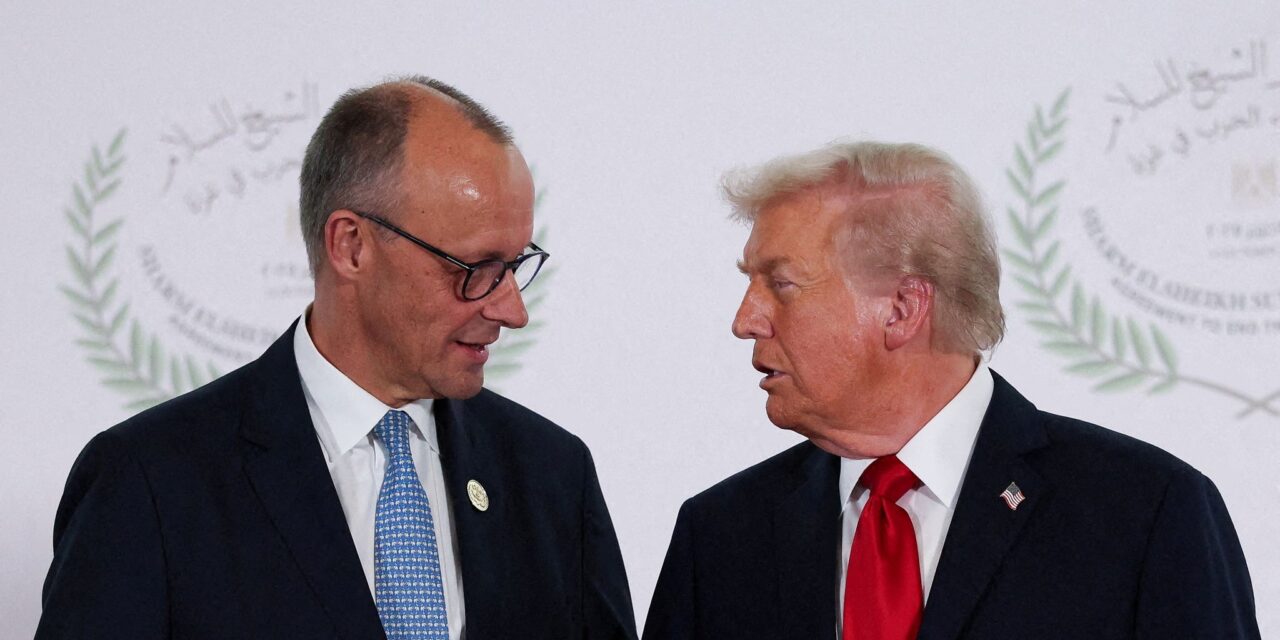
German Chancellor Friedrich Merz and Donald Trump in the White House, Washington, D.C., March 3, 2026 (Sky)
EA-Times Radio VideoCast: Trump’s Gang That Couldn’t Shoot Straight
UPDATE, MAY 4:
I joined Pakistan TV on Sunday evening to analyze Donald Trump’s “tantrum” over Europe and the US-Israel War on Iran.
I explain that while Trump’s threat to withdraw 5,000 US troops from Germany is more political posture than substance, it reinforces the Trump camp’s breaking of the post-1945 alliance with Europe.
In those circumstances, I examine how the Europeans are developing political, economic, and military measures to decrease reliance on Washington.
The other guest is Democratic Party strategist Nate Lerner.
Watch from 34:23:
UPDATE, MAY 2:
In a 20-minute special, I join DW News’s Brussels correspondent Rosie Birchard and host Anthony Howard to evaluate Donald Trump’s threats to Europe.
We begin with Trump’s blasts against Germany, including his declaration that US troops will be withdrawn, and expand this to his anti-European rhetoric amid the US-Israel War on Iran.
I emphasize that while Trump provides “white noise”, the serious challenge is from more coherent members of the Administration such as Vice President J.D. Vance.
In that context, we look at Europe’s plans to reduce and even eliminate reliance on Washington. Can they follow the lead set by Canada’s Prime Minister Mark Carney?
ORIGINAL ENTRY, MAY 1: I joined Poland’s TVP World on Friday morning for a 14-minute analysis of Donald Trump’s latest verbal assaults against European countries and their leaders.
Host Sascha Fahrbach and I begin with Trump’s latest threat, which he has made since 2017, to withdraw US troops from Germany. This time he has been triggered by Chancellor Friedrich Merz’s criticism that the Trump Administration “has no exit strategy” in its war on Iran, with the US “being humiliated” by the Iranian leadership.
We then look at similar warnings to Spain and Italy, after those countries limited overflights and use of bases for offensive operations in the war.
I put this in the wider context of an Administration which does not believe in alliance with Europe, and the possibility of the Europeans breaking their reliance on the US while Trump is in office.
Shifting to the positive, we discuss how the UK’s King Charles III had a very different reception from “wannabe King” Trump during the British monarch’s visit to Washington this week. I recap how Charles used the advantage of his position and personal diplomacy to press issues such as the US-UK and US-Europe relationships, NATO, environmental policy, and limits on executive power.