
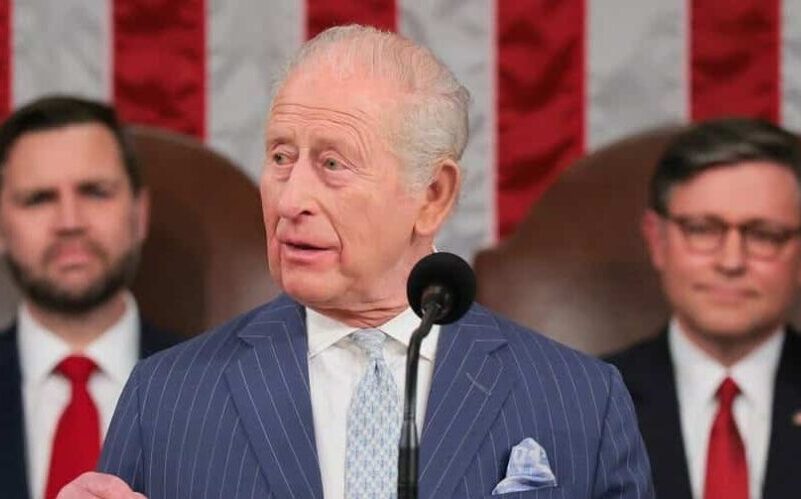
The UK’s King Charles III addresses the US Congress, Washington, D.C., April 28, 2026
EA on International Media: King Charles III Captures Washington
EA-CEO Retort VideoCast: Hungary, Trump, Ireland, and Pushing Back the Hard Right
King Charles III’s speech to the US Congress was not just a diplomatic success. The British monarch reminded us that oratory can still matter, even in the age of social media, loud noises, short soundbites, and permanent outrage.
Charles’ State visit came amid Trump’s upending of the international order, a US government in paralysis with a country divided, deadlock in the US-Israel War on Israel, and American relations with its traditional allies in tatters. Yet the King’s speech, delivered with restraint and precision, triumphed where many elected leaders have failed over the past decade: confronting the politics of Trump, Trumpism, and MAGA without getting trapped inside its language.
The King did not try to out-shout populism. He managed to bring both sides of Congress to their feet, even with elements of his speech in opposition to Trump’s postures. He connected with his real audience, the wider American political class and the US. The King’s words were polite, empathetic, respectful of constitutional values, and non-partisan on the surface. Yet, beneath that veneer, this was a direct challenge to the worldview of Trumpism.
For 10 years in US politics, Democrats and most opponents of Donald Trump got this wrong. They kept reaching for the moral script with the Michelle Obama line, “When they go low, we go high”, as if decency alone could defeat a movement built for spectacle, anger, and endless media saturation for clicks. That approach is admirable, but a shifting politics took the ground from beneath its feet. In the era of ratings and algorithmic conflict, the side that controls attention controls the terms of debate. Trump and the populists understood that early, with Steve Bannon’s flooding the zone with insults to create further rows and broadcast battlefields.
Hillary Clinton often sounded too procedural and cautious. Barack Obama, for all his brilliance, sometimes relied too heavily on the idea that the system would ultimately correct itself. Joe Biden represented bygone institutional era which cannot answer the questions of this day and age and is often too slow for the speed of modern outrage politics. Kamala Harris was trapped in a style managed with vibes and focus groups.
Populism is not defeated by civility alone. There must be clarity about the journey, along with energy and a language that can compete without losing its integrity. That is why the response style of Gavin Newsom, California Governor and likely 2028 Presidential candidate, matters. He understands that mockery and an aggressive social media fluency can puncture the aura of populist invincibility.
In an attention economy, tone is strategic. If the populist style is theatrical, the response cannot be a lecture. It has to be agile, sharp, and capable of making the other side look ridiculous.
New York Mayor Zohran Mamdani offers another route. He connects policy to lived experiences of rent, transport, cost of living, power, housing, and public provision. Mamdani’s style shows that compelling politics does not have to be bland to be serious. It has to be linked to people’s lives.
See also In Search of Conviction: Why the UK Can’t Produce A Mamdani (Yet)
Populism, especially on the hard right, is rarely beaten just by fist bumping. It survives by exploiting failure, distrust, and the sense that established politics has become disconnected from our daily realities. So instead of retreating into moral superiority, we have to build a politics that is emotionally legible, strategically modern, and rooted in issues people actually feel.
EA-CEO Retort VideoCast: Hungary, Trump, Ireland, and Pushing Back the Hard Right
Making Populism Look Smaller
The King’s speech was a constitutional rebuke that never sounded like one. He spoke of pluralism, rules-based order, environmental responsibility, Ukraine, and the value of alliance politics. Each point should be uncontroversial, but in Trump’s America, they can be damning.
While legislators lapped up the words, J.D. Vance and his acolytes recognized the significance of the speech. This was advocacy of pluralism against tribalism, of order against chaos, of stewardship against denial, of international responsibility against isolation. It was an invocation of the approach that MAGA mocks and tries to weaken.
This is why Congress, including some Republicans, responded so warmly. The chamber was hearing a different political language, one that still believes public life could be organized around duty, continuity, and shared purpose. In a political culture that has become addicted to conflict, the King’s composure was part of the message. He embodied an authority that does not shout because it does not need to.
None of this means Trump will change. He won’t. We have already seen how quickly his responses swing from flattery to chaos, whether on the King, on Iran, or on whatever issue he thinks will grab the news cycle. The White House’s image of the “Two Kings” of Charles and Trump was intended to offend the liberals and, at the same time, to provide a blanket for Trump’s insecurity. It tried to obscure that one man represents institution, continuity, restraint, and a long view of public duty, while the other represents personality, disruption, insecurity, and the politics of permanent combustion.
This time the White House failed. Charles reminded the room that pluralism, rules, alliances, the environment, and concepts of order matter. He signalled that the populist moment may not be over, but it is being challenged. He showed that there is still a way to speak above the noise without becoming irrelevant: the future of politics may belong not to those who shout the loudest, but to those who can sound authoritative without sounding performative.
This speech did not merely defend a set of values. It made populism look smaller. In this age, that is a serious achievement.
