
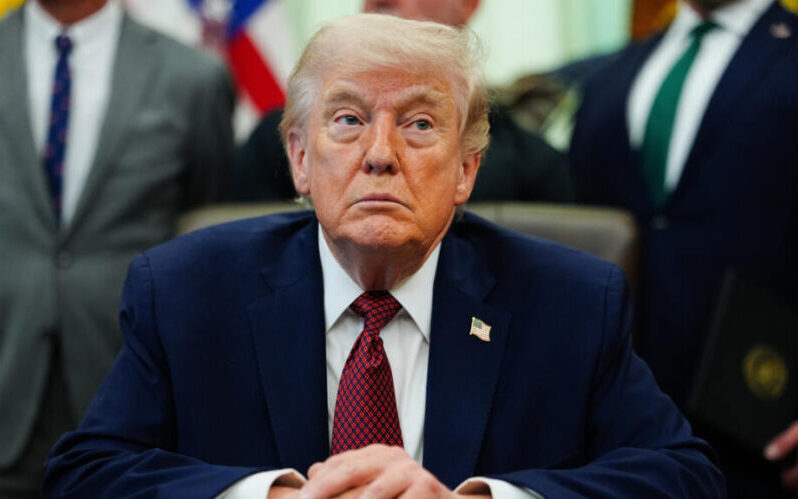
Donald Trump sits in the Oval Office of the White House, Washington D.C., April 18, 2026 (Julia Demaree Nikhinson/AP)
UPDATES: US-Israel Wars, Day 62 — Iran’s 2-Stage Ceasefire Proposal
UPDATE 1829 GMT:
Following up on Iran’s delivery of a new proposal through Pakistan to the Trump Administration, Foreign Minister Abbas Araqchi has spoken with the foreign ministers of Turkey, Qatar, Egypt, Saudi Arabia, Iraq, Azerbaijan, and Russia.
UPDATE 1618 GMT:
Only seven vessels, four commercial and three non-commercial, passed through the Strait of Hormuz on THursday.
Only two vessels exited the Strait.
Strait of Hormuz | Daily Vessel Crossings
As of 30 April, Hormuz crossings halved d/d to seven transits, split between four commercial and three non-commercial movements, with direction broadly balanced at four west-to-east versus three east-to-west.
Only two laden west-to-east… pic.twitter.com/y5Mc39xarg— Kpler (@Kpler) May 1, 2026
UPDATE 1611 GMT:
Iranian officials have confirmed that they sent a new proposal, via Pakistan, to the Trump Administration.
The White House refused to comment. Spokeswoman Anna Kelly said, “We do not detail private diplomatic conversations.”
UPDATE 1218 GMT:
CNN has established that at least 16 US military sites, more than half of the American positions in the Middle East, have been damaged by Iran’s retaliatory attacks.
UPDATE 0902 GMT:
Svein Tore Holsether, the chief executive of the world’s largest fertilizer company Yara International, says the US-Israel War on Iran may have “dramatic consequences” with food shortages and price rises in some of Africa’s poorest and most vulnerable communities.
The most important thing we can do now is raise the alarm on what we are seeing right now – that there is a risk of a global auction on fertilizer that means it becomes unaffordable for those most vulnerable.
Africa is actually quite well positioned to be a major food producer, not only for self-sufficiency, but even for exports to the rest of the world, but the reality is that they are massive food importers.
But we need to be aware in this part of the world of the potential consequences that if we get to a global auction on food, there will not be a famine in Europe – but we need to be aware of who we are taking the food away from.
He emphasized, “It is important to communicate the message about the danger of what potentially could happen before it is too late.”
UPDATE 0544 GMT:
After reaching $126 per barrel on Thursday, the highest level since spring 2022, the Brent crude oil price has adjusted to just over $111.
The fall is largely due to the rollover of the calendar month to May.
West Texas Intermediate oil is trading at $105.27.
UPDATE 1331 GMT:
Lebanon President Joseph Aoun has called for pressure on Israel to respect international laws and “stop targeting civilians, paramedics, civil defense, and humanitarian, health and relief organizations”.
Aoun told a delegation from the International Federation of Red Cross and Red Crescent Societies that Israel is continuing to violate the ceasefire in southern Lebanon, demolishing homes and places of worship.
He noted the increasing number of people killed and wounded:
The attacks do not spare paramedics and volunteers, with approximately 17 paramedics from the Lebanese Red Cross and other humanitarian organizations having been killed so far, in addition to targeting journalists.
UPDATE 1140 GMT:
At least nine people have been killed and residential buildings reduced to rubble across southern Lebanon by Israeli attacks, despite a supposed ceasefire.
UPDATE 0907 GMT:
Iran’s consumer prices rose 73.5% in the month of Farvardin (March 21 to April 20) compared to the same month in 2025, the Statistical Center of Iran reported on Thursday.
The consumer price index increased 5% from the previous month.
Average inflation in the 12 months ending in April rose 53.7% from the same period a year earlier.
ORIGINAL ENTRY: The Brent crude oil price has hit a wartime high amid the Trump Administration’s threat of a months-long naval blockade of Iran’s ports and the ongoing Iranian grip on the Strait of Hormuz.
Brent has surged to $124 per barrel early Thursday, a 5% leap. Since April 17, when the price was $90.38, the cost has risen 37%. It has almost doubled since the start of the US-Israel Wars on Iran and Lebanon on February 28.
Brent briefly peaked above $119 per barrel on March 19, as Iran’s retaliatory attacks hit energy facilities across Gulf States. It fell sharply two weeks ago with hopes that US-Iran talks could bring a ceasefire and the opening of the Strait of Hormuz. The possibility of discussions stalled last week, as the Iranians refused negotiations until the American blockade was lifted.
On Wednesday, Trump blustered that Iran “better get smart soon” as the White House said he and oil executives considered what steps could be taken to “continue the current blockade for months if needed”.
The US inflation rate rose to 3.3% in March. The average price of unleaded gasoline has soared from $2.98 to $4.23 per gallon — the highest since April 2022 in the early days of Russia’s invasion of Ukraine — as Trump’s approval rating on inflation has collapsed to 26%.