
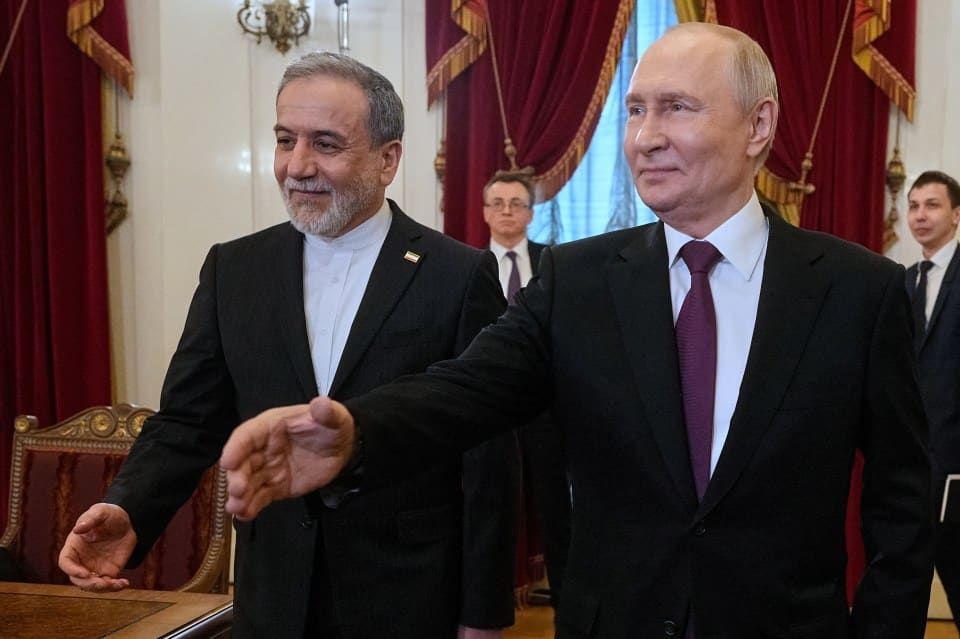
Iran’s Foreign Minister Abbas Araghchi with Vladimir Putin in St. Petersburg, April 27, 2026
UPDATES: US-Israel Wars, Day 60 — Trump Bails Out of Indirect US-Iran Talks in Islamabad
EA on International Outlets: US-Israel War — Iran Calls Trump’s Bluff
UPDATE 1640 GMT:
In a US Congressional hearing, Acting Pentagon comptroller Jules Hurst has acknowledged, “Approximately [to] this day, we’re spending about $25 billion on Operation Epic Fury, most of that in munitions.”
Other spending has been on operations, maintenance, and equipment replacement.
under questioning from Rep. Smith, a DoD official estimates the cost of the Iran war so far is $25 billion pic.twitter.com/aDzsLXIkpB
— Aaron Rupar (@atrupar) April 29, 2026
UPDATE 1325 GMT:
The UN and Lebanon says 1.24 million people in the country face acute hunger amid Israel’s attacks.
“Nearly one in four of the population analysed are expected to face food insecurity” at crisis levels or worse between April and August 2026, says the UN’s Food and Agriculture Organization, the World Food Programme, and Lebanon’s Agriculture Ministry.
This is a “significant deterioration” from the position before Israel’s war started on March 2 “when an estimated 874,000 people, roughly 17% of the population, were experiencing acute food insecurity”.
UPDATE 1120 GMT:
The Iranian currency has sunk to an all-time low of 1,760,000:1 v. the US dollar.
The currency has lost almost 10% in value since last week.
In 2018, before the imposition of comprehensive US sanctions by the first Trump Administration, the rial was 45,000:1.
UPDATE 1045 GMT:
The European Union will subsidize up to 70% of the extra cost of fuel, caused by the US-Israel War on Iran, for farmers, fishers, and road hauliers.
Individual companies can claim up to €50,000 each between now and the end of the year with minimal paperwork.
Energy-intensive industries will be able to recover up to 70% of the extra electricity cost of the eligible consumption.
UPDATE 0901 GMT:
US intelligence agencies are studying Iran’s possible response to Donald Trump ending American operations by declaring “victory”, say “two US officials and a person familiar with the matter”.
The intelligence community is analyzing the issue at the request of senior administration officials.
In the first days after the US-Israel War on February 28, intelligence agencies assessed that if Trump declared victory and the US drew down its forces in the region, Iran would likely view it as a win.
If Trump declared a triumph and maintained a heavy troop presence, Iran would likely see it as a negotiating tactic which would necessarily lead to the end of the war.
Military options are still formally on the table, but a ground invasion of the Iranian mainland is less likely than a few weeks ago, said a US official and another person familiar with the discussions.
A White House official described “enormous” domestic pressure on Trump to conclude the war.
Another official said Iran has taken advantage of the ongoing ceasefire to dig out launchers, munitions, drones and other materiel that had been buried by US and Israeli airstrikes. As a result, the tactical costs of resuming full-scale war may be higher now than they were in the initial days of the ceasefire from April 8.
UPDATE 0552 GMT:
The US-Israel War has put around one million people out of work directly and another million indirectly, reports Gholamhossein Mohammadi, an official at Iran’s Labor and Social Affairs Ministry.
About 25 million people are normally employed in Iran.
The annual inflation rate reached 67% in the month through mid-April, according to Iran’s Central Bank. The subsidized price of red meat is around $3.60 a pound, with the minimum wage at around $130 a month.
Iranian State media estimates that postwar reconstruction could cost around $270 billion, more than 75% of last year’s GDP of $341 billion.
Frustrated in its efforts at “regime surrender”, the Trump Administration is now trying to break Iran’s economy, including through a naval blockade of Iranian ports.
UPDATE, APRIL 29:
US officials say Donald Trump is pressing for an extended naval blockade of Iranian ports.
The sources said Trump assessed that other options — resumption of airstrikes or halting operations — carried more risk.
UPDATE 2037 GMT:
US Vice President J. D. Vance has repeatedly questioned the Defense Department’s depiction of the war in Iran, including whether the Pentagon has understated a drastic depletion of missile stockpiles, say “two senior administration officials”.
Officials, possibly linked to Vance, have told the media of the Vice President’s opposition to the war.
“Several people familiar with the situation” say Vance has raised his concern about the availability of certain missile systems in discussions with Donald Trump.
Both Defense Secretary Pete Hegseth and Joint Chiefs of Staff Chair Gen. Dan Caine have said publicly that US weapons stockpiles are robust. Trump has echoed the statements, saying US stockpiles of key weapons are “virtually unlimited”.
Some officials says Hegseth’s portrayals appear designed to tell Trump what he wants to hear. The Pentagon’s 8 a.m. press briefings take place when Trump watches Fox TV.
Officials also said Pentagon leaders are incomplete about damage to Iran’s stocks and capabilities.
UPDATE 2031 GMT:
At least five people, including three paramedics trapped under the rubble after an earlier attack, have been killed by an Israeli airstrike on the town of Majdal Zoun, near Tyre and the border, in southern Lebanon.
At least two Lebanese soldiers accompanying the rescue team were wounded.
UPDATE 2026 GMT:
A civilian contractor for the Israeli Defense Ministry has been killed and his son, a fellow contractor, lightly wounded by a Hezbollah drone attack in southern Lebanon.
The slain contractor was operating heavy engineering machinery near Bint Jbeil, as the Israeli military demolished infrastructure. The drone struck the excavator.
Hezbollah took responsibility for the attack, saying it targeted an Israeli bulldozer while it was demolishing homes.
UPDATE 2021 GMT:
Donald Trump has snapped at German Chancellor Friedrich Merz, who told students that “the Americans clearly have no strategy” in the war with Iran.
Trump insulted Germany and lashed out that Merz “doesn’t know what he’s talking about”.
Merz said on Monday:
The problem with conflicts like this is always that you don’t just have to go in; you also have to get out again. We saw that all too painfully in Afghanistan, for 20 years. We saw it in Iraq. So this whole affair is, as I said, ill-considered, to say the least.
He added:
The Iranians are obviously very skilled at negotiating, or rather, very skilful at not negotiating, letting the Americans travel to Islamabad and then leave again without any result.
An entire nation is being humiliated by the Iranian leadership, especially by these so-called Revolutionary Guards. And so I hope that this ends as quickly as possible.
UPDATE 1602 GMT:
The cost of gasoline in the US is at its highest point since April 2022, soon after Russia’s full-scale invasion of Ukraine.
The price of an unleaded gallon reached $4.18 with Tuesday’s jump of 1.6%, the highest daily increase in more than a month.
Brent crude is now $111.05, rising 2.61% today.
UPDATE 1259 GMT:
The UAE is leaving the Organization of Petroleum Exporting Countries from May 1.
The UAE’s Energy Ministry said the withdrawal, following a “comprehensive review” of production policy, “reflects the UAE’s long-term strategic and economic vision and evolving energy profile”.
The Emirates pledged to “act responsibly”, bringing “additional production to market in a gradual and measured manner” in line with demand and market conditions.
The Ministry said the country did not directly consult others, including Saudi Arabia, before the decision.
UPDATE 1022 GMT:
The Israeli military has ordered residents of 16 towns and villages in southern Lebanon to evacuate immediately to the Sidon area.
UPDATE 0948 GMT:
The Brent crude oil price has jumped another 3% today to $111.32 per barrel.
UPDATE 0925 GMT:
A liquefied natural gas shipment has crossed the Strait of Hormuz for the first time during the US-Israel War on Iran, reports Bloomberg.
The Mubaraz, which loaded LNG from the Abu Dhabi National Oil Company’s Das Island facility in the UAE in early March, is passing the southern tip of India.
The tanker was idling inside the Persian Gulf before it stopped sending a signal around March 31.
UPDATE 0556 GMT:
Israeli strikes on southern Lebanon killed four people, including a woman, and wounded 51 on Monday despite a ceasefire, reports the Lebanese Health Ministry.
Israeli forces have killed at least 40 people since the ceasefire was announced on April 16.
The Israeli military says one of its soldiers was severely wounded and another lightly hurt by a Hezbollah drone attack on Monday.
ORIGINAL ENTRY: The Iranian regime has seized the diplomatic initiative with a two-stage proposal to end the US-Israel Wars on Iran and Lebanon.
The regime sent the proposal via Pakistan to the US during Foreign Minister Abbas Araghchi’s tour of Islamabad, Oman, and Russia.
In the first stage, Iran would negotiate its control of the Strait of Hormuz, through which 20% to 25% of the world’s maritime oil and gas passes, in return for a lasting ceasefire. Tehran and the US would then discuss the Iranian nuclear programme in the second stage.
Araghchi said on Monday, as he arrived in St. Petersburg to meet Vladimir Putin:
There have been developments in the negotiation process, and the incorrect approaches and excessive demands of the United States have prevented the previous round of negotiations from achieving its objectives, despite some progress.
We reviewed what has happened in the past and discussed how, and under what conditions, negotiations could continue.
The Trump Administration’s national security and foreign policy officials met to consider the initiative. A US official said afterwards that Donald Trump “doesn’t love the proposal” because it did not address Iran’s nuclear program.
Other officials confirmed to US media outlets that Trump was not satisfied and unlikely to accept the terms.

Even state media sounds alarm as Iran’s economy sinks
https://www.iranintl.com/en/liveblog/202604294038
iri economy is imploding, the auto sector is crumbling, just about every manufacturer and supplier in the chain is laying off workers. And auto sector always have been the healthiest sector of economy….
Israel’s failed operation to overthrow the Iranian regime: https://www.ynet.co.il/news/article/yokra14748698
“The plan was aimed at the war in June 2026. By June, preparations and conditions will have been completed. But then, in January of this year, tens of thousands of Iranians took to the streets, at their own time. The tremendous work that Israel invested was in the background of the demonstrations.”