
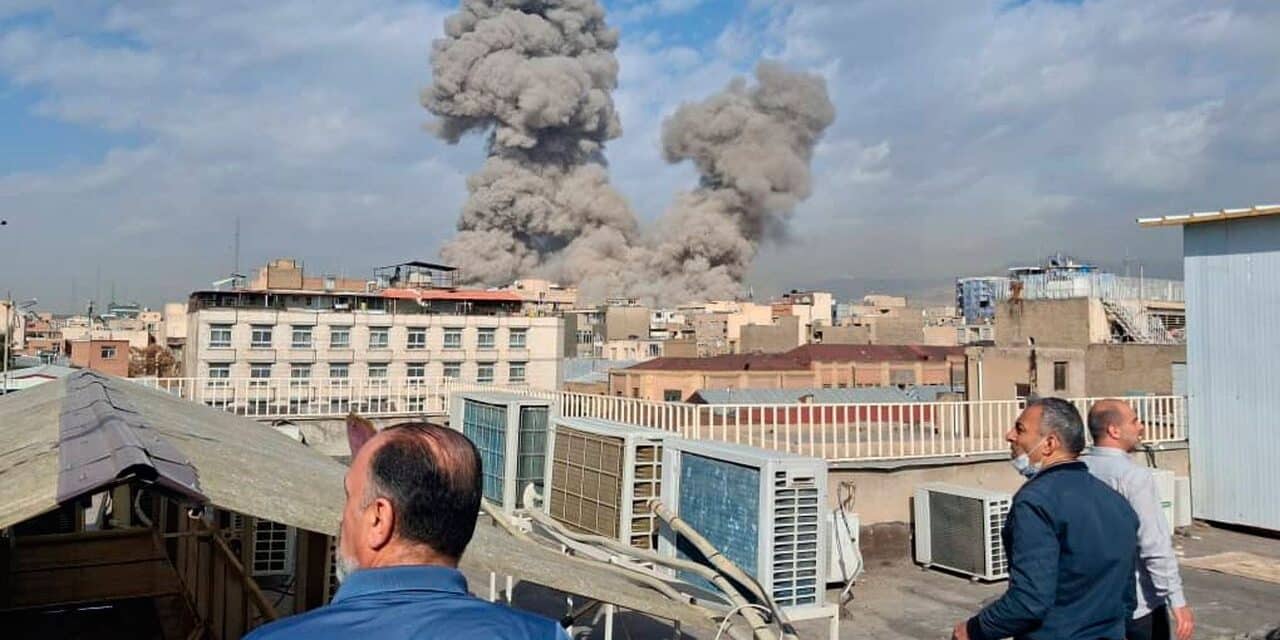
Residents on rooftops in Tehran, Iran watch smoke rise from Israel-US airstrikes (AP)
I composed this for the Irish Independent on Saturday afternoon, before the confirmation of the killing of Iran’s Supreme Leader and senior officials by an Israel airstrikes on Ayatollah Khamenei’s compound in Iran.
EA on International Media: The US-Israel War for Regime Change in Iran
Israel-US Strikes Kill Iran’s Supreme Leader and Senior Officials
Less than nine months after its 12-day assault on Iran, Israel’s Netanyahu Government has relaunched the war.
Nine days after wielding a golden gavel at his “Board of Peace” show in Washington, Donald Trump is part of that war: not just in a supporting role, as he was last June, but alongside the Israelis.
And less than two months after crushing nationwide protests for rights and reforms, killing thousands maybe tens of thousands of Iranians, the Supreme Leader and his regime are not trying to evade the strikes. They are fighting for their survival.
Why Netanyahu and Trump Attacked
The easiest part of the analysis is Israeli Prime Minister Benjamin Netanyahu. Having waged an two-year mass killing in Gaza, following Hamas’s mass killing in October 2023, he has occupation of 53% of the Strip and a fragile ceasefire. But there is no clarity on the long-term future.
His Government has decimated Lebanon’s Hezbollah and seen the end of Bashar al-Assad’s rule in Syria. But still Netanyahu faces an uncertain outcome in the next elections and in his trial on bribery charges.
He was forced by Trump to end his June campaign before it forced the surrender of the Iranian regime. For months his Government had been trying to persuade the Trumpists to replace “peace” with war.
The Trump camp’s shift takes longer to explain. Hoping for Iran’s capitulation with an end to its nuclear programme and limits on ballistic missiles, Trump’s envoys Steve Witkoff and Jared Kushner returned to three sets of talks with Iranian Foreign Minister Abbas Araqchi. The latest round was Thursday in Geneva.
Meanwhile, the Administration put a Sword of Damocles over Tehran’s hand with its largest deployment in the region since the 2003 invasion of Iraq. More than a dozen warships, including two aircraft carriers; scores of fighters jets; and missiles were assembled off the Iranian coast.
The regime was willing to play for time by engaging in the discussions. It was willing to limit its uranium enrichment and to allow the International Atomic Energy Agency to resume inspections. But it would not give up its right to a nuclear programme or put its ballistic missiles on the table.
The Trump camp was reportedly split. The US military was unsure that it had the resources for a protracted assault. Vice President J.D. Vance feared the consequences if there was no quick outcome, especially since the Trumpists had campaigned on “no foreign interventions”.
But the Administration is also pursuing a foreign policy of domination, outlined in December’s National Security Strategy. It had proclaimed its control of the Western Hemisphere, abducting Venezuelan President Nicolás Maduro. It had tried to impose itself on Europe, putting aside alliances, trying to seize Greenland, and supporting hard-right movements to undermine the European Union.
So “peace” was set aside for a war to show American’s domination in the Middle East and Iran, just over 20 years after a similar project failed in Iraq.
The Regime’s Retaliation
Last June, Iran fired missiles on Israel with some success. But the regime never attacked US positions. They only fired on the last day of the war in a “demonstration” assault, lobbying missiles into the Al-Udeid Airbase in Qatar after warning Washington that the strike was coming. That ploy worked: Donald Trump took the warning as a sign of goodwill and told Netanyahu to cease fire.
This time the regime sees the US in the war alongside the Israelis. Even capitulation over the nuclear programme may not be enough, given Trump’s declaration of “this very wicked, radical dictatorship” and call for its overthrow.
So from the outset, Iran has fired missiles on US bases in Qatar, the UAE, Bahrain, and Kuwait. There have no been confirmed casualties, but Tehran is demonstrating that — for the moment — it will resist.
But how many missiles does it have — and the launchers for them — after last June’s war? Will Iran’s militia and movement allies from Iraq to Lebanon attack? Could its partners in Yemen, the Houthis, fire not only on Israel but also on Gulf States?
We do not have the answers. Because as serious as last June’s war was, there was still an element of containment. This time, there is none.
The World Watches — But What Will Stop This?
I have been asked through Saturday: can the world stop this? The cold, hard answer is No, at least in the near-future.
Netanyahu and Trump are largely isolated in their quest. Other leaders have called out their violation of international law. UN Secretary General António Guterres has condemned the US-Israel strikes, as well as Iran’s retaliation, with a call for immediate cessation of hostilities and de-escalation. While former allies have been muted in their criticism, they have signalled their lack of support: French President Emmanuel Macron has spoken of the “grave consequences”, and the UK Government — which refused permission for the US to launch strikes from Diego Garcia in the Indian Ocean — said, “We do not want to see further escalation.”
But the US and Israel have enough firepower for immediate defiance of the world, international law be damned. The problems for them arise if the Iranian regime does not soon crack and fall.
The regime has been under intense pressure from within Iran. The economy is in serious trouble, with no obvious way out of mismanagement and sanctions. Last month’s protests were the largest since 2009, when millions challenged the manipulated Presidential elections. Even if they were put down bloodily, Iranians speak of “fire under the ashes” — the continued quest for political and social rights as well as economic security.
But it is a fiction that US-Israeli strikes will enable those protesters to seize power. As much as many Iranians — some of whom are my close friends, dating back to my work in Iran 20 years ago — want reforms or even the end of the regime, that has to come from within.
Last June demonstrated this. As soon as Israel attacked, the regime said Iranians, “You have to support your nation.” When the Trump camp joined in the strikes on nuclear facilities, it added to the regime’s message that any opposition would be in the service of those waging war.
So we are in the limbo of the Netanyahu-Trump Plan A. For if the regime holds out, there is no apparent Plan B.
That may mean this war is finally curbed by domestic unease, particularly in the US. Memories of Iraq 2003 are entrenched, and a “President for Peace” — who cannot risk putting US boots on the ground in Iran — does not sit well with an inconclusive war.
Right now, that speculation is distant. We are in the midst of a violent escapade with no immediate limits. Iranians will be the first victims, but those distant from the country will not be immune from the shocks.