
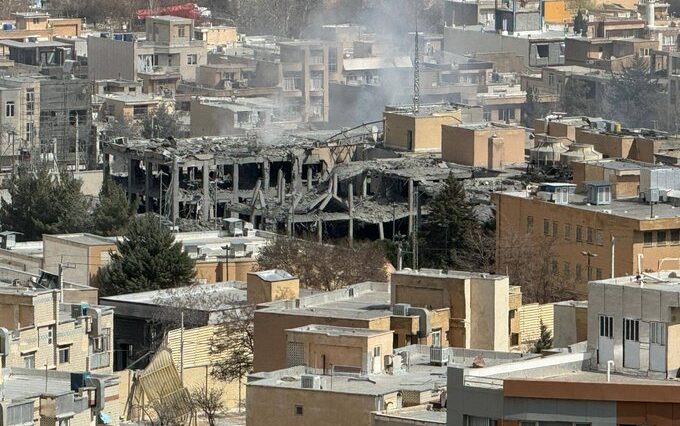
A police station destroyed by US-Israel strikes on Tehran, Iran, March 2, 2026
EA on Irish and Indian Outlets: What Next After Israel-US Killing of Iran’s Supreme Leader?
Netanyahu and Trump’s War for Regime Change in Iran
I joined Byline Times’ Adrian Goldberg for a 32-minute deep dive into the reasons for the Israel-US “illegal war” on Iran and an assessment of its consquences.
I begin by juxtaposing the legal position with the Netanyahu Government’s dedication to regime change and the Trump camp’s shift from talks to missiles and targeted assassinations.
I explain how the two sides differ with the Trumpists apparently willing to accept “regime accommodation”, if the remaining leaders will give up Iran’s nuclear program and ballistic missiles.
But I evaluate how even this may prove difficult to achieve, with the regime focusing for now on retaliation and with the lack of a Plan B beyond more missile strikes.

Americans against conflict with Iran: https://edition.cnn.com/2026/03/02/politics/cnn-poll-59-of-americans-disapprove-of-iran-strikes-and-most-think-a-long-term-conflict-is-likely
“Overall, 59% of Americans disapprove of the initial decision to strike Iran, with 41% approving. Strong disapproval (31%) roughly doubles strong approval (16%). A marginally higher share (44%) say they favor the US trying to overthrow the Iranian government, with 56% opposed to that. Just 12%, though, would favor sending US ground troops into Iran, while 60% would oppose it and 28% are unsure. A majority, 56%, say they see long-term military conflict between the US and Iran as at least somewhat likely, including 24% who see that as a very likely outcome.”
Iran’s best ally in all this may be the American people themselves.
Pentagon official admits munitions are running low after just 3 days of fighting: https://edition.cnn.com/world/live-news/iran-israel-us-attack-03-02-26-intl-hnk#cmm9r0ebb00003b6s8ob3wk9x
“The senior official said that that missile stocks are running low, especially Tomahawk land attack missiles and SM-3 interceptors.”
It takes 2-3 interceptors to engage one ballistic missile. Iran has far more missiles than they have interceptors.
Nervousness inside the Pentagon: https://www.washingtonpost.com/national-security/2026/03/01/us-troops-killed-iran/
“Inside the Pentagon, and among some members of the Trump administration, there was deepening concern Sunday that the Iran conflict could spiral out of control, said people familiar with the situation. “The mood here is intense and paranoid,” one person said.There is anxiety among senior leaders that the fighting will extend for weeks, further stressing limited U.S. air defense stockpiles, people familiar with the situation said. There is concern about this lasting more than a few days,” said another person. “I don’t think people have fully absorbed yet, like, what that has done with stockpiles,” they added, noting that it often takes two or three air defense interceptors to ensure that an incoming missile is stopped.”
Iran Strikes U.S. Military Facilities Across Gulf Region: https://www.nytimes.com/2026/03/01/world/middleeast/iran-strikes-us-military-facilities.html
“Iran has struck at least six U.S. military facilities around the Middle East since the United States and Israel began attacking the country on Saturday, according to a New York Times analysis of satellite imagery, verified videos and statements by U.S. military officials. It’s unclear how many munitions Iran launched at the locations or how many attacks may have been thwarted, but the incidents raise questions about these sites’ abilities to defend against future strikes. Facilities in Bahrain, Iraq and the United Arab Emirates, plus three sites in Kuwait, were hit on Saturday and Sunday. Several structures, including satellite communications equipment, were damaged or destroyed.”