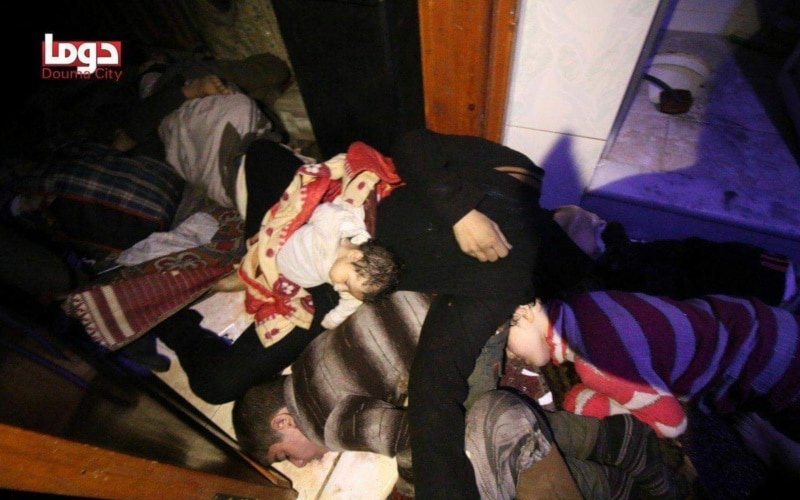
Bodies of victims in a building after an Assad regime chlorine attack, Douma, Syria, April 7, 2018
In April 2018, an Assad regime helicopter dropped a chlorine canister on an apartment block in Douma near Damascus, as Russia and Assad forces tried to force Syria’s opposition to surrender.
The attack killed 43 civilians, trapped by descending gas as they tried to escape. In March 2019, an investigation by the Organization for the Prohibition of Chemical Weapons found “reasonable grounds” that the regime was responsible.
For years, the regime, the Kremlin, and their supporters have pushed disinformation that there was no chlorine attack. Some have even declared that the opposition staged a “managed massacre”, killing the civilians elsewhere and moving them into the building.
Last Thursday in Dublin, I was involved in a debate with Aaron Maté, a Canadian activist who is a leading war crimes denier. He repeated the “false flag” allegation. Countered by others in the debate and by the audience — including a Syrian survivor of Assad’s chemical attacks — he left the chamber angry and humiliated.
Just after the attack in Douma, the Russians seized 11-year-old Hassan Diab, along with his father and Syrian medics. They flew them to The Hague and forced them to lie in the denial of the deadly strike.
Chloe Hadjimatheou, who has investigated the chemical attacks for more than a decade, found Hassan and interviewed him for The Observer:
Hassan Diab was so small he had to be helped onto his chair. The 11-year-old, along with his father and a group of Syrian medics, had been flown from Damascus to the Hague to speak at a conference in April 2018. Sitting at a long white table, they all had one thing in common: they had appeared in a video filmed in the aftermath of an apparent chemical attack on the city of Douma.
The video, filmed only three weeks earlier, showed medics treating men women and children, including young Hassan, for the apparent symptoms of chlorine gas inhalation. There were also clips showing the inside of an apartment building. Numerous bodies appeared strewn on a landing and in a hallway.
Sitting at that conference table in the Hague was Alexander Shulgin, not only Russia’s ambassador to the Netherlands but its permanent representative to the Organisation for the Prohibition of Chemical Weapons (OPCW) in the Hague. Beside him was his Syrian counterpart and all the witnesses flown in from Damascus, who told the world’s press they had got it wrong: there had been no chemical attack. The video was fake, they said. It had all been staged.
Eight years later I travelled to Syria, newly open to the world after the sudden fall of the Assad regime, to meet Hassan.
The buildings in Douma, a 20-minute drive north-east of Damascus, still show the pockmarks of war. Down a narrow dusty street lined with concrete apartment buildings, Hassan comes out to greet us. Now 19, with a slight figure and youthful face, he is still recognisable as the boy at the press conference in 2018.
He welcomes me into the modest apartment he shares with his mother, Rawaa, and his father, Omar. Over several cups of cardamon-infused coffee, they describe their experience that April, when the regime of the Syrian president, Bashar al-Assad, was pounding the city with relentless airstrikes.