
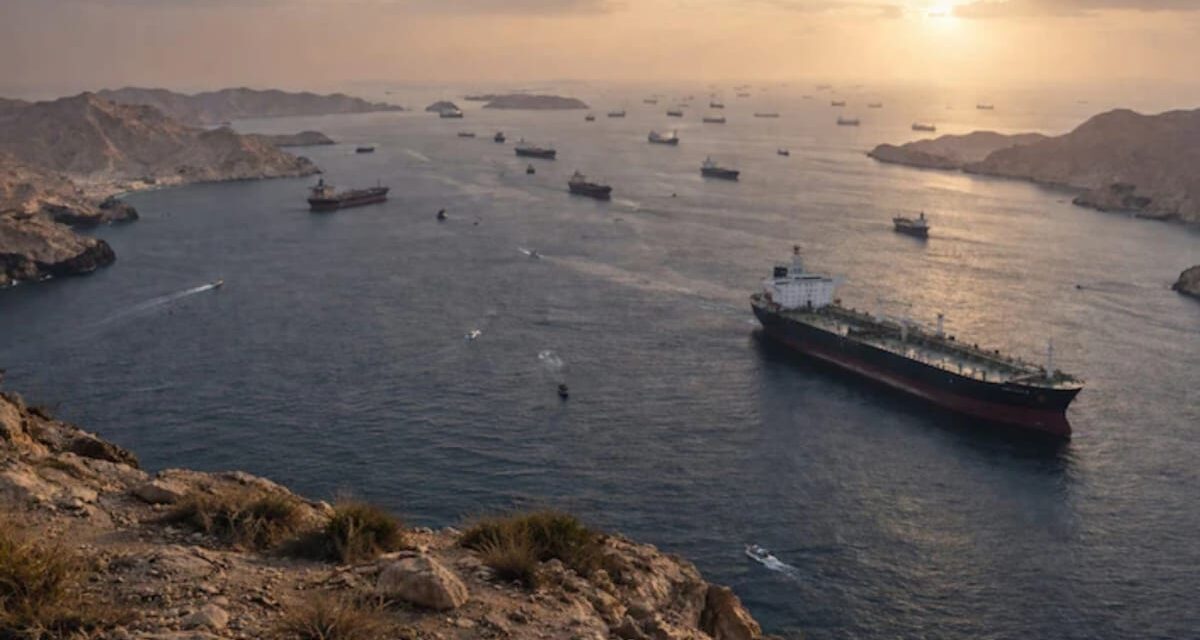
File image of the Strait of Hormuz
EA-DW News Special: US-Iran — The “Deal” That Is Not A Deal
EA on TVP World: Deal or No Deal to End US War on Iran?
UPDATES: US-Israel Wars, Day 108 — Deal or No Deal Between US and Iran?
UPDATE 1748 GMT:
US officials are reading out their version of the Memorandum of Understanding with Iran.
They confirm “the immediate and permanent termination of military operations on all fronts, including in Lebanon”.
They say Iran has committed to downblending — diluting its uranium of up to 60% grade — on Iranian soil, under the supervision of the International Atomic Energy Agency. However, they implicitly accept Iran’s deferral of the matter to a later stage in negotiations for “a satisfactory framework being agreed upon in the final deal”.
They emphasize that relief of US sanctions is linked to the nuclear issue “in an agreed upon schedule as part of the final deal”.
UPDATE 0958 GMT:
More than half of a $300 billion fund for Iran, part of a draft Memorandum of Understanding with the US, is already committed, a source has told Reuters.
A source said the Reconstruction and Development Fund will be comprised entirely of private-sector money as an investment vehicle, not as a reconstruction or reparations program. They said companies based in the US, the Gulf States, Asia, South America, and Africa have agreed to commit financing. Investments include energy, logistics, manufacturing, and transport.
They asserted that the fund will not be operational until a final agreement is signed: “During these 60 days [of US-Iran negotiations], the fund administrators will work with Iranians and investors to plan and scope projects.”
A senior Iranian source said Tehran originally sought $400 billion as compensation for war damages from the US but the Trump Administration refused.
The Iranian said the fund involves securing loans, establishing credit lines, and directly financing the reconstruction of sites damaged in the war such as the Mobarakeh Steel complex, refineries, and airports.
UPDATE 0818 GMT:
US intelligence agencies assess that Iran can effectively shut down access to the Strait of Hormuz at will.
“We have now handed Iran de facto control over the strait – a weapon more powerful than any nuke,” said a source “familiar with the assessments”.
Iran has also established that it can use targeted strikes against the energy infrastructure of Gulf countries as leverage, said a second source.
UPDATE 0528 GMT:
Iranian oil tankers have passed through the US blockade on Iran’s ports, confirms the TankerTrackers monitor.
Two supertankers, Diona and Hero 2, transited with a total of 3.8 million barrels of crude oil. A third tanker passed with 1 million barrels.
UPDATE, JUNE 17:
Iranian Foreign Minister Abbas Araghchi has emphasized, “Without the withdrawal of Israeli forces from the territories they occupied during this war, the war has not fully come to an end.”
Hezbollah said it has received assurances from Iran that Tehran will demand a withdrawal of Israeli troops from Lebanon in negotiations with the US.
On Tuesday, Israeli drone attacks killed at least four people in Lebanon. Some of the victims were from a “double-tap” strike in which an Isreli drone targeted a car in the village of Mayfadoun and then launched a second strike as people gathered at the scene.
UPDATE 1720 GMT:
The Saudi outlet Al Arabiya English has published the 14-point Memorandum of Understanding to be signed by the Trump camp and the Iranian regime on Friday.
There will be “an immediate and permanent end to the war on all fronts, including Lebanon”. The two countries “undertake that from now on they will not launch any hostile action against each other, and will refrain from the threat or use of force against each other”.
The US will immediately lift its naval blockade on Iranian ports as Iran restores traffic across the Strait of Hormuz within 30 days. The US “also undertakes to withdraw its forces from the surrounding areas within 30 days after the final agreement”.
The US, with regional partners, will develop a comprehensive plan “for the rehabilitation and economic development” of Iran, with financing of at least $300 billion.
The US will end all sanctions on Iran and terminate UN and International Atomic Energy Agency resolutions condemning Tehran. As soon as the Memorandum of Understanding is signed, the US will issue sanctions waivers on Iranian oil.
The US commits to the unfreezing of an unspecified amount of Iranian assets held abroad as negotiations progress towards a final agreement.
Iran recommits to never producing a nuclear weapon. Its nuclear program will be addressed in the final agreement.
The final agreement will be guaranteed by a UN Security Council resolution.
UPDATE 1706 GMT:
The US is preparing to offer sanctions relief to Iran, in the form of a waiver allowing Tehran to export its oil, say a US official and a Mideast diplomat.
The officials said the relief will begin as soon as the memorandum of understanding is formally signed on Friday. A US official said Iran must keep to the terms of the agreement.
An Iranian oil tanker was allowed to cross the US blockade on Iranian ports on Tuesday.
UPDATE 1552 GMT:
Senate Majority Leader John Thune has asked the Trump Administration for the text of the memorandum of understanding with Iran and for a briefing. So far, he has gotten neither.
Thune told a reporter, “At some point they understand they’re going to have to. I think they’ve intimated as much, that they’ve got to get this in front of us. And hopefully that’ll happen sooner rather than later.”
UPDATE 1413 GMT:
The toll in Lebanon from Israel’s attacks since March 2 has risen to 3,826 killed — including hundreds of women, children, and paramedics — and 11,851 wounded.
UPDATE 1254 GMT:
The price of Brent crude oil has fallen another 3.8% to $79.99 per barrel, its lowest level since Iran closed the Strait of Hormuz in early March.
West Texas Intermediate has dropped 3.9% to $77.61 per barrel.
UPDATE 1134 GMT:
Iran has executed another two individuals involved in nationwide protests in January 2026.
The leading executioner in the world alongside China on a per capita basis, Iran has stepped up the hangings during the US-Israel War.
The two victims today, Javad Zamani and Abolfazl Saedi, were described as “armed leaders of early 2026 unrest” in Shahrud in northern Iran. They were convicted of moharebeh (waging war against God), corruption on earth, damaging public and private property, and crimes against national security.
On Monday, UN human rights chief Volker Türk said Iran has executed at least 40 people, including 18 protesters, on “national security grounds” so far in 2026. He accused authorities of intensifying a “brutal crackdown”.
UPDATE 1125 GMT:
A source confirms that $24 billion in frozen Iranian assets could be released in four installments as part of the US-Iran framework deal.
The assets will be unfrozen if Iran allows for the toll-free reopening of the Strait of Hormuz and agrees on certain “understandings” over talks about its nuclear program.
A Pakistani source said the money could be transferred to Iran as economic assistance, for example to help fund mine-clearing operations in the Strait.
UPDATE 1110 GMT:
Iran Foreign Minister Abbas Araghchi, has warned that any Israeli attack on Lebanon or its presence on the Lebanese territory will be a violation of a US-Iran framework agreement.
“This is perhaps the most important issue in the memorandum – the declaration of an immediate and permanent end to the war on all fronts, including in Lebanon,” he said.
Araghchi confirmed that Iran and the US will start a new round of negotiations on Friday in Switzerland. He said the first stage will cover the Strait of Hormuz, the US’s naval blockade, and reconstruction. A second stage will take up Iran’s nuclear program and US sanctions.
UPDATE 1106 GMT:
Israel continued artillery shelling of southern Lebanon this morning.
The Israelis bombarded the outskirts of al-Rayhan in the district of Jezzine. A drone targeted a van in the Bint Jbeil district.
Hezbollah claimed responsibility overnight for an attack on Israeli soldiers advancing towards the town of Kfar Tebnit, around four miles north of the Litani River.
UPDATE 1058 GMT:
Donald Trump has again criticized the Netanyahu Government and Israel’s attacks on Lebanon.
At the G7 summit in France, Trump told reporters:
Israel’s fighting Hezbollah too long and too many people are being killed. And you don’t have to knock down an apartment house every time you are looking for somebody, because there are a lot of people in those apartment houses and they are not all Hezbollah, that I can tell you.
And I suggested to Israel to let Syria take care of Hezbollah because to be honest with you I think they will do a better job of doing it.
Trump reiterated his blasting on Israeli Prime Minister Benjamin Netanyahu on Sunday, after Israel again bombed the southern suburbs of Beirut, “I let them know that. I didn’t like it – not at all.”
He repeated, “If Israel can’t do the job, without killing everyone else, he [Syrian President Ahmed al-Sharaa] will do the job. Syria will do the job.”
Putting more pressure on Netanyahu, after saying he had a “great relationship” with the Prime Minister, Trump chided that he “has to be more responsible with respect to Lebanon”.
He declared, “Without me there would be no Israel, because no other president was willing to do what I did.”
UPDATE 0638 GMT:
The head of Israel’s Air Force, Maj. Gen. Omer Tischler, has indicated that Donald Trump blocked widespread Israeli strikes inside Iran on June 8.
Earlier in the day Iran fired around 30 missiles at Israel after the Israelis struck Dahiyeh, a southern suburb of Beirut. Tischler noted that Israel responded with an offensive “1,500 km [932 miles] from home” with attacks on dozens of targets including air defense systems.
However, he continued, “the entire Air Force was ready to take off for a broad strike sortie” with “hundreds of targets in the heart of Iran”.
“The strike was halted while we were briefing in the squadrons, just one hour before the departure for the sortie,” he said.
Tischler did not explicitly note that, before the cancellation, Trump had berated Israeli Prime Minister Benjamin Netanyahu, complaining that Israel’s strikes jeopardized a framework deal between the US and Iran.
UPDATE 0532 GMT:
Countering Donald Trump’s declaration that shipping through the Strait of Hormuz has resumed, the chief executive of Japan’s Mitsui OSK Lines says transit will not start for weeks.
Jotaro Tamura said, “What will have to come in place is not just a simple agreement between the relevant countries. It has to be material and translated into the real situations in the Strait of Hormuz, so that shipping lines can make themselves comfortable to go through.”
UPDATE, JUNE 16:
Senior aides to Donald Trump were surprised by his social media announcement on Sunday that a framework agreement with Iran was “now complete”.
Trump digitally signed the document in the White House just after 5 p.m. local time, but his top advisors thought the terms were still being negotiated.
Officials said Trump signed as he spoke by phone to journalists, Vladimir Putin, and other leaders — all while preparing to attend cage fights on the White House lawn that evening for his 80th birthday.
The text of the agreement, said to be a page and a half long, has not been made public. The White House said on Monday that it will be released in 24 to 48 hours.
UPDATE 1716 GMT:
Shipping through the Strait of Hormuz was at a standstill on Monday, rebuffing Donald Trump’s claim that loaded oil tankers were “starting to move”.
At 2 pm GMT on Monday, tracking firm Kpler detected only one commodities carrier traversing the strait with its transponder switched on.
UPDATE 1410 GMT:
US Vice President J.D. Vance has acknowledged that Iran will have access to a $300 billion reconstruction fund under the framework deal.
Vance said access would be allowed “so long as they honor their end of the obligation”.
CBS: The Iranians are saying they're gonna have access to a $300 billion reconstruction fund. True or false?
JD VANCE: That's the sort of things they could have access to so long as they honor their end of the obligation pic.twitter.com/30Ip8CGItn
— Aaron Rupar (@atrupar) June 15, 2026
He denied that the text includes a provision for the unfreezing of $24 billion in Iranian assets held abroad.
UPDATE 1332 GMT:
Iran Foreign Ministry spokesperson Esmaeil Baghaei said that, despite the framework deal with the US, “Iran’s deep mistrust of the United States stems from long history of wrongdoing by American leaders. The United States still has a long way to go before it can earn the trust of the Iranian people.”
Baghaei said the framework is “merely a step toward reducing tensions and end a war”.
Hezbollah welcomed the memorandum of understanding, saying it brought a comprehensive ceasefire across all fronts, including Lebanon.
The Lebanese group said it has not carried out any operations since the announcement.
UPDATE 0936 GMT:
Citing an “informed source”, Iran’s Revolutionary Guards-linked Fars says Tehran added a clause on imposing maritime service fees, for ships crossing the Strait of Hormuz, to the framework deal just before its announcement.
Fars said this is within “Iranian-Omani sovereignty” over the Strait.
UPDATE 0852 GMT:
Another senior Israeli minister is rejecting the US-Iran framework deal.
Finance Minister Bezalel Smotrich said:
The joint campaign had many achievements in weakening Iran, and they will not go to waste. We will have to continue the campaign to topple the regime ourselves and in creative ways, and ensure that Iran will never have nuclear weapons….
In Lebanon, we will be tested. This is our war, our fighters, and the immediate security of our northern residents. I will continue to act so that we continue to stand firm…and allow the IDF [Israel Defense Forces] full freedom of action to continue pushing Hezbollah away.
UPDATE 0756 GMT:
An “Israeli source” says Israeli Prime Minister Benjamin Netanyahu blames Donald Trump’s envoys, son-in-law Jared Kushner and real estate developer Steve Witkoff, for creating a wedge between himself and Trump.
Netanyahu believes the American negotiators were influenced by “Qatar, which, fearing Iran, pushed positions that widened gaps between Jerusalem and Washington”.
Qatar has provided billions of dollars supporting the business ventures of Kushner and Witkoff’s son Alex.
UPDATE 0741 GMT:
The Brent crude oil price has fallen by more than 5% to $82.85 per barrel, the lowest level since early March.
UPDATE 0739 GMT:
Defense Minister Israel Katz says Israel will maintain its occupation of southern Lebanon as well as parts of Gaza and Syria.
Katz said the Israel Defense Forces “will remain in the security zones in Lebanon, Syria and Gaza – indefinitely – to defend the border and Israeli communities against jihadist elements”.
UPDATE 0631 GMT:
Israel’s National Security Minister Itamar Ben Gvir has posted:
Trump’s agreement does not bind us….We are not party to this agreement. It does not safeguard our security.
We must not settle for anything less than the dismantling of Hezbollah. We must not withdraw from a single inch of territory that our soldiers have captured and cleared of terrorist infrastructure.
Prime Minister Benjamin Netanyahu has yet to issue a statement.
Israel has continued attacks across southern Lebanon this morning, including two strikes on Khiam, a drone attack on a car in Kfar Tebnit, and shelling of Kfar Tebnit and Nabatieh al-Fawqa.
ORIGINAL ENTRY: The Trump camp and the Iranian regime have reached a framework deal to end the US war on Iran, but the details are still unclear.
Iran’s Deputy Foreign Minister Kazem Gharibabadi confirmed the deal on State TV early Monday. He said “immediate end” to the war includes Israel’s attacks on Lebanon.
Hours earlier, Donald Trump posted that “the Deal with the Islamic Republic of Iran is complete”. He said the Strait of Hormuz will be reopened in return for the lifting of the US blockade on Iranian ports, but he made no reference to Lebanon or to Iran’s nuclear program.
Neither side revealed what Iran will receive for the reponening of the Strait. Tehran is seeking the easing of US sanctions and the unfreezing of around $24 billion in Iranian assets held around the world.
An Iranian official said Iran and Oman will oversee the arrangements for the waterway, through which around 20% to 25% of the world’s maritime oil and gas passes. The Iranian outlet Mehr emphasized that the Strait will be reopened within 30 days under “Iranian arrangements”.
The deal is scheduled to be signed in Geneva on Friday.
A Last-Minute Israeli Intervention
The Trump camp had been saying all weekend that the deal was imminent, but it was jeopardized on Sunday by Israeli strikes on Dahiyeh, a southern suburb of Lebanon’s capital Beirut.
At least three people were killed and 15 wounded in the destroyed apartments. Israel claimed it fired on a “Hezbollah command center”.
Trump fumed that he asked Netanyahu, “What the fuck are you doing?”:
It is so bad – I couldn’t believe it. An hour before we are supposed to sign the deal….
Why did Bibi [Netanyahu] have to do a fucking attack? I was so pissed off. I let him know. He has no fucking judgement. I let him know that.
He added that he had asked Iran not to retaliate, as it did the previous Sunday with the launch of around 30 missiles on northern and central Israel.
Iran Parliament Speaker Mohammad Bagher Ghalibaf chided that the Israeli strikes showed “America either lacks the will to fulfil its commitments or the ability to do so”. Gen. Mohammad Jafar Asadi, the deputy commander of Iran’s joint command headquarters, pledged, “These crimes will not go unanswered,” and the Supreme National Security Council said, “The response of the fighters of Islam is imminent.”
However, Qatari mediators, having arrived in Tehran on Sunday morning, apparently saved the negotiations.