
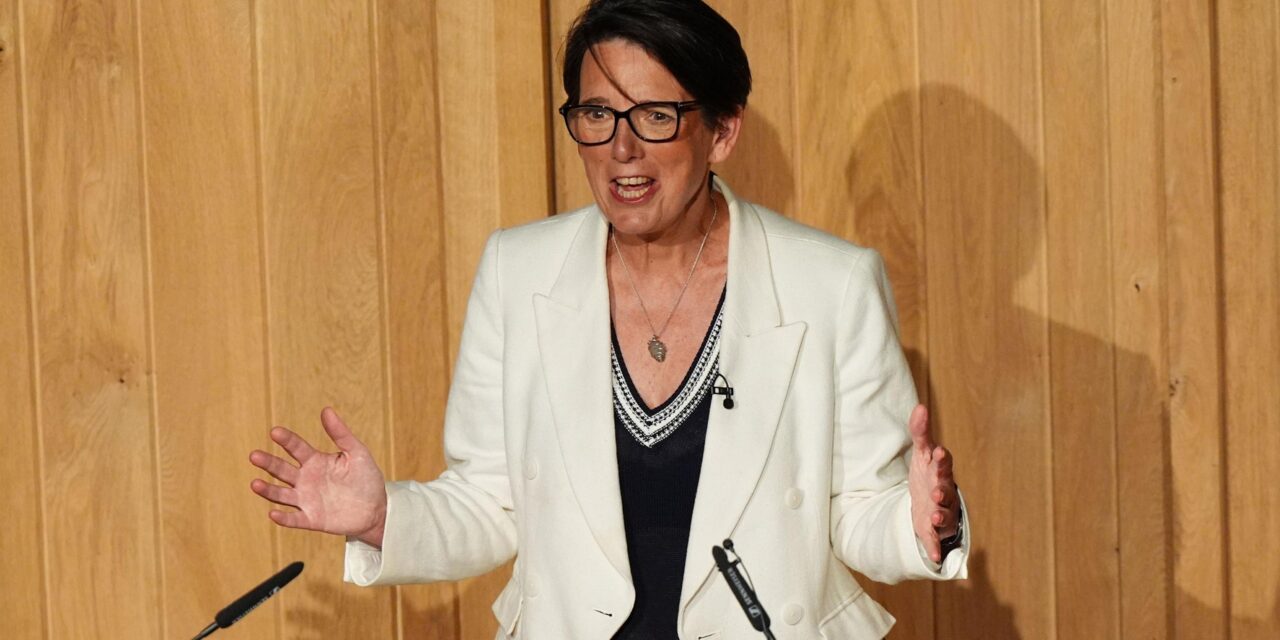
Anne Keast-Butler, director of the UK electronic intelligence agency GCHQ, addresses an audience, May 27, 2026 (PA)
EA-Ukraine VideoCast: Why Kremlin’s Threat to Destroy Kyiv Betrays Its Weakness
Ukraine War, Day 1,554: Europe’s Leaders Rebuff Russia’s Threat v. Embassies in Kyiv
UPDATE 1027 GMT:
The BBC’s Russia correspondent Steve Rosenberg reports on the expanding problem with fuel amid Ukraine’s strikes on refineries.
From today’s Russian papers: “The number of Russian regions with restrictions on the sale of fuel is multiplying.” The reason given? “Unscheduled repairs at oil refineries.” #ReadingRussia pic.twitter.com/SBRkVsZ46O
— Steve Rosenberg (@BBCSteveR) May 28, 2026
Russian companies were advised to curb sales of oil products in a Tuesday meeting with Deputy Prime Minister Alexander Novak, said “several people familiar with the situation”.
One source said a decision to ban exports is at an advanced stage, but the date has not been set.
UPDATE 1021 GMT:
Arriving in Sweden, Ukraine President Volodymyr Zelensky has announced an imminent agreement for support of Kyiv’s military.
I am in Sweden today on a working visit. We are preparing a major defense package for Ukraine and a strong step regarding Gripen fighter jets, which will definitely make our combat aviation more effective. Meetings are scheduled today with Prime Minister Ulf Kristersson, and… pic.twitter.com/WjwV589PKk
— Volodymyr Zelenskyy / Володимир Зеленський (@ZelenskyyUa) May 28, 2026
UPDATE 0651 GMT:
Ukraine President Volodymyr Zelensky has sent letters to Donald Trump and the US Congress warning of Kyiv’s worsening shortage of air defense systems, particularly anti-ballistic missile capabilities.
“When it comes to air defense against missiles, we rely on our friends,” Zelensky wrote. “When it comes to defending against ballistic missiles, we rely almost exclusively on the United States.”
Zelensky said neutralizing Vladimir Putin’s “last major advantage on the battlefield” would force the Russian leader to negotiate.
In his nightly address to the nation, Zelensky summarized:
The sooner we are able to provide greater protection against ballistic threats, the sooner we will be able to make diplomacy work. As long as Russia continues to rely on missiles, its interest in diplomacy is not real. We must correct this. And we can do so only together with America.
This week, I prepared a special letter addressed to the President of the United States and to Congress. And yesterday, the letter was officially delivered to the institutions in Washington. It is quite rare for the leader of another state to address both the President and… pic.twitter.com/FtHmdimd9A
— Volodymyr Zelenskyy / Володимир Зеленський (@ZelenskyyUa) May 27, 2026
Ukrainian officials are concerned about the country’s limited supply of Patriot interceptors and other Western-provided systems. “It’s really tough when it comes to anti-ballistic defense,” one person familiar with the matter said.
UPDATE 0639 GMT:
A father has been killed and his wife and two daughters, aged 3 and 6, wounded in a Russian attack on a children’s playground in Kherson city in southern Ukraine.
The strike occurred around 5:30 p.m. on Wednesaday. Russian forces used multiple-launch rocket systems in the attack on the playground where families had gathered. Four civilians were wounded.
The mother and her daughters suffered blast injuries and multiple shrapnel wounds and are receiving medical treatment.
Kherson was liberated in November 2022. Since summer 2024, Russian drone attacks have intensified, deliberately targeting civilians in a “human safari”.
ORIGINAL ENTRY: Almost 500,000 Russian soldiers have been killed in Ukraine during Vladimir Putin’s full-scale invasion, says the head of the UK electronic intelligence agency GCHQ.
Confirming reports of war monitors, Anne Keast-Butler said Russian forces are “going backwards on the battlefield” inside Ukraine for the first time since late 2022.
She then spoke of “new intelligence showing that almost half a million Russian soldiers have now been killed since the conflict began”.
The independent Russian outlets Meduza and Mediazona have documented 352,000 Russian fatalities from examination of public records.
Ukraine’s General Staff said on Wednesday that Russia has lost 1,358,950 troops — killed, wounded, or captured — since the full-scale invasion was launched on February 24, 2022.
Amid Russia’s assaults trying to seize more territory in eastern Ukraine, their casualties were estimated by Western intelligence agency at around 30,000 during April. US Secretary of State Marco Rubio said 15,000 to 20,000 Russians are slain each month.
Despite its manpower advantages, Russia’s gradual gains have slowed and then stopped. In April, Ukraine regained territory for the first time since 2023.
“6-Month Critical Window” For Ukraine
Brig. Gen. Andrii Biletsky, commander of Ukraine’s Third Army Corps, said in an interview that Russia’s army is exhausted and incapable of making major breakthroughs: “The lack of personnel no longer allows them to advance the way they did, for example, a year ago.”
Biletsky assessed that Ukraine can push Russia to abandon its quest to seize the rest of the Donetsk region in the east of the country.
We need to define those directions where we can improve our positions, take some strategic points, and then speak with the Russians from a position of strength – not weakness – about a truly stable truce.
From a military point of view, this is realistic.
He summarized, “I believe the next six to nine months are a turning point. More precisely, I think the next six are the most critical.”