
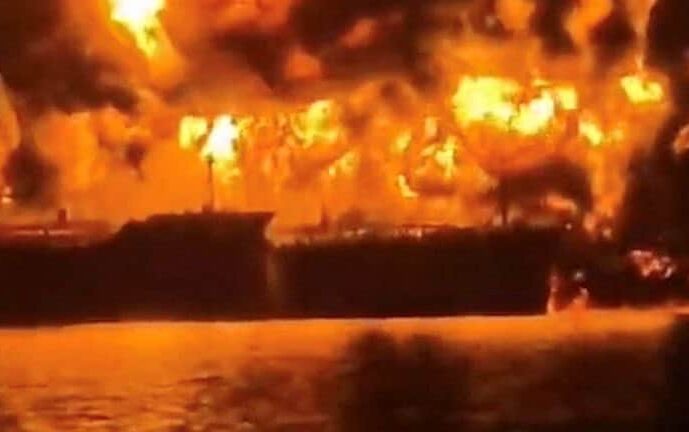
Fuel tankers ablaze after an Iranian attack on the Iraqi port of Basra, March 11, 2026
EA-Times Radio VideoCast: War on Iran — Trump’s Lies, Betrayal, and Choice of Putin Over US Troops
EA-Irish Examiner Podcast: Trump Does Not Know How to End His “Uncontained War” with Iran
EA on International Media: US-Israel War on Iran — Trump and Co. Ramble On with No Plan B
US-Israel War on Iran, Day 12: Both Sides Declare “Most Intense” Strikes of War
UPDATE 0847 GMT:
Iran’s Health Ministry says at least 202 children and 223 women, including three pregnant mothers, have been killed during the US-Israel War.
Twelve of the slain children were under the age of five.
UPDATE 0738 GMT:
Oil-loading operations have resumed at the UAE’s port of Fujairah after a drone attack and fire early Saturday.
The port processes around a million barrels per day of the UAE’s Murban crude oil, equivalent to around 1% of global demand.
On Saturday, Iran issued an evacuation warning for three major ports in the UAE. It claimed the US used “ports, docks and hideouts” in the Emirates to launch strikes on Kharg Island, the hub for more than 90% of Iranian oil exports.
UAE’s Defense Ministry said on Sunday morning, “Air defenses are currently responding to incoming missile and drone threats from Iran.”
Iran has fired more than 1,800 missiles and drones at the UAE during retaliation for the US-Israel War which began February 28.
International Cooperation Minister Reem Al Hashimy said Iranian attacks on Gulf States are “almost unhinged”.
We’ve borne the brunt of most of the missiles and drone attacks, and it’s really quite surprising for us that Iran has taken such an irrational path to fight the Gulf States and act in this quite unlawful, quite unacceptable manner.
UPDATE 0724 GMT:
US officials say Israel informed Washington this week that it is running critically low on ballistic missile interceptors.
One official said the US has been aware of Israel’s low capacity for months, “It’s something we expected and anticipated.” He emphasized that the US has adequate supplies: “We have all that we need to protect our bases and our personnel in the region and our interests.”
It is unclear if the US will share any of its interceptors with Israel. The US official said the Israelis are “coming up with solutions to address” their shortage.
Israel’s Foreign Minister Gideon Saar denied the report.
UPDATE, MARCH 16:
The chair of the US Federal Communications Commission, Brendan Carr, has threatened to ban broadcasters over reporting of the US-Israel War which the Trump Administration does not like.
Carr, a political appointee of Donald Trump, posted:
Broadcasters that are running hoaxes and news distortions – also known as the fake news – have a chance now to correct course before their license renewals come up.
The law is clear. Broadcasters must operate in the public interest, and they will lose their licenses if they… https://t.co/7bBgnsbalw
— Brendan Carr (@BrendanCarrFCC) March 14, 2026
On Thursday, Defense Secretary Pete Hegseth berated journalists for their coverage of the US-Israel War, saying they should be a “patriotic press”. Yesterday Donald Trump railed at “sick and demented people” such as the New York Times and the Wall Street Journal.
The Administration has been rattled by revelations in the media such as the US strike that killed at least 175 people, most of them children, in a primary school in southern Iran on February 28. Outlets have exposed the lack of planning by the Trump camp for Iran’s retaliatory strikes and the closing of the Strait of Hormuz.
Trump railed on Friday about the coverage, citing US officials, of an Iranian missile strike damaging five US military tankers on an airfield in Saudi Arabia.
But in an interview with NBC News, he admitted that he was not prepared for Iran’s strikes on Gulf States.
Calling the States “terrific”, he said, “They got shot at unnecessarily”. This was “the biggest surprise I had of this whole thing.”
On Friday, the US State Department ordered “non-emergency US government employees” and the family members of US government employees to leave Oman, citing “safety risks”.
UPDATE 1520 GMT:
The toll from Israel’s strikes on Lebanon since March 2 has risen to 826 killed, including at least 106 children and 65 women, and 2,009 wounded.
The Lebanese Health Ministry said the number of paramedics killed has risen to 31, after two missing health workers were recovered from the rubble of a primary healthcare centre in Burj Qalawiya.
Five hospitals have been forced to shut down due to direct attacks or security threats.
Officials said the toll could rise with rescue teams still searching damaged sites.
More than 1 million people have been displaced as Israel issued another evacuation order for the southern suburbs of Beirut.
UPDATE 1211 GMT:
Iran has allowed some Indian vessels to pass through the Strait of Hormuz, says Tehran’s Ambassador to India Mohammad Fathali.
The Indian Ports, Shipping and Waterways Ministry said permission was granted to two Indian-flagged tankers carrying liquefied petroleum gas bound for ports in the country’s west.
On Friday, Türkiye’s Transport Minister said a Turkish-owned ship has moved through the Strait after receiving approval from Iran.
UPDATE 1207 GMT:
Semi-official Iranian outlets, citing local officials, claim oil exports from Kharg Island are continuing as normal after US attacks on Friday.
One official said the oil terminal is “fully operational” and activities “continue without interruption”. There were no reports of casualties.
The Mehr news agency said, “The situation on the island has quickly returned to normal and conditions are under control.”
US Central Command proclaimed:
Last night, U.S. forces executed a large-scale precision strike on Kharg Island, Iran. The strike destroyed naval mine storage facilities, missile storage bunkers, and multiple other military sites. U.S. forces successfully struck more than 90 Iranian military targets on Kharg… pic.twitter.com/2X1glD4Flt
— U.S. Central Command (@CENTCOM) March 14, 2026
UPDATE 1053 GMT:
Five US Air Force refueling planes were struck and damaged on the ground by an Iranian missile strike on Prince Sultan airbase in Saudi Arabia.
Two US officials said the tankers were hit in recent days. They were damaged but not fully destroyed and are being repaired.
No one was killed by the strikes.
UPDATE 1035 GMT:
Twelve medical workers were murdered by an Israeli strike on a health center in southern Lebanon on Friday night.
The attack was on the village of Burj Qalaouiyah in the Bint Jbeil District, killing doctors, paramedics, and nurses were on duty.
The Lebanese Health Ministry said on Friday that 773 people, including more than 100 children have been killed by Israeli strikes since March 2. More than 800,000 people have been displaced amid Israeli orders for forced evacuations across southern Lebanon and southern suburbs of Beirut.
UPDATE 1005 GMT:
Some oil loading operations in the UAE’s port of Fujairah, near the Strait of Hormuz, have been suspended after a drone attack and fire.
Iran’s Revolutionary Guard Corps said US interests in the UAE, including ports, docks, and military locations, are legitimate targets after the US attacked the strategic oil hub of Kharg Island.
The Guards urged residents in the UAE to evacuate ports, docks, and US military shelters.
UPDATE 0639 GMT:
Iran or its allies have struck the US Embassy in Baghdad early Saturday.
Reports said a drone was used, but two Iraqi security officials said a missile struck a helipad inside the compound.
Explosions rang out across Iraq’s capital soon after US-Israel attacks killed two fighters of the Iran-backed militia Kata’ib Hezbollah near Baghdad.
UPDATE 0634 GMT:
A US official says 2,500 marines and the amphibious assault ship USS Tripoli are being deployed to the Middle East.
The 31st Marine Expeditionary Unit and the Tripoli are based in Japan and have been in the Pacific Ocean for several days.
The US Navy already has 12 warships, including the aircraft carrier USS Abraham Lincoln and eight destroyers, in the Arabian Sea.
UPDATE, MAR 14:
Iran has threatened attacks on oil companies across the Middle East if the US strikes Kharg Island, the hub for 90% of Iran’s oil exports.
Energy infrastructure would be “immediately be destroyed and turned into a pile of ashes”, the Iranian military pledged.
The threat followed Donald Trump’s unsupported claim that US strikes have “obliterated” Tehran’s forces on the island in the northern Persian Gulf.
“For reasons of decency, I have chosen NOT to wipe out the Oil Infrastructure on the Island,” he posted on social media. “However, should Iran, or anyone else, do anything to interfere with the Free and Safe Passage of Ships through the Strait of Hormuz, I will immediately reconsider this decision.”
Iranian media said there has been no damage to oil infrastructure on the island.
On Thursday, Iran’s Parliament Speaker Mohammad-Bagher Ghalibaf posted that any attacks on the island would prompt the Islamic Republic to “abandon all restraint”.
Neil Quilliam of the UK Royal Institute of International Affairs cautioned, “We may see the $120 a barrel [oil] price we saw [last] Monday heading to the $150 if Kharg were attacked. It’s too vital for global energy markets.”
UPDATE 1704 GMT:
Donald Trump has accepted Russia’s supply of information to Iran targeting US warplanes, warships, and troop positions.
KILMEADE: You think Putin is helping Iran?
TRUMP: I think he might be helping them a little bit, yeah. And he probably thinks we're helping Ukraine, right?
KILMEADE: And you are, right?
TRUMP: Yeah, we're helping them also, and so he says that, and China would say the same… pic.twitter.com/0QWp173bm5
— Aaron Rupar (@atrupar) March 13, 2026
UPDATE 1701 GMT:
A drone strike killed two members of an Iranian Kurdish armed opposition group in northern Iraq on Friday.
“A drone struck one of our positions at 4.40pm, killing two party members and wounding four others,” said Mardin Zahidi of the Khabat Organisation of Iranian Kurdistan.
The attack was in the Bashiqa Mountains between the city of Mosul and Iraqi Kurdistan.
Reports earlier this month said the Trump Administration was considering the incursion of Iranian Kurdish fighters, armed and trained by the US military and the CIA, into western Iran. However, the initiative was apparently halted, in part because of Turkish objections and opposition from Iraqi and Iraqi Kurdish leaders.
UPDATE 1657 GMT:
Turkey’s Defense Ministry has confirmed the downing of a ballistic missile launched from Iran, the third intercepted during the US-Israel War.
The Ministry said the missile “was neutralized by NATO air and missile defense assets deployed in the eastern Mediterranean”.
On Friday, red alert sirens sounded at the Incirlik airbase in southeast Turkey, a key NATO site.
UPDATE 1619 GMT:
At least 773 people in Lebanon have been killed in by Israeli strikes since March 2, reports the Lebanese Health Ministry.
Another 1,933 people have been wounded, including 103 children.
UPDATE 1506 GMT:
All six crew members on a US KC-135 refuelling warplane that crashed in western Iraq are confirmed dead.
US Central Command said earlier that four crew had perished in the collision of two KC-135s above western Iraq on Thursday, but rescue operations were continuing.
Thirteen US military personnel have been killed during the war on Iran.
UPDATE 1504 GMT:
Israel has issued evacuation orders for most of southern Lebanon, instructing residents within 25 miles of the border to head north.
UPDATE 1015 GMT:
Donald Trump insisted to G7 leaders in a virtual meeting Wednesday that Iran is “about to surrender,” according to “three officials from G7 countries briefed on the contents of the call”.
“I got rid of a cancer that was threatening us all,” he boasted. “Nobody knows who is the leader, so there is no one that can announce surrender.”
On Thursday, Iran’s new Supreme Leader, Mojtaba Khamenei, issued a statement on State TV declaring Tehran’s defiance.
The other G7 leaders urged Trump to end the war quickly, stressing that the Strait of Hormuz must be secured as soon as possible.
Trump insisted that despite Iran’s effective closure of the Strait, the situation is improving and commercial ships should resume operations in the area.
He was “ambiguous and noncommittal” about his objectives and timelines for ending the war, officials said.
UPDATE 0951 GMT:
A Turkish-owned ship has passed the Strait of Hormuz after receiving approval from Iran.
Turkiye’s Transport Minister Abdulkadir Uraloglu said, “Fifteen ships were there. We obtained permission from the Iranian authorities for one of them, which had used an Iranian port, and it passed.”
UPDATE 0944 GMT:
Four of the six crew aboard a crashed US KC-135 refuelling airplane have been killed.
Two KC-135 tankers collided above western Iraq. The second airplane safely landed.
Rescue efforts continue.
Four Confirmed Deceased in Loss of U.S. KC-135 Over Iraq
TAMPA, Fla. – At approximately 2 pm ET on March 12, a U.S. KC-135 refueling aircraft went down in western Iraq. Four of six crew members on board the aircraft have been confirmed deceased as rescue efforts continue.
The…
— U.S. Central Command (@CENTCOM) March 13, 2026
UPDATE 0733 GMT:
The Iranian Red Crescent says 24,531 civilian units have been damaged by US and Israeli strikes.
They include 19,775 residential units; 4,511 business units; 69 schools; 16 Red Crescent centers; 21 rescue and relief vehicles; and 19 ambulances.
UPDATE 0721 GMT:
Iran’s Revolutionary Guards have promised an even bloodier repression if January’s nationwide protests are renewed.
Iranian forces killed several thousand demonstrators, most of them on the nights of January 8 and 9.
“The evil enemy, failing to achieve its field battle goals, is once again pursuing the instillation of fear and street riots,” the Guards said in a statement broadcast on State TV.
They promised “a stronger blow than on January 8”.
UPDATE 0711 GMT:
Two people have been killed in Oman from debris after air defenses intercepted one of two drones launched upon the Al Awahi industrial area.
An Iranian attack set afire an industrial area in Dubai in the UAE.
Smoke rose from the blaze in the Al Quoz neighborhood.
The Dubai Media Office played down the explosion:
Authorities confirm that debris from a successful interception caused a minor incident on the façade of a building in central Dubai. No injuries have been reported.
— Dubai Media Office (@DXBMediaOffice) March 13, 2026
Saudi Arabian forces downed a “hostile drone” heading towards the embassies district in Riyadh. Three drones were intercepted over eastern Saudi Arabia.
A red alert sounded for around five minutes at the Incirlik airbase near Adana in southeast Turkey.
UPDATE 0613 GMT:
The Trump Administration has burned through “years” of critical munitions in the US-Israel War on Iran, say “three people familiar with the matter”.
The rapid depletion of weaponry includes advanced long-range Tomahawk missiles. One official said of the “massive expenditure”: “The navy will be feeling this…for several years.”
US officials have told the Senate Armed Services Committee that the cost of the war on Iran was more than $11.3 billlion in its first six days.
The total did not include many costs associated with the operation, such as the buildup of military hardware and personnel ahead of the initial strikes.
UPDATE 0606 GMT:
A French soldier was killed on Thursday in an attack in Erbil in Iraqi Kurdistan.
French President named the victim, France’s first of the US-Israel War on Iran, as Chief Warrant Officer Arnaud Frion of the 7th Battalion of Chasseurs Alpins.
This attack against our forces engaged in the fight against Daesh [the Islamic State] since 2015 is unacceptable. Their presence in Iraq is part of the strict framework of the fight against terrorism. The war in Iran cannot justify such attacks.
France’s army said earlier that six French soldiers in training with Iraqi partners had been wounded by a drone attack.
UPDATE, MARCH 13:
US officials say the Trump Administration was unprepared for Iran’s laying of mines in the Strait of Hormuz on Thursday.
Donald Trump wrote on Monday that he would hit Iran “twenty times harder” if they blocked the waterway. He and Defense Secretary Pete Hegseth have proclaimed that the Iranians cannot control the Strait because the US has destroyed their navy.
However, Tehran is using smaller boats to place mines in the Strait, through which around 25% of the world’s maritime oil and 20% of the maritime gas passes.
Senior Trump administration officials told lawmakers in classified briefings that they did not plan for the possibility.
Iran said it was closing the Strait just after the initial US-Israel strikes on February 28. Two days later, a senior Republican Guards official announced that the passage was closed and claimed Iran would “set those ships ablaze”.
“Planning around preventing this exact scenario … has been a bedrock principle of US national security policy for decades,” explained a “former US official who served in Republican and Democratic administrations“.
“I’m dumbfounded,” he said.
Energy Secretary Chris Wright admitted on Wednesday that the US military is “not ready” to escort tankers through the Strait.
It’ll happen relatively soon, but it can’t happen now….All of our military assets right now are focused on destroying Iran’s offensive capabilities and the manufacturing industry that supplies their offensive capabilities.
UPDATE 2216 GMT:
An American KC-135 refueling aircraft crashed in friendly airspace in western Iraq on Thursday.
The other warplane involved in the incident safely landed.
US Central Command said rescue operations continue.
U.S. Central Command is aware of the loss of a U.S. KC-135 refueling aircraft. The incident occurred in friendly airspace during Operation Epic Fury, and rescue efforts are ongoing. Two aircraft were involved in the incident. One of the aircraft went down in western Iraq, and the…
— U.S. Central Command (@CENTCOM) March 12, 2026
UPDATE 1645 GMT:
US officials have told the Senate Armed Services Committee that the cost of the war on Iran was more than $11.3 billlion in its first six days.
The total did not include many costs associated with the operation, such as the buildup of military hardware and personnel ahead of the initial strikes.
UPDATE 1345 GMT:
Donald Trump has dismissed the 35% rise in oil prices spurred by the US-Israel War on Iran, arguing that “we make a lot of money” as well as stopping Iran from having Nuclear Weapons, and destroying the Middle East and, indeed, the World”.
UPDATE 1335 GMT:
In his first statement as Iran’s Supreme Leader, Mojtaba Khamenei has demanded that all US bases in the region be closed. If not, they will be attacked.
We will ask for compensation from the enemy. If we can’t get compensation from the enemy, we will destroy their properties as much as they have destroyed ours.
The statement was read out by a presenter on State TV. Khamenei reportedly suffered a fractured foot and facial lacerations in the attack on February 28 that killed his father and predecessor, Ali Khamenei; his mother; and his wife as well as dozens of commanders and officials.
While professing “friendship” with neighboring countries, Khamenei indicated attacks on them will continue on the pretext of striking US bases. He added that the Strait of Hormuz will remain closed.
The resistance in Yemen “will also do the job”, Khamenei said, and armed groups in Iraq “want to help” Iran. He thanked Iran’s military and said, “We will avenge the blood of our martyrs.”
UPDATE 1325 GMT:
Energy Secretary Chris Wright has admitted that the US military is “not ready” to escort tankers through the Strait of Hormuz.
It’ll happen relatively soon, but it can’t happen now. We’re simply not ready.
All of our military assets right now are focused on destroying Iran’s offensive capabilities and the manufacturing industry that supplies their offensive capabilities.
He asserted that it is “quite likely” the escorts will take place by the end of the month.
UPDATE 1321 GMT:
The Israel Defense Forces have expanded their evacuation orders for southern Lebanon, encompassing dozens more towns.
The IDF issued the warning to all civilians south of the Zahrani River.
“Anyone who is near Hezbollah members, its facilities, or its [weapons] is putting their life at risk. Any building used by Hezbollah for military purposes may become a target,” an IDF spokesman said.
UPDATE 1226 GMT:
A long-time military observer in Syria reported that US airstrikes killed more than 30 Iran-backed militiamen and wounded dozens along the Iraq-Syria border.
The “Iraqi Islamic Resistance” earlier claimed to have launched 13 attacks with drones targeting “enemy bases” in Iraq and the region.
UPDATE 1204 GMT:
The United Nations Children’s Fund (UNICEF) says more than 200 children have been killed and more than 1,100 injured in Iran by the US-Israel War.
The organization also said 91 children have been killed in Lebanon, four in Israel, and one in Kuwait.
UNICEF called for “an immediate end to the war”, and urged combatants to exercise extreme caution in military operations to reduce harm to civilians, particularly children.
“Nothing justifies the killing and maiming of children or the destruction and disruption of essential services upon which children depend,” the statement summarized.
UPDATE 1132 GMT:
The UN High Commission for Refugees says up to 3.2 million people have been displaced inside Iran during the US-Israel War.
Ayaki Ito, the refugee response coordinator for the Middle East emergency, said between 600,000 and 1 million Iranian households are now temporarily displaced.
“This figure is likely to continue rising as hostilities persist, marking a worrying escalation in humanitarian needs,” he said.
UPDATE 0710 GMT:
US intelligence services assess that Iran’s leadership is largely intact and is not at risk of collapse soon.
Three officials said a “multitude” of intelligence reports provide “consistent analysis that the regime is not in danger” and “retains control of the Iranian public”.
A “senior Israeli official” said colleagues have acknowledged in closed meetings that they are not confident that the war will lead to a regime change.
He emphasized that Tel Aviv has no intention of allowing the current regime in Iran to remain in place, so a ground operation is necessary.
UPDATE 0635 GMT:
An Israeli drone strike along the seafront in central Beirut killed at least eight people and wounded 21 early Thursday.
The attack was Israel’s third on the center of the Lebanese capital during the war.
The drone strikes on the neighborhood of Ramlet al-Baydaa fell where hundreds of displaced people have been sleeping for the past week.
Riyadh al-Lattah, a 57-year-old woodworker from the southern suburbs of Beirut, was camped out with his wife and five children across the street from where bombs fell.
It was terrifying. We heard them hit once and then once again almost immediately. We didn’t think they would hit here. What’s here? It’s just the sea….
This war is harder. At least last time they would warn you. They’d tell you before they hit; now it’s just random bombings
Hussein al-Atrash, 18, said, “We came here because we thought we would be safe. Wherever we go, they bomb.”
Israeli strikes on Lebanon have killed at least 634 people and injured 1,586 since March 2. More than 816,700 residents have registered as displaced.
Iran’s Lebanese ally Hezbollah launched drones and rockets at northern Israel on Wednesday night, injuring two people.
ORIGINAL ENTRY: Retaliating against the US-Israel War, Iran escalated its strikes on the Gulf States on Wednesday, damaging shipping, energy, and port infrastructure.
In a late-night operation, Iranian boats struck three vessels in the Iraqi port of Basra on the Persian Gulf. Two fuel tankers, the Marshall Islands-flagged Safesea Vishnu and the Malta-flagged Zefyros, were set ablaze.
At least one crew member was killed. Another 38 were rescued, but others are missing.
The attack targeted a ship-to-ship transfer of oil. It is unclear if Iran used a flying or seaborne drone or a missile.
Three merchant ships were hit earlier in the day. The most serious attack was on the Thai-flagged bulk carrier Mayuree Naree, struck around 11 nautical miles north of Oman. Twenty crew members were rescued, but three are trapped in the engine compartment.
A cargo vessel caught fire, forcing its crew to evacuate, while a container ship sustained damage.
Bahrain’s authorities told residents in three areas of Musharraq to stay home after an Iranian attack on fuel tanks. They should “remain in their homes, They should “close windows and ventilation openings as precaution against potential effects of smokes from the fire currently being fought”.
Oman has shifted all vessels out of its main oil export terminal at Mina Al Fahal, outside the Strait of Hormuz, in a precautionary move. A storage facility was set on fire on Thursday.
Kuwait said its air defences had downed eight Iranian drones, and Saudi Arabia said it had intercepted five heading toward its Shaybah oil field.
Despite Donald Trump’s proclamations that his Administration would protect shipping in the Strait of Hormuz, the US Navy is still refusing requests from the industry for military escorts. “Sources familiar with the matter” say the risk of attacks is too high for now.
An Iranian official denied a report that it will allow Indian-flagged tankers to pass the Strait without threat of attack.
Oil Price Surges Past $100 Per Barrel
Oil prices recrossed the $100 per barrel threshold on Thursday, surging more than 9%.
The International Energy Agency had tried to stem concerns on Wednesday with its 32 member states approved the release of 400 million barrels from strategic reserves, more than double its largest previous intervention.
The release includes 172 million barrels from US reserves.
But the step was quickly overtaken by the Iranian attacks and the effective closure of the Strait, through which around 25% of maritime oil and 20% of maritime gas passes.
The price of oil, just above $60 per barrel when the US-Israel War was launched on February 28, reached $118 on Monday morning before falling back amid Donald Trump’s assertion that the war was “very complete”. It dropped below $90 before last night’s surge.

Desertions, shortages and army-IRGC rift strain Iran’s military
https://www.iranintl.com/en/202603127596
“Reserve mobilization falters
Efforts to widen the manpower pool appear to have run into resistance as well.
Sources said attempts by the Revolutionary Guards to mobilize reserve forces earlier this week produced limited results.
Many of those summoned for service reportedly did not report to military centers. Instead, some individuals used the situation to leave their areas and assist family members in moving toward border regions in hopes of leaving the country.”
Even FOX news has abandoned the President: Trump suddenly seems anxious to end the war as American casualties mount and Iran finds ways to hit back: https://www.foxnews.com/media/trump-suddenly-seems-anxious-end-war-american-casualties-mount-iran-finds-ways-hit-back