
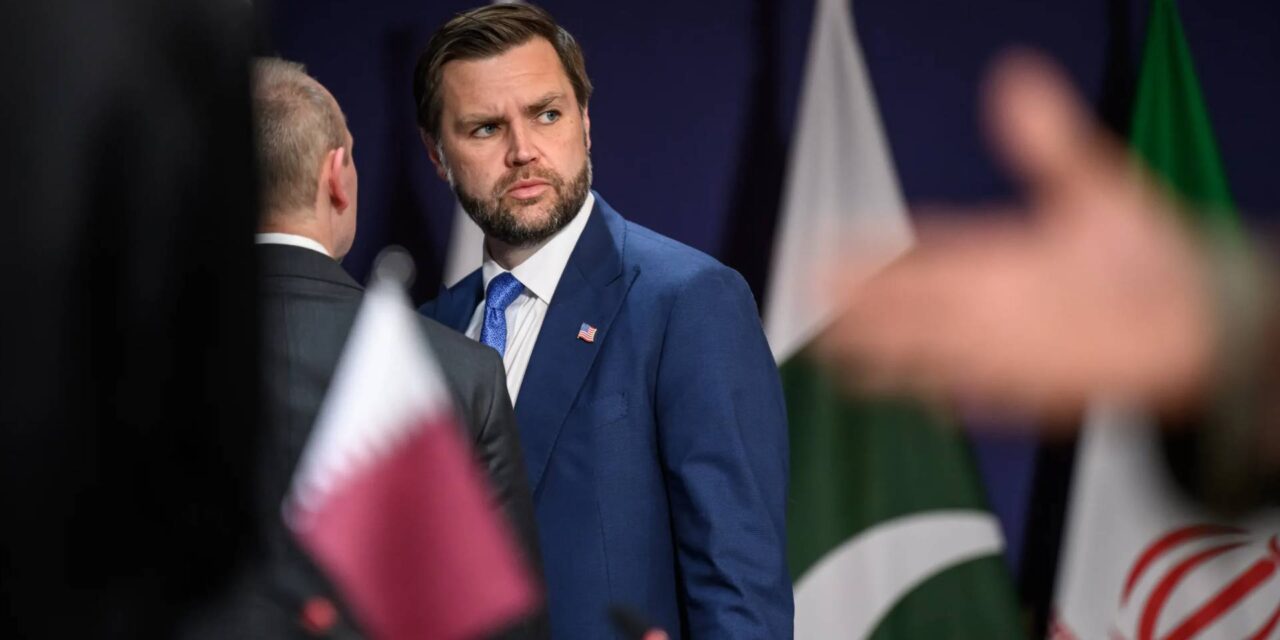
J.D. Vance before a quadrilateral meeting between the US, Iran, Pakistan, and Qatar at the Burgenstock resort overlooking Lake Lucerne, Switzerland, June 21, 2026 (Fabrice Coffrini/Reuters)
UPDATES: US War on Iran, Day 258 — “Minor” US Strikes on Qeshm Island in the Strait of Hormuz
US Vice President J.D. Vance, an opponent of the Trump camp’s War on Iran, has reportedly taken the lead in contacts with Tehran to end the conflict.
US officials told the Wall Street Journal that Vance has eclipsed Donald Trump’s envoys Steve Witkoff and Jared Kushner. In mid-October, the Vice President sent a message via Qatari mediators to Iran seeking the resumption of talks.
Vance is considering direct talks with Mohsen Rezaei, the Secretary General of Iran’s Supreme National Security Council. However, Rezaei said Tuesday that he has no plans to meet Vance.
The Vice President also seized the lead in June when Trump accepted a Memorandum of Understanding, largely based on Iran’s 14-point proposal, to end the war. However, under pressure for conceding too much to Tehran, the Administration soon backed away from the document and it lapsed in August.
Two US officials said Trump is criticizing the Memorandum, insisting that it is a mistake which allows Iran to recover and bring in oil revenues.
Secretary of State Marco Rubio is telling officials of other countries that the US must maintain its blockade on Iran, trying to force the regime into concessions. White House Chief of Staff Stephen Miller also supports the economic warfare.
Iran: No Talks at Present
Iran’s Rezaei said on Wednesday, “I affirm that we are not conducting any talks with the Americans at the present time. There are no negotiations between the United States and us at present.”
Reports of talks in Qatar were “lies and slander, and its aim is to ease economic pressures and lower oil prices”. Iran was not discussing its nuclear program with mediators, as Tehran is determined to keep all its enriched material for nuclear-powered ships and submarines which it is developing.
Rezaei said that, for the reopening of the Strait of Hormuz, the US must accept all seven core Iranian positions including a lifting of the US naval blockade; removal of sanctions; reparations for war damage; and an Israeli withdrawal from Lebanon.
The response we received from the Americans was a deceptive response and was marred by much ambiguity and confusion.
We asked them to give a frank and clear response to our conditions, and to this day they have not provided it, and they may provide this response in the future.
He reiterated that the US must accept all seven core Iranian positions — including a lifting of US sanctions and blockade, reparations, and an Israeli withdrawal from Lebanon — for the Strait of Hormuz to be opened.
“The first item in our diplomacy with the United States is ending the war on all fronts, particularly in Lebanon,” he said.
He warned, “If the Americans make a mistake and attack us, we will not content ourselves with targeting nearby bases, but will strike all nearby bases, and we will also target distant American bases.”
Any base, including in Europe, from which US planes take off will be considered a target.
Rezaei proclaimed that Trump and Israel Prime Minister Benjamin Netanyahu no longer have the political ability to wage even a 10-day war.
Iran Strikes Omani Island
“Three sources with knowledge of the matter” confirmed Wednesday that Iran attacked ship navigation systems on the Omani island of Didamar in the Strait of Hormuz.
Iranian State media said on Tuesday that the Revolutionary Guards had carried out the strikes.
The three sources did not provide a damage assessment. Video showed smoke rising but it was unclear what was burning.
Shipping officials said the attacks will likely have limited impact on commercial shipping, as other systems are in place elsewhere.