
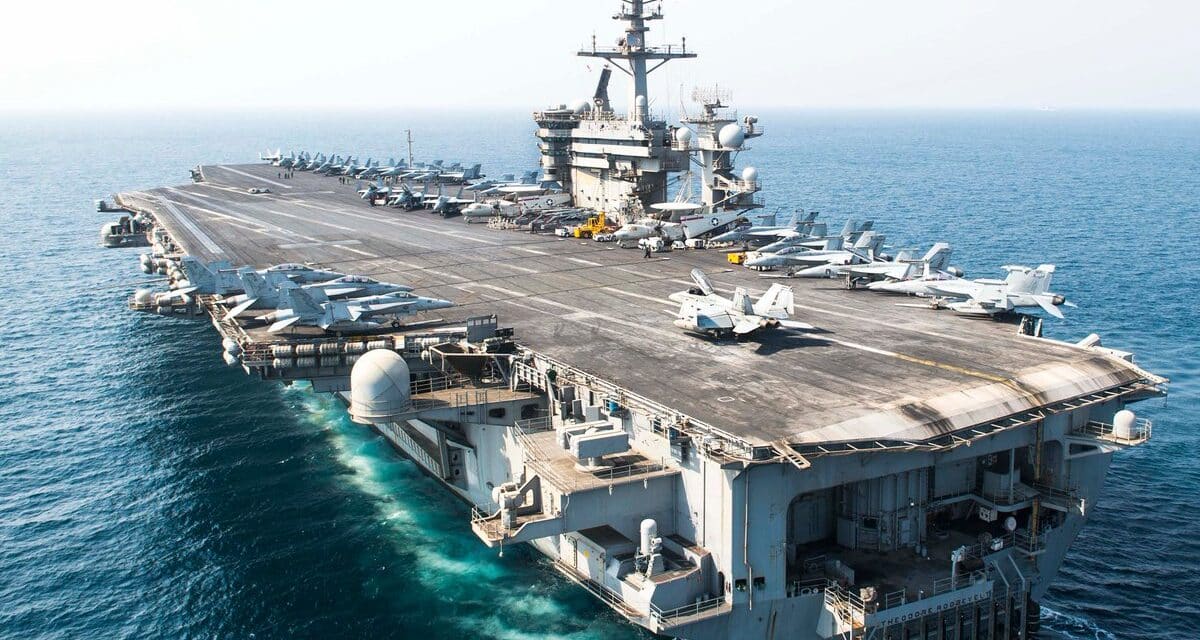
USS Theodore Roosevelt
UPDATE 1323 GMT:
An oil tanker crossing the Strait of Hormuz has turned back after it was hailed by Iran’s Revolutionary Guards and told that it might be targeted.
The UK Maritime Trade Operations center said the incident occurred 20 km (11 nautical miles) north of Khasab, Oman.
UPDATE 1035 GMT:
The head of Saudi Arabia’s State oil company Aramco says the global squeeze on crude oil and refined fuels, triggered by the US-Israel War on Iran, is likely to worsen.
Amin Nasser estimated that refilling global stockpiles, used for emergency measures, could take two years.
“Until Hormuz fully reopens and confidence returns, the crude reality is that pressure at both ends of the barrel will intensify,” he told the Energy Intelligence conference in London.
UPDATE 0916 GMT:
Iran held a high-level government meeting on Saturday about the economic damage of the US War.
Mohsen Rezaei, the Secretary of the State National Security Council, said that “the circumstances [are] among the most difficult periods the country has faced”.
In recent days, government and private sector employees, including nurses and teachers, have posted on social media that they are quitting their jobs because their salaries no longer support them. Retired government employees have held protests in recent weeks, complaining they have not received their full pensions.
President Masoud Pezeshkian, who was at the meeting, acknowledged the worsening conditions on social media on Saturday. He said the government “has adopted a new posture to manage the special conditions”, without specifying the measures.
UPDATE 0537 GMT:
Declaring an offensive to regain lost territory, the Saudi-backed Yemeni Government claims 1,122 attacks against Houthi sites, including artillery positions, rocket launchers and command and control centers.
The Government’s military declared that around 1,747 Houthi fighters were slain in the Saada, al-Jawf, and Taiz Provinces and along Yemen’s coast.
UPDATE 0534 GMT:
Israeli military shelling has targeted the municipalities of al-Mansouri, Majdal Zoun and the outskirts of Haddatha and Baraachit in southern Lebanon.
UPDATE, OCT 5:
Middle East oil exports surpassed their pre-war level last week for the first time.
The weekly average of shipments rose for several days above the pre-conflict average of 18 million barrels per day.
Despite the rise, the Brent crude oil price stands at $101.50 per barrel, compared to just over $60 before the US-Israel War on Iran.
Iran Revolutionary Guards commander Ali Fadavi insisted in a televised interview that the Strait of Hormuz remained under Tehran’s control. He said the Guards have warned ships using the US-supervised southern route in the waterway that “their vessels may be targeted at any point”.
Fadavi declared that only 3 to 4 million barrels of oil per day are now moving through the route.
UPDATE 1019 GMT:
A tanker in the Strait of Hormuz has been struck by a projectile, damaging the engine room, reports the UK Maritime Trade Operations center.
The crew is reportedly safe.
UPDATE 0651 GMT:
Iran Foreign Minister Abbas Araghchi says Tehran is “serious about finding diplomatic solutions, just as we are serious about defending ourselves”.
We are ready to reach a just solution through diplomatic channels, and at the same time we are prepared to deliver a more devastating response to any military aggression.
Parliament Speaker Mohammad Bagher Ghalibaf said earlier that Tehran is neither “excited” nor “intimidated” by American actions, and will “both fight and negotiate”.
We are present on the military battlefield with all our might and will confront him with new surprises, and we also use the tools of diplomacy to establish our superiority in the military field and impose the rights of the Iranian people.
Ghalibaf added:
The Americans, who say something different in the media, have recently put forward proposals through a mediator. But they must understand that the period of dragging out the process and dictating one-sided demands is over.
The position of the Islamic Republic of Iran is completely clear and firm, and the Strait of Hormuz will not be opened until our seven conditions, based on the Islamabad Memorandum of Understanding, are met.
UPDATE, OCT 4:
The
Click here to learn more
.
UPDATE 1622 GMT:
Yemen’s Houthis say Saudi forces launched 26 strikes on the capital Sana’a today, a day after the first attacks in years.
No deadlines were given on casualties.
Fighting continues in Taiz, with Saudi-backed Yemeni government forces claiming control of the Samaa fort after “violent battles”. A source said dozens of Houthi fighters were killed or wounded and others fled.
UPDATE 0641 GMT:
Iran’s authorities have executed another participant in January’s nationwide protests.
Siavash Jamshidi Kheirabadi was hanged early Saturday on a charge of moharebeh, “enmity against God”. He was accused of firing on security forces on January 8.
Alongside China as the world’s leading executioner per capita, Iran has hanged more than 30 protesters following its killing of several thousand people during the protests.
UPDATE 0539 GMT:
Israeli warplanes have launched two air attacks targeting the town of Bani Haiyyan in the Marjayoun district of southern Lebanon.
There is no immediate information about casualties or the extent of damage.
UPDATE 0457 GMT:
The Yemen Government’s armed forces say they carried out 474 air strikes and precision attacks with 24 hours against Houthi positions, movements, reinforcements, and military capabilities.
Military spokesperson Colonel Majid al-Nuzaili said the operations involved warplanes, drones, artillery, missiles, and rocket launchers, with particularly heavy activity in the Taiz region.
He claimed the attacks killed or wounded 1,540 Houthi fighters, most of them on the Taiz fronts, and destroyed or damaged 216 military vehicles and other capabilities.
The Houthis said Saudi forces carried out 94 airstrikes and missile attacks on civilian sites in Sanaa, Saada, Taiz, Hajjah, Amran, and Ibb, resulting in casualties.
UPDATE 0453 GMT:
A crude oil tanker has been struck by an unknown projectile, 4 nautical miles east of Oman, reports the UK Maritime Trade Operations center.
All crew are reported safe and there has been no environmental impact.
UPDATE, OCT 3:
Senior members of the Trump Administration met for hours at the Camp David retreat on Friday, discussing next steps in the War on Iran and the Saudi-Houthi conflict in Yemen, said three US officials.
Vice President J.D. Vance chaired the meeting. Secretary of State Marco Rubio, Secretary of Defense Pete Hegseth, Trump envoy Steve Witkoff, CIA director John Ratcliffe, and chairman of the Joint Chiefs of Staff Gen. Dan Caine participated.
“Things were decided or at least deeply discussed,” said one official.
UPDATE 1744 GMT:
Yemen’s Houthis say Saudi forces launched 94 strikes against areas under their control in the past 24 hours.
The group said there have been 1,350 Saudi strikes across Houthi-held areas since fighting was renewed.
UPDATE 1733 GMT:
Leaders of G7 nations — Canada, France, Germany, Italy, Japan, the UK, and the US — have agreed to release up to 100 million barrels from emergency diesel and crude oil stockpiles.
Donald Trump, who is facing a doubling of US diesel prices to a historic record and November’s mid-term elections, has demanded the release and threatened a ban on American diesel exports.
French President Emmanuel Macron, the current chair of the G7, say the drawdown will be coordinated by the International Energy Agency and take place within four months. G7 members and partners will front-load a substantial diesel release within the first 20 days.
After a leaders’ meeting, Macron said the G7 nations want to “work in a coordinated manner to help bring down the prices of petroleum products, particularly diesel”.
The President added that G7 leaders have agreed to make production more flexible so refineries can work at their maximum capacity. They will not take any measures to “restrict the exchange of energy and petroleum products between partner countries”.
The G7 leaders said they would discuss the “possibility of additional diesel releases as necessary” in the coming days.
UPDATE 1437 GMT:
Three in four families in parts of Yemen are going hungry from the “absolutely devastating” impact of a surge in fighting, reports the UN’s World Food Programme.
The surge in conflict between the Saudi-backed government and the Houthi group has displaced tens of thousands of people and disrupted supplies to millions. The share of households without sufficient food has risen to 74% in government-controlled areas, with a population around 10 million, accessible to WFP.
UPDATE 0859 GMT:
Donald Trump reportedly launched a foul-mouthed tirade against Defense Secretary Pete Hegseth, weeks into the US-Israel War on Iran.
In April, Trump summoned Hegseth and other senior military officials for an update, having told the public that the war would have been won by then.
Trump handed Hegseth a printout of a New York Times article about the US rapidly draining its munitions stockpiles. That included the use of more than 1,200 Patriot interceptor missiles at a cost of more than $4 million each, and of more than 1,000 Tomahawk cruise missiles, roughly 10 times the amount purchased each year.
“What the fuck is this?” Trump said, handing Hegseth the printout.
The Defense Secretary tried to dismiss the report, including the US being forced to obtain military supplies in Asia and Europe, as “fake news”.
However, the figures were based on internal Defense Department estimates.
UPDATE 0531 GMT:
Saudi Arabia says Yemen’s Houthis attacked an electricity facility in the holy city of Medina.
The Houthis deny the claim.
In Yemen, Saudi-backed government forces say they are repelling a large-scale Houthi attack in the Taiz Governorate and inflicting heavy losses. They said they carried out 20 air attacks in three hours against Houthi movements, reinforcements, and military vehicles.
UPDATE 0522 GMT:
The US has deployed two extra Patriot missile defense system batteries to Saudi Arabia and Qatar for their oil and gas facilities, say “two US officials and one regional source”.
The batteries were delivered month.
Axios notes the US, needing to use Saudi airspace for renewed attacks on Iran, would likely be denied if the Saudis fear energy facilities are exposed to Iranian retaliation.
ORIGINAL ENTRY: The US is sending a third aircraft carrier strike group to the Middle East, as the Trump camp threatens a renewal of a full-scale War on Iran.
The Trump camp had three carrier strike groups in the Middle East in April, just before the ceasefire with Iran, for the first time since 2003.
The USS Theodore Roosevelt’s deployment also includes the USS Makin Island specialist amphibious attack group with two amphibious landing ships. There are more than 7,000 sailors and 2,000 Marines, bringing the US naval presence to more than 20,000 sailors and Marines and hundreds of aircraft.
The group could be in the Middle East by the end of October. It joins the carriers USS George HW Bush and the USS George Washington and the USS Boxer amphibious readiness group.
The George Washington, usually deployed to the Pacific Ocean, moved to the Middle East to relieve the USS Abraham Lincoln. The Lincoln had been at sea for more than 260 days, with deteriorating conditions leading to health issues and suicide attempts by the men aboard.
It is unknown if the Washington will return to the Pacific when the Roosevelt group arrives.
In a magazine interview on Thursday, Donald Trump repeated his declaration that he might escalate bombing of Iran after mid-term elections on November 3.

After Iran war damage, US may close some Middle East bases for good: https://www.csmonitor.com/USA/Military/2026/0929/iran-war-middle-east-military-bases
“The last U.S. troops pulled out of Iraq Wednesday, highlighting a shifting – and shrinking – American military footprint in the Middle East. That footprint is expected to become even smaller as Pentagon officials, surveying extensive damage to U.S. bases in the Persian Gulf caused by the war in Iran, are reportedly considering shuttering some of those installations. From Tehran’s perspective, these are exciting developments. It’s just what its leaders have been hoping for, and demanding, for decades. That doesn’t necessarily make the U.S. base closures a bad idea, some analysts say.”