
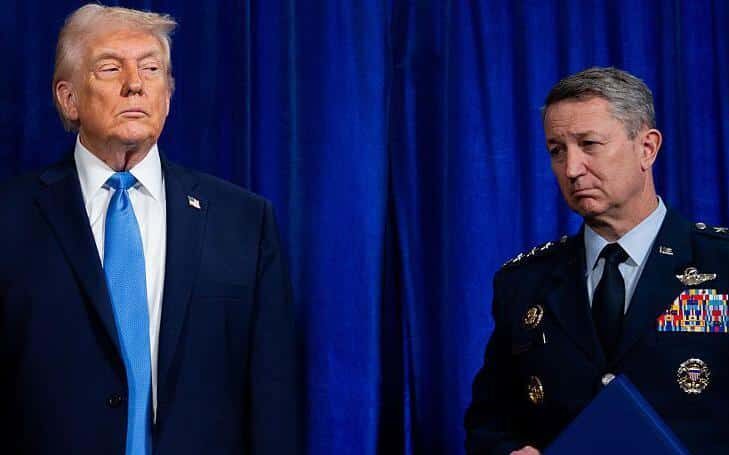
Donald Trump and the Chairman of the Joint Chiefs of Staff Gen. Dan Caine (Getty/File)
A Legitimate Regime In Iran? The Politics of the Supreme Leader’s Funeral
EA on International Media: Trump “TACOs” Over US Strikes on Iran
UPDATES: US War on Iran, Day 162 — An Iran-Oman Deal on Strait of Hormuz?
UPDATE 0949 GMT:
The German shipping giant Hapag-Lloyd says the closure of the Strait of Hormuz cost the group $600 million in the second quarter of 2026.
Net profit fell to $83 million, down from $306 million a year earlier. Strong exports from Asia and improved demand in the US partially offset losses from the US-Israel War on Iran.
In its Liner Shipping segment, operating profit fell to $153m from $167m due to additional costs for bunker, insurance, storage, rerouting and inland transportation following the strait’s closure.
UPDATE 0631 GMT:
Israeli forces have blown up and burnt homes in the towns of Majdal Zoun and Al-Mansouri and in neighboring valleys in southern Lebanon.
Israeli warplanes targeted Al-Mansouri in two successive waves overnight, with the sound of explosions heard in the city of Tyre.
UPDATE, AUG 13:
US Sen. Richard Blumenthal is seeking answers from Defense Secretary Pete Hegseth and acting Navy Secretary Hung Cao about conditions aboard the USS Abraham Lincoln aircraft carrier, which has remained at sea for more than 250 days amid the US War on Iran.
“The Trump Admin must explain what they are doing to support sailors on the USS Abraham Lincoln who have been continuously at sea for nearly 7 months. Widespread reports of supply shortages, plumbing issues, deteriorating mental health & more demand immediate attention,” Blumenthal posted.
In January, the Trump Administration ordered the aircraft carrier’s strike group to divert from maneuvers in the South China Sea to the Middle East.
Family members have challenged Navy leadership over the conditions, including food shortages, faced by the 5,000 sailors and Marines aboard the Lincoln. Some personnel reported severe mental health issues, attempted suicides, and crew members threatening to jump off the ship.
The sailors have told relatives of moldy showers, sporadic hot water, rationed meals and soap, broken toilets, and 12- to 16-hour shifts with no days off.
UPDATE 1735 GMT:
The International Energy Agency estimates that global oil supply will drop by 4.3 million barrels per day this year, an increase over its July forecast of a 3.7 million bpd drop.
“With an agreement enabling the reopening of Hormuz and unhindered transit through the Bab el-Mandeb Strait still elusive, we have again lowered supply estimates for the rest of the year,” the IEA.
The August figure is a 4% loss of global oil supply, which is 1.27 million bpd short of demand.
The agency expects a 1.8 million bpd deficit over the July-to-September period, the deepest quarterly shortfall since 2021.
UPDATE 1214 GMT:
Yemen’s Houthi insurgents have launched more ballistic missile attacks on the port of al-Makha near the Bab al-Mandeb Strait in the southwest of the country.
There are no details on casualties.
The Houthis fired 10 ballistic missiles and four drones at the city on Tuesday.
UPDATE 0659 GMT:
Traffic through the Strait of Hormuz fell to a one-week low on Tuesday.
Only eight vessels transiting the Strait, below the 10-day average of about 12, according to the shipping monitor Kpler. LSEG recorded 11 transits on Tuesday, down from 14 a day earlier.
Around 135 ships crossed the Strait daily before the US-Israel War on Iran started on February 28.
UPDATE, AUG 12:
Firefighters and residents of south Lebanon say the Israeli military is lighting wildfires to burn down forested areas.
On Tuesday, the Israeli military dropped flares in a wooded area outside Khiam, sparking blazes. When firefighters attempted to extinguish the flames, a drone struck nearby, forcing them to withdraw, said the head of civil defense in the Nabatieh region, Hussein Fakih.
“There are enormous areas of woodland that have burned, I don’t have the exact figures, but in the areas close to the [frontline], around 30-40% of the land has been affected by fires,” he said.
They started doing this right after the ceasefire, and there have been incendiary bombs every day. Small drones come out and drop incendiary materials. [White] phosphorus shells are fired at the woodlands, in addition to illumination flares that they drop during the daytime so the vegetation catches fire.
Last Friday, Israeli munitions sparked large wildfires in two heavily forested areas: in Kfarchouba, close to the border, and between Jezzine and the western Bekaa valley.
Firefighters, requesting intervention to a “deconfliction” group which includes the Israeli military, were given permission to fight the fires at only two spots.
The Israeli military has claimed that Hezbollah uses the forested areas as cover for fighters and tunnels.
UPDATE 1918 GMT:
Ali Sabah, from Nabatieh in southern Lebanon, has died from wounds sustained when an Israeli drone targeted his car this morning (see 0834 GMT).
UPDATE 1859 GMT:
Yemen’s Coast Guard has raised the toll to six killed and 10 injured from the Houthi attack on a commercial vessel in the Bab al-Mandeb Strait.
The Iran-backed Houthis claim they targeted a Saudi ship carrying military equipment in the Strait.
UPDATE 1506 GMT:
Yemen’s Transport Ministry has revised the toll from today’s Houthi attack on a commercial vessel in the Bab al-Mandeb Strait (see 1043 GMT).
Four crew, three Pakistanis and an Indonesian, were killed when the Houthis fired three ballistic missiles at the Yemeni commercial vessel. The group then launched an additional missile targeting rescue teams.
A UK maritime security company earlier said that a member of the Yemeni Navy was killed, but the Transport Ministry said they were alive while wounded.
UPDATE 1339 GMT:
Qatar Foreign Ministry spokesperson Majed al-Ansari says negotiations between Oman and Iran over the Strait of Hormuz are at a “critical juncture”.
Al-Ansari said Qatar’s focus, as a mediator, is the opening of the waterway “at the earliest opportunity”. He emphasized that Doha is “not comfortable with any delay”.
The spokesperson cited a unified Gulf demand for conditions in the Strait to return to those before the US-Israel War and for guaranteed freedom of navigation. The waterway must not become “a tool for political blackmail as happened during this crisis”.
UPDATE 1329 GMT:
Iran has launched a missile at the headquarters of the Kurdish opposition Komala Party in Iraqi Kurdistan.
Komala spokesperson Amjad Panahi, said party members escaped injury through advance preparations and protective measures.
Komala, which advocates for the rights of Kurds in Iran, has been the target of more than 102 Iranian missiles and camps.
Two weeks ago, an Iranian missile attack on a Komala base in the Alana Valley injured six members.
UPDATE 1043 GMT:
Three people have been killed during an attack by Yemen’s Iran-aligned Houthis on a vessel in the Bab el-Mandeb Strait.
Two sources from the Yemeni coast guard and two military officials in the Yemeni government confirmed the strike on the cargo ship.
The UK maritime security company Vanguard reported:
Two crew members, one Pakistani and one Indonesian national, were killed, while four others, comprising three Pakistani and one Indonesian national, were injured.
The Yemeni Navy subsequently deployed to assist the vessel and came under fire, resulting in one additional casualty.
UPDATE 0834 GMT:
An Israeli drone targeted a vehicle on the outskirts of Nabatieh in southern Lebanon.
An ambulance team was hit by a second strike while transporting an injured person.
UPDATE 0630 GMT:
Despite a supposed ceasefire, Israeli forces are continuing artillery shelling on the town of Zawtar al-Sharqiyah in southern Lebanon, with heavy machine gun fire towards several neighborhoods.
UNIFIL, the UN peacekeeping force in Lebanon, said Israel fired 455 projectiles into southern Lebanon and breached Lebanese airspace 97 times from Friday to Sunday, the heaviest fire in weeks.
UPDATE, AUG 11:
Only six vessels crossed the Strait of Hormuz on Monday, compared to a daily average over the past 10 days of around 11.
Four commodity vessels entered the waterway, including two empty oil product tankers. Two vessels exited the Strait: a small tanker laden with liquefied petroleum gas and another carrying residual fuels.
Before the US-Israel War on Iran, around 135 ships passed through the Strait each day.
In the Bab al-Mandeb Strait connecting the Red of Sea and the Gulf of Aden, 25 vessels passed on Monday. Traffic has remained broadly unchanged with a 10-day average of almost 24 ships.
UPDATE 0825 GMT:
Iran’s Foreign Ministry spokesperson Esmaeil Baghaei reaffirms, “Reopening the Strait of Hormuz is conditional on the lifting of the US naval blockade.
Baghaei said Iran and Oman have reached an understanding on a navigation plan for the Strait. Technical issues on a joint statement remain under discussion, but “the negotiations are proceeding smoothly and constructively”.
The spokesperson said no fees for vessels passing through the Strait have been discussed at this stage; however, charges will “naturally” apply when maritime services are provided.
UPDATE, AUG 10:
The Iran-backed Houthis killed four troops and three civilians in their attack on the port of al-Makha on Sunday, says Yemen’s internationally-recognized government.
Another 30 people were injured.
Houthi outlets showed the launch of missiles and drones in a claimed attack on Saudi troops and ammunition depots. The Yemeni government said 11 UAVs were intercepted.
UPDATE 1706 GMT:
Amid shortages of munitions, US Deputy Defense Secretary Steve Feinberg has told defense industry heads that they must “drive significantly faster, more aggressive delivery schedules and/or increased production for critical capabilities”.
Feinberg convened an emergency Pentagon meeting on July 31 after Donald Trump chewed out Defense Secretary Pete Hegseth for not informing him of the shortages. Hegseth blamed Feinberg.
The Deputy Secretary’s written directive to defense industry leaders said they must present a plan within 21 days on how to increase production: “Years-long development cycles are not acceptable. We must dramatically accelerate our program schedules and expand our production capacity now.”
UPDATE 1025 GMT:
Yemen’s Iran-linked Houthis have targeted the Yemeni port of al-Makha, controlled by the internationally-recognized government, in the southwest of the country.
The Houthis said they fired on “Saudi enemy troops and weapons depots” and caused widespread destruction and “the death and injury of dozens, including Saudis”.
The Yemeni government said at least seven people were killed and around 35 injured.
UPDATE 1008 GMT:
Iranian Foreign Minister Abbas Araghchi said talks cannot resume with the US until the Trump camp makes amends for violations of June’s Memorandum of Understanding.
Araghchi said Tehran is not in negotiations with the US and is only exchanging messages through intermediaries. He said, “Efforts are under way to create grounds for negotiations.” However, reiterated that any agreement with Oman over the Strait of Hormuz is a technical and legal matter, and the waterway will not be reopened until the US remedies its breaches of the MoU.
UPDATE, AUG 9:
Saudi Arabia’s Energy Ministry says firefighters extinguished a fire that broke out at dawn at the Saudi Aramco refinery in Jizan.
The Ministry said there were no injuries. It did not cite a cause of the blaze, but Yemen’s Iran-aligned Houthis claimed responsibility for drone strikes.
The Houthis said they were responding to Saudi drone attacks on Yemen’s Saada and Hajjah Provinces.
Saudi authorities have also blamed Iran-backed militias in Iraq for attacks on Jizan, located on the Red Sea near the Saudi-Yemeni border.
Aramco shut down the 400,000 barrel-per-day refinery on July 27 after a Houthi attack that damaged the plant’s Integrated Gasification Combined Cycle (IGCC) complex and tank farm area.
UPDATE 1724 GMT:
The Secretary of Iran’s Supreme National Security Council, Mohammad Bagher Zolghadr, has amplified Iran’s conditions for reopening the Strait of Hormuz.
Iranian Foreign Minister Abbas Araqchi said earlier that the conditions must be met even if Iran and Oman reach an agreement on management of the waterway (see 1412 GMT).
Zolghadr said the US must “correct its behavior”: end threats against Iran and its “sacred values”; permanently halting military action against the Islamic Republic and its regional allies; withdrawing US naval and air forces involved in a blockade against Iranian ports and vessels; compensating Iran for damage caused by the US-Israel war; lifting American sanctions; and releasing Tehran’s frozen assets.
“The Supreme National Security Council will not retreat from these demands, whether in war or in negotiations,” Zolghadr said.
US Vice President J.D. Vance insisted in a Fox TV interview, “The Iranians have told us they have no plans to toll the Strait of Hormuz.”
UPDATE 1416 GMT:
A vessel was struck and set afire around 18 nautical miles off the coast of the town of Khasab in Oman, reports the UK Maritime Trade Operations center.
The fire has been extinguished and the vessel and all crew are safe.
The UAE and other Gulf States, including Saudi Arabia and Qatar, have condemned Iran’s earlier strike on a vessel belonging to the Abu Dhabi National Oil Company (see 1032 GMT).
The UAE Foreign Ministry said the attack was a “flagrant violation” of UN Security Council Resolution 2817 on freedom of navigation.
Targeting commercial shipping and using the Strait of Hormuz as a tool of pressure or economic blackmail constitutes acts of piracy by the Iranian Revolutionary Guard and poses a direct threat to the stability of the region and its people, as well as to global energy security.
UPDATE 1412 GMT:
Iranian Foreign Minister Abbas Araghchi says Iran and Oman are “very close” to agreeing management of the Strait of Hormuz.
Araghchi said reopening the Strait depends on further conditions, including US compensation to Iran for violations of June’s Memorandum of Understanding.
UPDATE 1032 GMT:
A vessel belonging to the Abu Dhabi National Oil Company has been targeted by a missile while crossing the Strait of Hormuz.
“The attack did not result in any injuries and the situation was brought under control,” reported the UAE’s WAM State news agency.
ORIGINAL ENTRY: The Chair of the US Joint Chiefs of Staff, Gen. Dan Caine, is telling the Trump camp that the US needs an off ramp out of its war on Iran.
Caine assesses that escalation of the war could backfire and airpower alone is unlikely to achieve objectives, according to “three sources familiar with the matter“.
The general’s evaluation was instrumental last week in the decision, after a meeting of Trump’s Cabinet at the Camp David retreat in Maryland, not to widen airstrikes inside Iran. He warned of shortages of air defense interceptors in the event of Iranian retaliation.
The military is also facing a shortage of offensive missiles, having expended much of its stock in the assault on Iran. On the sidelines of the meeting, Donald Trump angrily confronted Secretary of Defense Pete Hegseth, who tried to blame his deputy for the situation.
Caine has proposed the off ramp in discussions with other senior officials, including CIA Director John Ratcliffe, Secretary of State Marco Rubio, and Vice President J.D. Vance, said two sources. The JCS Chair is making clear the limitations and pitfalls of the available military options.
“I think it is just his way of protecting the military,” one official said.
One source explained that the “only ones in favor” of expanded airstrikes inside were “elements of CENTCOM”, US Central Command. Israel also broadly favors the escalation.
A “senior Administration official” said Trump ultimately decided to retreated after talking with Middle East allies, who spoke to him about Iranian retaliation including attacks on their energy infrastructure.
Saudi leader Crown Prince Mohammed bin Sultan made his objection clear to Trump in a conversation last week.

How Iran Adapted Its Attacks as U.S. War Munitions Dwindled: https://www.nytimes.com/2026/08/11/us/politics/iran-military-base-attacks-us-munitions.html
“During five intense days last month, Iran launched waves of drones and missiles at U.S. troops on three bases in Jordan, hoping to break through the formidable American air defenses. Using advanced missiles that can suddenly change course, Iran pummeled the bases’ defensive systems, forcing the Americans to burn through scarce supplies of Patriot interceptors…….The strikes reveal a deadly confluence of two important trends: First, Iran has become a more skilled adversary as the war has progressed, learning how to evade U.S. air defenses as it widened the battlefield to include most of the Middle East and enlisted allies like the Houthis in Yemen and militias in Iraq. Second, the Pentagon’s supply of interceptors has quickly dwindled, with the weapons becoming more precious each day of the off-and-on conflict. The two trends drive home a point that has slowly emerged in the months since the war started, that a global superpower with a mighty military footprint can still be held at bay by a lesser adversary willing to wage asymmetric warfare to find any advantage it can…….On a single day during that deadly week last month, according to two U.S. officials, American forces in the Middle East fired about 50 Patriot interceptors, which cost about $4 million each…………In April, Iran shot down an American F-15E fighter jet over southern Iran with a shoulder-fired surface-to-air missile. Both the pilot and the weapons officer ejected. The pilot was rescued quickly, but the weapons officer was missing for nearly two days, hiding from Iranian security forces until U.S. Special Operations forces rescued him in a daring operation. In this case, Iran learned from Ukraine and deployed a swarm of drones in an area American fighter jets had penetrated, a senior U.S. military official said. In interviews with Pentagon officials, the crew said that the F-15E’s defensive countermeasures provided only half a second of warning before Iran hit the $60 million advanced fighter jet with a shoulder-fired missile. American military officials concluded that the drones fed three critical pieces of information to Iranian commanders that helped them target the F-15E: its GPS location, speed and direction, one senior military official said.”