
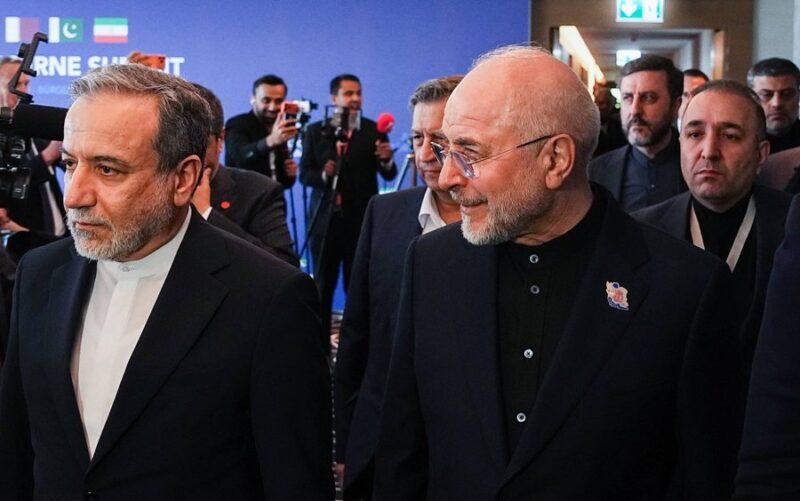
Iranian Foreign Minister Abbas Araghchi and Parliament Speaker Mohammad Bagher Ghalibaf arrive for talks with Trump officials in Switzerland, June 21, 2026
EA-CEO Retort VideoCast: How Trump Camp Lost in Iran and the Middle East
EA on WION and Pakistan’s Express 24-7: Trump Camp’s Dead End in Iran War
US War on Iran, Day 171: Israel Steps Up Killing in Southern Lebanon
UPDATE 1319 GMT:
China has rejected Trump Administration economic pressure to break the Iranian regime.
Foreign Ministry spokesperson Lin Jian said “sanctions and pressure will not help resolve the issue”. He called on all sides to address tensions through political and diplomatic means.
Military force and pressure tactics will only lead to escalation that serves no one’s interests. We call on parties to act responsibly and solve disputes through dialogue and negotiation.
UPDATE 0438 GMT:
Israel bombed southern Lebanon overnight, including the Ali al-Tahir Hill, the area between Al-Dabsheh Hill and Douhat Kfar Roummane, and the northern outskirts of Nabatieh al-Fawqa.
The Israelis also fired artillery across the area including the Ali al-Tahir Hill.
UPDATE, AUG 22:
Monitored ship traffic through the Strait of Hormuz fell to seven commodity vessels on Wednesday, downed from 14 on Thursday. Four vessels entered and three were exiting.
No supertankers or liquefied natural gas carriers were recorded passing through the narrow chokepoint. One very large gas carrier transporting propane and butane left the waterway along the Iranian route.
US officials claim that tankers with their transponders off are leaving the Strait along the Omani route to the south. They declare that the traffic is 10 million barrels of oil per day, half the pre-war total.
The global price of Brent crude oil is now $93.57 per barrel.
UPDATE 0915 GMT:
The US has secretly created a shipping corridor in the Strait of Hormuz for around 10 million barrels of oil daily, say two American officials.
The sources said 15 to 20 tankers pass along the Omani coast every night. The volume is about half of the 20 million bpd before the US-Israel War.
One US official declared, “We’ve been controlling the southern Strait of Hormuz for two months now. The Islamic Revolutionary Guard Corps may be a nuisance, but they don’t control the Strait. We do.”
The group overseeing the operation is based in North Carolina, where a major US military base is located, and coordinates its actions with partners in the Middle East. American ilitary personnel assist tankers entering the Persian Gulf from the Arabian Sea, loading oil in regional countries, and then exiting through the Strait.
Ship convoys move at specific times according to military directives, ensuring protection against Iranian cruise missiles and drones. The US military says it downed eight Iranian drones and two cruise missiles this week.
UPDATE 0549 GMT:
Nine commodity vessels transited the Strait of Hormuz on Wednesday, unchanged from Tuesday.
UPDATE 0545 GMT:
Israel carried out a series of airstrikes in southern Lebanon overnight, targeting the strategic Ali al-Taher Hill and the nearby al-Dabsheh area.
The Israelis shelled the areas intermittently throughout early morning.
Israeli forces carried out demolition operations and shelled the towns of Majdal Zoun and al-Mansouri overnight and at dawn.
UPDATE, AUG 20:
Israel is threatening more attacks on Syria and Türkiye after its bombing of the Abu al-Duhur airbase in northwest Syria on Tuesday.
The Israelis fired five missiles, damaging the runway, in an apparent attempt to disrupt Turkish arms deliveries. The attack has been criticized by the US, Qatar, and other countries.
Israeli Defense Minister Israel Katz posted on Thursday morning that President Recep Tayyip Erdoğan is “dragging Türkiye into dangerous adventures in Syria”:
Israel will not allow any entity to threaten its security.
It is preferable for Erdoğan to continue delivering empty, delusional speeches against Israel in the Turkish parliament rather than testing Israel’s resolve to defend itself.
Syrian Foreign Minister Asaad Al-Shaibani said Turkish forces were at the base days before the strike. However, he added that Damascus told the Netanyahu Government at the time that there are no plans for a permanent deployment.
There was no Turkish military build-up at the base in any sense that would justify such an interpretation. The base was, in fact, largely empty. It had not yet been fully rehabilitated or become fully operational, and the work there was still at the rehabilitation stage.
He said the Turkish visit was part of “ongoing military cooperation in the areas of training and the exchange of expertise”.
UPDATE 1603 GMT:
Iran has assessed striking US assets in southeastern European countries such as Bulgaria if Donald Trump returns to war, say “two people close to the regime”.
Last month Bulgaria approved the use of its Bezmer airbase for US refuelling aircraft.
One official said Cyprus, where a British airbase was struck by a drone in March, is among potential targets for retaliation. The sources said Iranian forces have examined attacking sub-sea fibre-optic cables in the Strait of Hormuz.
Last month the Revolutionary Guards told the UK that “any base that is used to launch an attack on Iranian territory will be considered a legitimate target”.
Iran can deploy medium-range ballistic missiles against US assets in southern and southeastern Europe, but would struggle to do damage at longer ranges.
UPDATE 1037 GMT:
The US has doubled down on criticism of Israel’s airstrikes on Abu al-Duhur airbase in northwest Syria on Tuesday.
The US Ambassador to Türkiye and Syria, Tom Barrack, said the Israeli operation with five missiles, damaging a runway, carried a “real risk of rapid escalation into a direct military confrontation” with Türkiye as well as Syria.
He noted that Turkish forces were unaware Israeli aircraft were heading towards the Syrian base or of their intended purpose. They “could potentially have been inclined to scramble their own jets in the belief that they themselves were under attack”.
Barrack emphasized, “The events of yesterday were serious and worrisome.”
UPDATE 0643 GMT:
The UAE has imposed an indefinite trade embargo on Iran, saying Tehran is “undermining regional and international peace and security”.
The Defense Ministry said it detected two ballistic missiles launched from Iran towards the Emirates.
Iran’s Foreign Ministry said the accusations were baseless and the incident is a “false flag operation”.
The UAE is the largest seller of goods to Iran, providing 1/3 of the Islamic Republic’s imports.
UPDATE 0607 GMT:
Only six commodity ships crossed the Strait of Hormuz on Tuesday, down from nine on Monday and below the 10-day daily average of 11.
Before the US-Israel War, around 135 vessels transited daily.
Other ships may be crossing with their transponders turned off.
UPDATE, AUG 19:
Israel has carried out overnight airstrikes on the strategic Ali al-Taher Hill area in the Nabatieh district in southern Lebanon.
Israeli forces also carried out explosions and shelled several towns, including demolitions in Haddatha and artillery attacks in Majdal Zoun and its surrounding valleys.
The Israelis also searched homes and seized two people in Jubata al-Khashab in Quneitra Province in southern Syria.
The Israelis invaded with more than 100 military personnel and 15 military vehicles.
Israel also shelled the Yarmouk Basin area in western Daraa Province.
UPDATE 1950 GMT:
An unmanned cargo vessel was struck on Monday by multiple unknown projectiles, 40 nautical miles southeast of Yemen’s al-Macha, reports the UK Maritime Trade Operations center.
The vessel suffered “complete constructive loss”.
Yemen’s Iran-backed Houthis claimed they targeted an oil refinery on Saudi Arabia’s southern Red Sea coast on Tuesday.
The Houthi news agency Saba said the Aramco refinery in Jazan was attacked by drone, in response to Saudi airspace violations over the governorates of Saada and Hajjah” in Yemen.
UPDATE 1606 GMT:
The US, Turkey, and Qatar are among countries criticizing Israel’s airstrikes on an airbase in northwest Syria.
The Israelis attacked the Abu al-Duhur air base in Idlib Province. A Syrian military official said five missiles were fired on the main runway, causing significant material damage but no casualties. Unidentified reconnaissance aircraft flew over the area for hours before the strikes.
Israel’s Army Radio said the attacks followed the delivery of “logistical and military equipment, including radars and drones” by Turkish forces.
The Turkish Foreign Minister said in a statement:
We strongly condemn the airstrikes carried out by Israel.
We call on the international community to adopt a more resolute stance in order to bring an end to Israel’s aggression against Syria… and to ensure accountability for these actions, which disregard international law.
Qatar’s Ministry of Foreign Affairs expressed “strong condemnation and denunciation”:
Israel’s continued violation of the sovereignty of the countries of the region without deterrence reveals a dangerous approach to imposing a fait accompli by force and a systematic disregard for international legitimacy.
And US Ambassador to Turkey Tom Barrack, who is also the Special Presidential Envoy to Syria, posted:
The Al-Sharaa government has neither adopted a predatory posture nor maintained proxy forces. It has, in fact, repeatedly indicated a preference for de-escalation with Israel.
The United States has in the past, and will continue in the future, to host discussions to encourage diplomatic cadence over kinetic frustration for both nations.
We are deeply concerned that the confirmed Israeli airstrikes on Abu al-Duhur Airbase constitute an unnecessary escalation that does not advance regional stability.
The Al-Sharra government has neither adopted a predatory posture nor maintained proxy forces. It has, in fact,…
— Ambassador Tom Barrack (@USAMBTurkiye) August 18, 2026
,/p>
UPDATE 0530 GMT:
A vessel on outbound transit of the Strait of Hormuz has been struck by a projectile, reports the UK Maritime Trade Operations center.
The engine room was damaged. There is one casualty among the crew.
UPDATE 0525 GMT:
Iran’s official annual inflation rate has reached 66%.
The point-to-point inflation rate, which measures price changes compared to the same month a year earlier, rose to 87.9% in July. Food and beverage prices surged by 128.1% year-on-year.
The minimum cost of living cost for a working-class family is 90 million tomans ($1,385) per month, compared to the monthly salary of a minimum-wage worker of around 25 million tomans ($385).
Many workers were only able to afford their living expenses for around eight days in each month, says labor activist Faramarz Toufighi.
UPDATE 0519 GMT:
Israeli forces shelled the outskirts of the village of Majdal Zoun in southern Lebanon with artillery, as warplanes carried out a dawn airstrike on the nearby town of al-Mansouri.
The forces fired machine guns on the outskirts of the towns of Haddatha and Baraachit.
UPDATE, AUG 18:
Six commodity ships transited the Strait of Hormuz yesterday, three were exiting and three entering, compared with the 10-day average of 11 ships.
Three ships passed on Saturday and two on Sunday.
The very large gas carrier Xavia entered the Strait via the Iranian route empty of cargo. A medium-range fuel tanker and an intermediate-range tanker also entered the Gulf, while a medium-sized LPG carrier, a Panamax bulk carrier, and a Panamax-sized fuel tanker exited.
Sources claim the UAE, Iraq, Qatar, and Kuwait are exporting more than 4 million barrels of oil per day using vessels with their transponders turned off.
UPDATE 1622 GMT:
The UN peacekeeping force in Lebanon, UNIFIL, says Israeli flags planted on a coastal highway in southern Lebanon violate a Security Council resolution.
UNIFIL urged all sides to avoid “provocative actions”.
Video posted on Sunday by an Israeli journalist showed Israeli flags flying along the Naqoura-Tyre road. The footage appeared to have been taken from a military vehicle.
UPDATE 1450 GMT:
Iranian Foreign Ministry spokesperson Esmaeil Baghaei said the deadline for negotiations in June’s Memorandum of Understanding has no standing.
“We did not begin any negotiations because, a few weeks after the signing, widespread violations of the agreement [by the US] began, thereby rendering the 60-day provision irrelevant.”
UPDATE 1133 GMT:
Donald Trump has threatened to bomb Oman if the Gulf State “gets in the way” of his War on Iran.
Iran and Oman are in discussions over management of the Strait of Hormuz.
Trey Yingst of Fox TV posted, “I asked the President about…parallel talks that are taking place between Iran and Oman about control of the Strait of Hormuz.”
Trump responded: “If Oman gets in the way, we’ll bomb the shit out of them.”
In late May, Trump threatened to “blow up” Oman if it failed to “behave”.
UPDATE 0913 GMT:
Gulf States have established secret oil shipments through the Strait of Hormuz, “informed sources” tell Bloomberg.
The sources said the UAE, Iraq, Qatar, and Kuwait are exporting more than 4 million barrels of oil per day using vessels with their transponders turned off. After transiting the Strait of Hormuz, the ships transfer the oil to other tankers in the Gulf of Oman.
Images from the Sentinel 1 satellite show around 150 vessels of varying sizes off the coast of Oman, compared to only about 40 vessels in the area in January.
Despite the shipments, the global price for Brent crude oil has risen to $89.19 per barrel. The price — which was around $110 in the opening weeks of the US-Israel War on Iran — had fallen to just over $70 in July with hopes of a long-term ceasefire.
The Abu Dhabi National Oil Company reports that 23 of its vessels have been attacked since the start of the war. One sailor was killed and 20 were injured.
Despite the risks, Saudi Arabia is reportedly preparing to use the route: 16 supertankers are amassed off the coast of Oman, and three more approaching.
Before the war, ships with around 20 million barrels of oil passed through the Strait daily. Almost no vessels are crossing the waterway with active transponders.
UPDATE 0901 GMT:
Iraqi Kurdistan Prime Minister Masrour Barzani says Iranian drones targeted his personal office in northern Iraq.
Barzani also said the Iranians fired on the home of the head of Kurdistan’s security and intelligence agency. He condemned the attacks as “reckless and unacceptable” and a “dangerous escalation”.
It was revealed over the weekend that the Trump Administration used the Iraqi Kurdistan President Nechirvan Barzani as a secret backchannel to establish the position of Iran’s Revolutionary Guards.
Barzani responded that Guards commander Gen. Ahmad Vahidi was backing the Iranian regime’s negotiations.
The Trump Administration wanted Barzani to host direct talks between the US and Iran in Erbil in northern Iraq. The Iranians declined because of fears that representatives would be targeted for assassination by Israel.
ORIGINAL ENTRY: June’s Memorandum of Understanding, seeking to end the US War on Iran, expires today.
Following a ceasefire declared on April 7, the Memorandum set out a further two-month pause. Based on 14 points set out by Iran, it recognized Iranian management of the Strait of Hormuz in conjunction with others, such as the Gulf State of Oman.
In return for opening the Strait, which carries around 20% of the world’s maritime oil and gas, Iran would receive significant financial and economic benefits. US sanctions would be lifted. Some of the $100 billion of Iranian assets held abroad would be unfrozen. A private investment and reconstruction fund of up to $300 billion would be established.
The issue of Iran’s nuclear program would be secondary to that of the Strait. Rather than accepting the Trump camp’s demand that all uranium enrichment for a civilian program would be halted, the possibility of continued enrichment within Iran — albeit to a much lower grade than the current 60% — would be negotiated.
Trump digitally signed the document without consulting senior advisors. He confirmed it formally three days later while he was at a dinner in the Palace of Versailles after the G7 summit.
The Trump camp faced immediate criticism from those in Washington who said the concessions were too great to Iran. Talks through Pakistani and Qatari mediators stalled, and a series of violent episodes escalated in the Strait, inside Iran, and across the Gulf. Yemen’s Iran-backed Houthis declared a blockade on Saudi Arabian ports, threatening to close the Bab al-Mandeb Strait.