
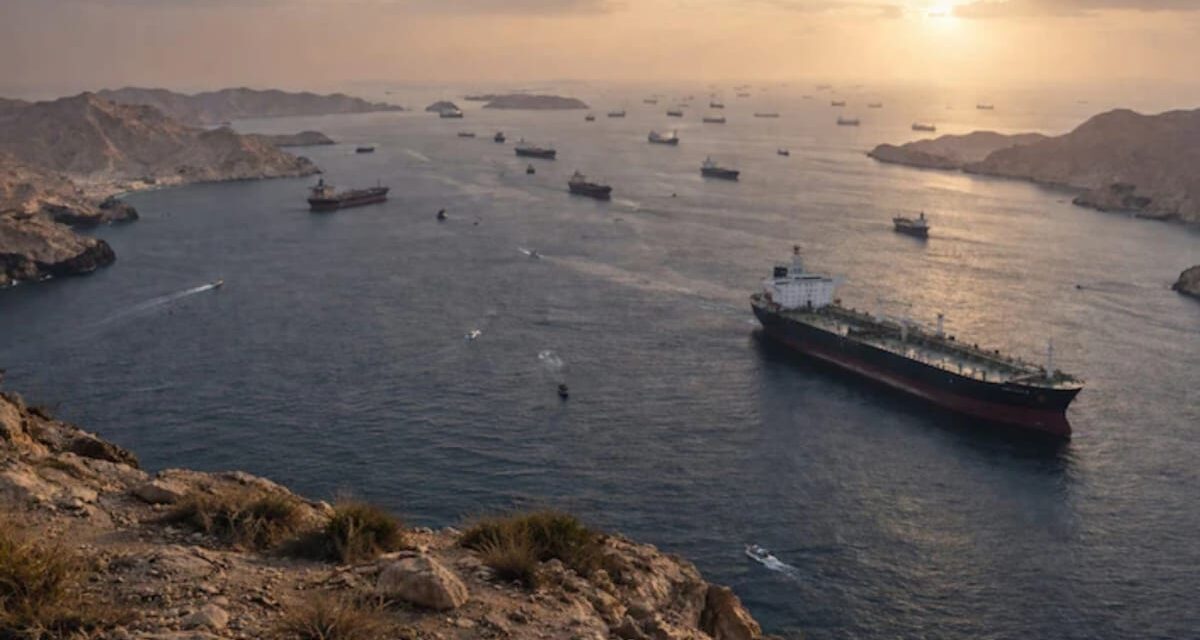
File image of the Strait of Hormuz
EA on International Media: Trump “TACOs” Over US Strikes on Iran
UPDATES: US War on Iran, Day 159 — Trump “TACOs” and Bails Out on Wider US Strikes
UPDATE 1235 GMT:
Turkey, Pakistan, and Saudi Arabia have signed a defense pact in a ceremony in Mecca.
The “Mecca Joint Defense Agreement” was confirmed by Saudi Crown Prince Mohammed bin Salman, Turkish President Recep Tayyip Erdoğan, and Pakistan’s Prime Minister Shehbaz Sharif.
Pakistan’s Foreign Ministry said in a statement, “The Agreement is intended to strengthen collective deterrence against any act of aggression, and stipulates that any armed attack against any one of the three States shall be regarded as an attack against them all.”
A Turkish official said the pact is strictly defensive in nature, is not against any specific actor, and is open to other regional countries.
UPDATE 1224 GMT:
At least two civilians have been killed and 14 injured by Houthi shelling of residential neighborhoods and displacement camps in the government-held city of Marib, says Yemeni Health Minister Qasim Buhaibeh.
A “source close to the Saudi military” says the Saudi-led coalition supporting Yemen’s government will not “stand idly by” amid the Houthi attacks: “The Coalition does not seek escalation, but we will not allow the current balance of power on the ground to be changed.”
Hizam al-Assad of the Houthi political bureau posted:
There is no security for the invading Saudi forces, nor for their mercenaries, nor for their camps on our land. Our armed forces are compelled to reclaim our rights, lift the siege on our country, and confront every individual who obstructs our people’s path towards attaining their rights, freedom, and independence, regardless of their nationality.
UPDATE 0722 GMT:
Just four vessels crossed the Strait of Hormuz on Thursday: the very large crude carrier Nissos Kea, carrying about two million barrels of Basra crude loaded in Iraq; two liquefied petroleum gas carriers; and a minor bulk carrier.
From Monday to Thursday, traffic dropped to 33 ships, down from 50 the previous week. Only six crude oil tankers have exited the Strait.
In the Red Sea’s Bab al-Mandeb Strait, 26 vessels transited on Thursday, up from 19 the previous day.
UPDATE, AUG 7:
Yemen’s Iran-aligned Houthis have raised the toll to 45 killed from their attacks on three bases of the Saudi-backed military of the Yemeni internationally-recognized government.
A “military source” said 58 people were slain.
The Saudi-led coalition behind the government claimed at least 11 civilians were wounded in an attack on Najran airport in southwest Saudi Arabia near the border.
They said the wounded included seven Saudi nationals, among them a woman and a 4-year-old child who suffered second-degree burns; one Yemen; two Egyptians; and one Pakistani.
UPDATE 1339 GMT:
A suspected Houthi rocket and drone attack has killed at least 30 people and wounded others in the military camps of Yemen’s internationally-recognized government in Marib and Hadramaut.
Houthi military spokesman Yahya Saree warned:
We advise those misled and deceived among our people to leave the Saudi enemy camps and return to their homes before it is too late.
We assure our dear Yemeni people in all governorates that the armed forces are fully prepared to confront any escalation.
UPDATE 1101 GMT:
Donald Trump has lashed out at Defense Secretary Pete Hegseth over the failing US War on Iran, claim “two people familiar with the exchange”.
Last Friday, on the sidelines of a Cabinet meeting at the Camp David retreat in Maryland, Trump railed at Hegseth that he had been misled on munitions shortages limiting military options. He told the Defense Secretary that he thought the munitions issue “had been fixed”.
Hegseth blamed his deputy, Stephen Feinberg, for the shortages and for not ensuring that Trump was fully informed. The angered Trump called Feinberg, who convened an emergency Pentagon meeting on Friday night.
Military leaders, including Joint Chiefs of Staff chair Dan Caine, told the Administration that the US faces a critical shortage of air defense interceptors and of high-precision missiles. Despite the encounter with Hegseth, Trump has lied throughout this week that there is no issue.
UPDATE, AUG 6:
Only two vessels crossed the Strait of Hormuz on Wednesday, down from eight each on Monday and Tuesday.
Before the US-Israel War on Iran, around 135 ships transited the waterway daily.
In the Bab al-Mandeb strait, on the southern side of the Arabian Peninsula, only one commodity vessel — a Bahamas-flagged dry bulk carrier — passed on Wednesday.
Amid the blockade by Yemen’s Iran-aligned Houthis on Saudi Arabian ports, 20 ships moved between the Red Sea and the Gulf of Aden on Tuesday.
UPDATE 2053 GMT:
Yemen’s Houthis have claimed responsibility for a ballistic missile strike on a Saudi oil vessel in the Gulf of Aden.
Military spokesman Yahya Saree said the Daisy was forced to turn around. The incident occurred 95 nautical miles southeast of Aden.
UPDATE 1605 GMT:
Iranian Foreign Ministry spokesman Esmaeil Baghaei says Iran and Oman have come to an agreement on the geographic characteristics of a shipping route in the Strait of Hormuz.
Iran and Oman are in the final stage of preparing a joint announcement on the agreement, provided “certain third parties” do not interfere in the process, Baghaei asserted.
He cautioned that the accord does not automatically guarantee safe passage and warned that US military action in the region could still undermine security, citing the naval blockade on Iran and other “aggressive and threatening actions against Iran and its interests”.
Deputy Foreign Minister Kazem Gharibabadi echoed that an understanding has been reached between the two countries on almost all issues, including the location of entry and exit routes for maritime traffic. The agreement is “on the verge of being finalized”.
Gharibabdi said most of the designated shipping route will go through Iran’s territorial waters, while some will pass through Omani territorial waters.
The new routes will be used for a period of two to four months, potentially longer.
The Minister added that US “breach of promises and commitments” would ultimately need to be “resolved”.
UPDATE 1408 GMT:
At least two Israeli soldiers have been killed by the detonation of an improvised explosive device in a booby-trapped building in the village of Majdal Selm in southern Lebanon.
Several troops were wounded, one critically.
UPDATE 1404 GMT:
One person has been killed and 11 injured by an Israeli drone attack on the town of Tibnin in southern Lebanon.
The strike sparked blazes in the surrounding woodlands.
Israel’s military earlier issued a forced evacuation warning for the village of al- Mansouri. It set fire to woodlands on the outskirts of Kfarshouba.
UPDATE 1238 GMT:
An Iranian official says negotiations over the Strait of Hormuz are being conducted exclusively between Iran and Oman and “have nothing to do with the United States”.
The official continued, “The possible agreement between Iran and Oman on the arrangements for vessels to pass through the Strait of Hormuz has nothing to do with the immediate opening of this strait.”
They said that if Iran and Oman reach an agreement, “the reopening of the Strait of Hormuz depends on a change in US behavior and the correction of its violations”.
UPDATE 1045 GMT:
The US Army has used up much of its global stockpile of its precision long-range missiles during the war on Iran, say “three people familiar with the data”.
Two sources said the US has used “virtually all” of the surface-to-surface Army Tactical Missile Systems (ATACMS) and Precision Strike Missiles (PrSM). Each missile costs more than $1 million.
The officials expressed concern that the diminishing stocks could limit the ability to deter adversaries, including Russia and China.
UPDATE 0728 GMT:
Only eight vessels crossed the Strait of Hormuz on Tuesday, the same number as Monday.
Three tankers and three bulk carriers entered the Strait, while a gas carrier and a tanker exited.
Traffic through the waterway was around 135 vessels per day before the launch of the US-Israel War on Iran on February 28.
In the Bab al-Mandeb strait from the Red Sea to the Gulf of Aden, 20 vessels crossed on Tuesday, with 10 entering and 10 exiting. Twenty ships transited on Monday.
UPDATE 0724 GMT:
Yemen’s Iran-backed Houthis are claiming a missile attack on a Saudi oil tanker in the northern Red Sea.
A Houthi military spokesperson said the Wafa was targeted with ballistic missiles off the coast of the Saudi port Yanbu.
The spokesperson said the Houthis have targeted eight Saudi tankers since imposing a blockade on Saudi Arabia’s ports last month.
ORIGINAL ENTRY: Officials are reporting progress on an agreement between Iran and the Gulf State of Oman for joint management of the Strait of Hormuz between the two countries.
Iran’s Foreign Ministry spokesperson Esmaeil Baghaei said on Tuesday that the talks have “been assessed positively at both the technical and political levels”: “Iran is working with Oman to develop the necessary mechanisms for future arrangements governing the management of maritime traffic through this strategic waterway.”
Having tried and failed to break Tehran’s control of the Strait, US officials offered support after Donald Trump’s retreat from wider attacks on Iran.
Treasury Secretary Scott Bessent declared, “We are in talks with the Iranians, and I think there is a chance we may have a deal today or tomorrow to open the Strait and move towards a more normalized position in this conflict.”
Secretary of State Marco Rubio was more cautious in remarks to reporters, “There’s been progress made in those talks, but not finality yet.”
Iran and Oman still appeared to differ over the exact system for the waterway, through which around 20% of the world’s maritime oil and gas passes.
A senior Iranian official confirmed that Tehran wants control over inbound shipping and visibility over outbound traffic, with the ability to intervene if necessary. The outbound lane will run between Iran and Oman, with exit clearance granted through Oman after notifying Tehran.
“Two regional officials” echoed that ships will enter via an Iranian-controlled route. However, they did not indicate that the exit via an Omani route would require or allow Iranian intervention.
The officials said that, defying the Trump Administration’s past objections to any charges for passages, service fees will be levied for security and environmental protection. Any deal is also contingent on the US lifting its blockade on Iran’s ports.
The global price of Brent crude oil tumbled below $80 per barrel with the news of progress in the talks. Brent stands at $78.55 on Wednesday morning.

Trackbacks/Pingbacks