
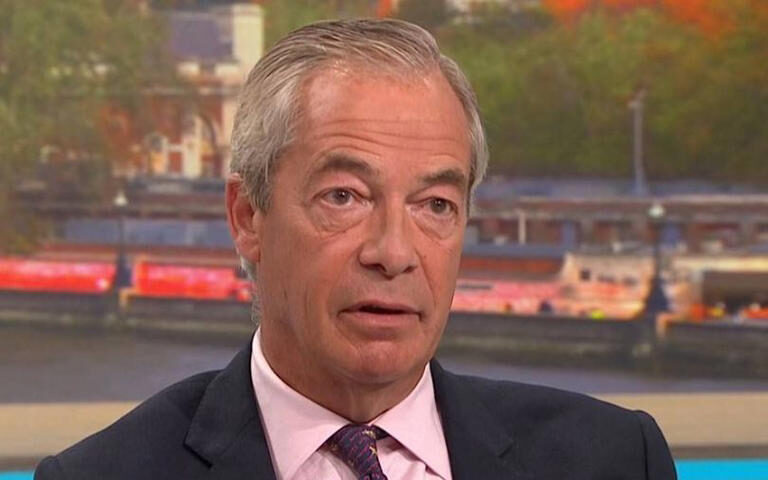
UK Reform Party leader Nigel Farage during a televised interview, June 23, 2026 (ITV)
The Pogrom in Belfast: We Ignore It At Our Peril
UK Politics: Why “Hannah The Plumber” and the Green Party Offer Hope
British politics is consumed by the prospect that Andy Burnham, the former Mayor of Manchester, will replace UK Prime Minister Keir Starmer.
But Burnham’s victory in the Makerfield by-election last Thursday, enabling him to re-enter Parliament and challenge Starmer for the premiership, is not the only important story.
The flip side of Burnham’s 54.8% share of the Makersfield vote is the Reform Party’s 34.6%. If Keir Starmer has passed his peak, so may have Reform leader Nigel Farage.
Farage, like his political guru Donald Trump, was initially treated as a passing irritant who would eventually exhaust himself, perhaps a scandal’s distance from disappearing. How wrong this has proven. Farage has shaped the national conversation, more than any other politician of the past two decades, by moulding a party — technically a company — to his way of thinking. He has embraced the social media revolution to make politics about personality and grievances rather than policy and solutions.
But even political phenomena have half‑lives.
Reform’s Plateau: A Movement That Stopped Growing
Polling before Makerfield showed the same pattern nationally. While the party is ahead of Labour, Conservatives, and the Greens, it has stagnated at around 25%.
Farage’s brand has always relied on momentum, with the projection that he has been dragging the country behind him. And now his vulnerabilities are becoming clearer as he is subject to the scrutiny reserved for people who might wield power.
Asked by London radio host Nick Ferrari if he wanted to be Prime Minister, Farage replied that he was “currently best placed to be PM… but in two years, who knows?” It was a rare moment of candor.
Campaigning rewards simple answers, soundbites, and stirring the pot over complex problems. Governing demands compromise, detail, and the ability to absorb criticism without treating every question as an ambush — all areas where Farage has never looked comfortable.
The Record: A Man Who Loves Politics, Not Parliament
During his years as a member of the European Parliament and later as a British MP, Farage consistently ranked among the least-active representatives in attendance, committee participation, and legislative work. In Europe, he often treated Parliament as an institution to be attacked rather than the place to shape policy.
Farage’s defenders often argue that his influence lies beyond Westminster, but that misses the point. The people of his constituency in Clacton-on-Sea did not elect a commentator, broadcaster or international political celebrity, they elected an MP. Yet Farage has participated in barely a third of votes in the House of Commons. While he finds time for overseas conferences, media appearances, and the endless campaign trail, hundreds of votes affecting pensions, welfare, employment rights, and public services have taken place without him.
The irony is that Farage has built an entire career attacking a political class which he claims is detached from ordinary people. Yet the mundane duties of democratic representation, voting, committee work, constituency surgeries, and casework hold little attraction for him. He is committed to the politics of spectacle, but he has never demonstrated a commitment to the politics of service.
If he wants the public to believe he is a Prime Minister-in-waiting, that is the question he can no longer avoid. For most of his career, Farage has preferred the role of commentator-in-chief, attacking those in power while avoiding the responsibilities that come with exercising it. Voters will decide whether a man who has spent decades playing politics from the sidelines is prepared to do the hard graft when the spotlight is no longer enough.
The Nowak Episode: “Pure, Cold Rage” is Not Leadership
The murder of Henry Nowak exposed this fragility. Farage’s intervention after the trial of Nowak’s killer Vickrum Singh Digwa, with the Reform leader calling for “pure, cold rage”, tried to whip up division, hatred, and even violence for political advantage. Some also saw a calculated attempt to divert attention from his acceptance of a £5 million gift from crypto billionaire Christopher Harborne.
Farage mobilized the anger of some of his supporters, but for many potential voters this looked like provocation. Not all Reform voters are racists, but every racist could be.
With the Restore Party of his former ally Rupert Lowe outflanking him on the hard right, Farage has a tiny blanket to cover a broad coalition. If he pulls the blanket up towards the hard right, he risks alienating voters who may be disillusioned but are not extremist. If he pulls it back towards the wider coalition, he risks frustrating the most combustible elements of his base.
The Restore Party, attracting former Reform figures, threatens to fracture the nationalist-populist vote while attracting open racists. While Burnham’s majority over Reform was roughly triple vote for Restore, Farage now faces two fronts. In some seats, that could doom Reform.
Lowe is to Farage what Farage was to the Conservative Party: the man who made the mainstream right move harder to the right. Farage’s dilemma has been exposed: he spent years teaching voters that the Conservatives are finished, but with the challenger to his hard-right, he suddenly needs the center-right vote as well as an anti-Tory vote.
What Is Reform Without Farage?
Strip out Farage, and Reform UK PLC looks less like a party and more like a vehicle of angry people who are not politically talented. Deputy Leader Richard Tice remains, along with Conservative defectors attempting to rebrand themselves as insurgents. But without Farage’s charisma and campaign instinct, the project risks being exposed as a holding pen for disaffected Tories.
If the future of Reform is a recycled Conservative at the helm, the party will sink. Farage was the only politician who made the idea look bigger than a personality cult, but his departure could expose it as that personality cult.
Reform also has a US problem. Farage’s politics drew energy from a trans-national moment in which Donald Trump remains the emotional centre of gravity. If Trump’s aura of inevitability fades, the aftershocks will travel throughout the world. Much of Europe’s populists are already edging away from Trump, and Hungary has shown that even dominant populist projects can lose their magic touch. Grievance and anger can win attention but they do not put bread on the table.
Seizing The Initiative From Reform
Politics is not won with spreadsheets but with stories. Farage’s opponents have often mistaken his political incorrectness for simple wrongness. Instead, his finger on the pulse was the source of his strategic effectiveness. Andy Burnham and Green Party leader Zack Polanski have understood the necessary response: speak to insecurity without scapegoating; link local decline to inequality and underinvestment rather than migration; and build a narrative of solidarity, belonging, and competence.
This message should be taken into community halls, WhatsApp groups, football grounds, and short-form video with authentic stories and a clear message. Meet Reform UK PLC head-on: not with outrage but with clarity, confidence, and a better emotional story about Britain and its future.
Farage remains one of the most effective campaigners of his era but his politics is built on a cult which has to keep “winning”. Having lost the Gorton and Denton by-election and now the Makerfield vote, that image is waning. Farage’s cry of foul over the results did not resonate with many. And as scrutiny of his finances and ethics intensifies, his offense turns to an ill-tempered defense.
It remains to be seen if, come the General Election, Nigel Farage is still leader of Reform or if runs again for Parliament. In the meantime — as space opens for a more honest, less performative politics — Mr. Farage, despite his £5 million “gift”, is on the ropes.
