
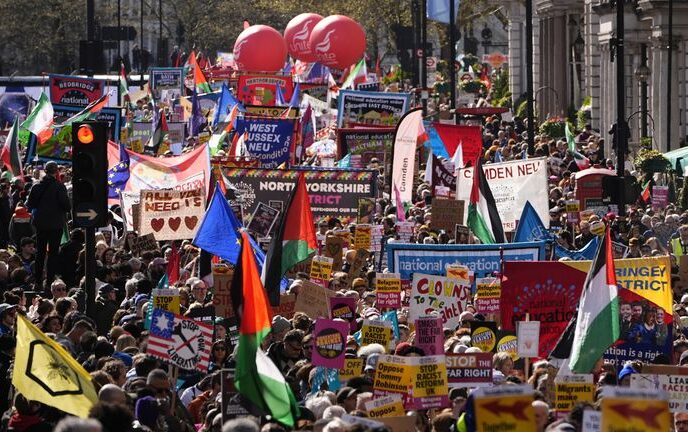
Together Alliance march in London, UK, March 28, 2026 (Sky)
Britain’s Muslims Are Ready to Rebuild the UK — But is the UK Ready to Let Them?
May’s local elections exposed a deep fracture running through Britain. Across the country, Labour and the Conservatives, the two parties that have dominated British politics for generations, suffered major losses. The hard right Reform UK surged across parts of England, the Greens continued to grow, and smaller parties and independents gained ground. Britain increasingly resembles a fragmented political landscape in which five or six parties have replaced two dominant blocs to compete for public support and national direction.
This fragmentation goes beyond politics. Trust in institutions is weakening, faith in politics is fading, and communities feel increasingly disconnected from each other and Britain’s collective story. The UK now is fractured along political, social, cultural, and communal lines.
These fractures are often treated as ordinary features of modern democracy. In reality, they are becoming a strategic vulnerability. As the world enters a more dangerous and unstable period marked by geopolitical competition, economic uncertainty, information warfare, and rising international tensions, national security cannot be understood purely through a military and security lens. It also depends on civic defences: the level of trust between people, the cohesion of society, and the belief of citizens that they share a common stake in the future of their country.
Britain has long neglected its civic defence. So a society riddled with distrust becomes easier to destabilize and is less capable of sustaining the unity required during periods of crisis. With hostile states, online ecosystems, and political actors increasingly using division as a weapon, civic resilience is no longer a soft social concern. It is an essential component of national security.
A House Divided Against Itself Will Not Stand
Across the world, fear and anger are weaponized to pit communities against each other for political gain, weakening a nation’s social fabric and ability to act with strength. That dynamic is now being amplified by the way information travels.
Far-right activists like Tommy Robinson and groups such as Reform UK and Restore Britain have long relied on a model that thrives in moments of crisis, turning fear into suspicion and suspicion into division. Algorithms reward outrage and engagement. Figures such as Elon Musk sit within an ecosystem that accelerates and normalizes these narratives. Hostile states such as Russia have also long recognized the strategic value of exploiting division, including through coordinated online influence operations designed to amplify polarising content.
It is even more worrying that this framing of issues is no longer confined to the political fringes. After the terrible attempted murder of two Jewish men in Golders Green in north London, some public comments proclaimed “ambient” antisemitism in parts of the Muslim community, alongside calls for tighter restrictions on protest. There were suggestions that those who stand against genocide and for Palestinian rights stand shoulder to shoulder with antisemites. These divisive statements enter a public space where hateful generalizations can easily take hold.
Civic resilience depends on more than laws and institutions alone. It depends on whether people genuinely feel they are equal stakeholders in the national project, particularly in moments of tension or crisis. A country in which communities increasingly view one another through suspicion cannot easily mobilize the trust, solidarity, and shared purpose required during periods of instability.
Civic Defense in an Unstable World
The world Britain now faces is markedly different from the one that shaped much of the post-Cold War era. The war in Ukraine, instability across the Middle East, economic shocks, cyber threats, and growing tensions between major powers all point toward a far more volatile international environment.
At the same time, Britain’s strategic position is less certain than many are willing to admit. The US under Donald Trump has increasingly signalled a more transactional approach to alliances and European security, while NATO itself faces growing threats on its eastern flank from Russia. The post-Brexit era has also exposed unresolved questions about Britain’s long-term place within an increasingly fragmented international order.
The challenge facing Britain is not only that the world is becoming more unstable. It is that the nature of instability itself is changing. Modern conflict is no longer confined to traditional battlefields. States and non-state actors increasingly target the social fabric of rival societies. The aim is not always military defeat. Often, it is mistrust, fragmentation, and civic erosion.
Therefore Britain cannot think about defense purely in military terms. That is only one layer of national resilience and security. Beneath them sits something equally important: civic defense — the ability of a society to remain cohesive under pressure, resist manipulation, maintain trust across communities, and sustain democratic legitimacy during periods of crisis.
Historically, Britain understood this. During the Blitz in World War II, the capacity of ordinary people to endure hardship collectively and maintain solidarity under sustained pressure became known as the “Blitz spirit”. But that spirit cannot be recreated through nostalgia or patriotic rhetoric. It depends on whether citizens genuinely feel invested in one another and in the country they share.
Rebuilding A Fractured Nation
Ultimately, the central question we face in Britain is whether we can rebuild a sense of shared purpose strong enough to withstand the pressures of an increasingly unstable world. This requires more than vague calls for unity or performative slogans of cohesion. It demands a serious rethinking of citizenship, belonging, and national identity. Too many people increasingly feel that their place in Britain is conditional and wavers during periods of political tension. A resilient society cannot function that way.
Britain must move toward unconditional citizenship, where every citizen feels recognized as an equal partner. Societies function better when people believe they belong and share a common purpose and understanding. This does not mean romanticizing the past or demanding conformity. Britain today is diverse and interconnected. The task is not to reverse this, but to build a civic identity that unites people across differences around a shared vision for Britain’s future.
In Japan, there is an art known as kintsugi, in which broken pottery is repaired using gold lacquer. The cracks are not hidden or denied. Instead, they are acknowledged and transformed into part of the object’s strength and beauty. The repaired piece becomes stronger precisely because its fractures were confronted.
Britain faces a similar choice. We can continue down a path where division is exploited, communities are set against one another, and national cohesion steadily weakens. Or we can recognize that civic resilience and by extension civic defense is not a secondary concern but a fundamental pillar of national security in the 21st century.
If Britain is to navigate the dangerous world now emerging, we will need more than military strength. We require a renewed sense of civic citizenship, shared purpose, and social trust. Only then can we build the kind of resilient nation capable not just of enduring instability, but of overcoming it together.
