
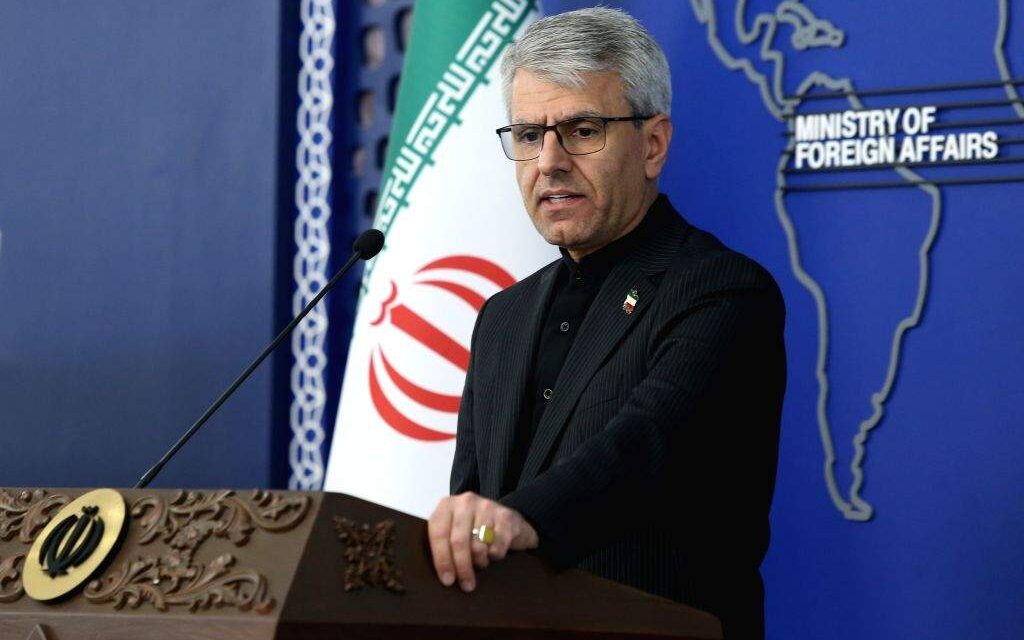
Iranian Foreign Ministry Esmaeil Baghaei presents Tehran’s demands to end US-Israel War, April 6, 2026
US-Israel War on Iran, Day 38: Trump’s War Crimes Threat
UPDATE 2123 GMT:
US journalist Shelly Kittleson, kidnapped by an Iran-backed Iraqi militia from a Baghdad street corner last week, has been released.
An Iraqi official said Kittleson was freed this afternoon. Earlier in the day, the Kata’ib Hezbollah militia said it had decided to free the journalist, abducted on March 31.
The group militia its decision came “in appreciation of the patriotic stances” of outgoing Iraqi Prime Minister Mohammed Shia al-Sudani. It added, “This initiative will not be repeated in the future.”
The statement said Kittleson must “leave the country immediately” upon her release.
UPDATE 1955 GMT:
Russia and China vetoed a Bahraini resolution at the UN Security Council to reopen the Strait of Hormuz.
The vote was 11-2. Pakistan and Colombia abstained.
The initial draft gave a clear UN mandate to any state wishing to use force to unblock the strait. Objections from countries such as France, Russia, and China made clear that any action must be “defensive”, and language referring to authorization to use force was removed.
The resolution also called for an end to attacks on civilian water, oil, and gas infrastructure.
UPDATE 1700 GMT:
In southern Iraq, at least three people have been killed and five wounded by rockets fired from the direction of Kuwait.
The weapons hit a house in Khor al-Zubair near Basra. Some family members remain under the debris.
UPDATE 1613 GMT:
The toll from Israel’s attacks on Lebanon since March 2 has reached 1,530 killed — including 102 women, 130 children, and 57 health workers — and 4,812 injured, says the Lebanese Health Ministry.
UPDATE 1454 GMT:
French nationals Cecile Kohler and Jacques Paris, held as political prisoners since May 2022 and given long prison sentences in June 2025, are on their way home.
French President Emmanuel Macron posted:
Cécile Kohler and Jacques Paris are free and on their way to French territory, after 3 1/2 years of detention in Iran. This is a relief for all of us and obviously for their families.
Cécile Kohler et Jacques Paris sont libres et en chemin vers le territoire français, après trois ans et demi de détention en Iran. C’est un soulagement pour nous tous et évidemment pour leurs familles.
Merci aux autorités omanaises pour leurs efforts de médiation, aux services…
— Emmanuel Macron (@EmmanuelMacron) April 7, 2026
An official at the French Foreign Ministry said Kohler and Paris left Iran at dawn in a diplomatic convoy with the French Ambassador and are currently in Azerbaijan”.
UPDATE 1321 GMT:
US officials and Iranian semi-official media report American strikes on Kharg Island, the hub in the northern Persian Gulf handling more than 90% of Iran’s oil exports.
UPDATE 1316 GMT:
Donald Trump has posted on social media, “A whole civilization will die tonight, never to be brought back again.”
UPDATE 1307 GMT:
Israel is bombing Iranian railways.
A strike on a rail bridge in Kashan in central Iran killed two people and injured.
Another rail bridge between Hashtgerd and Tabriz in northwest Iran was damaged, closing a major highway between Tehran and Tabriz.
The Israel Defense Forces warned Iranians to stay away from trains early Tuesday.
UPDATE 1303 GMT:
Istanbul Governor Davut Gul has revised the account of the fatal shooting near the Israeli Consulate in the Turkish city.
Initial reports said three people were killed, but Gul said attacker was slain and two others wounded. Two police officers were injured in the firefight with the assailants.
Gul said that there have been no Israeli diplomatic staff at the consulate in Istanbul since late 2023.
UPDATE 1110 GMT:
Three people — two of them attackers — have been killed and two police officers injured in shooting near the Israeli Consulate in Istanbul, Turkey.
A third assailant was captured.
UPDATE 1050 GMT:
French Foreign Minister Jean-Noël Barrot has responded to Donald Trump’s threats against Iran, “We oppose any strike on civilian infrastructure….[It would] open a new phase of escalation and reprisals … which would worsen an already concerning situation. The risk is that we see a regional conflagration without limits.
Barrot called for the reopening of the Strait of Hormuz, as its closure is affecting the global economy. He said France’s role is to “limit the consequences” of the conflict and “support mediation efforts”.
“This is a war we did not choose and whose consequences we are managing,” he said.
UPDATE 0912 GMT:
At least eight people were killed and dozens wounded by overnight Israeli airstrikes on southern Lebanon.
Three were slain in Maarakeh, one in Zebdine, one in Deir al-Zahrani, and three in Tayr Debba.
UPDATE 0835 GMT:<
Israel says it struck another key petrochemical compound in Iran, this time in Shiraz in the southwest of the country.
UPDATE 0823 GMT:
Almost 3,600 people have been killed in Iran, including at least 1,665 civilians, by the US-Israel War, reported the US-based Human Rights Activists News Agency.
At least 248 of those killed were children.
On Monday, at least 49 civilians were killed and 58 injured, HRANA summarized. The agency recorded 573 attacks in 215 incidents across 20 of Iran’s 31 provinces, the highest rate of attacks in the last 10 days.
UPDATE 0712 GMT:
Iran has struck a Saudi petrochemical complex overnight.
“An attack caused a fire at the SABIC [Saudi Basic Industries Corporation] plants in Jubail. The sounds of explosions were very loud,” a witness said.
Videos on social media claimed to show a fire in the complex.
NEW
Reports indicate Al Jubail Industrial City in Saudi Arabia is on fire following Iranian strikes. pic.twitter.com/c6KbzFmh3z
— Open Source Intel (@Osint613) April 6, 2026
The Saudi Ministry of Defence said seven ballistic missiles were intercepted over the east of the country.
The King Fahd Bridge was closed to traffic, suspending the only land link with Bahrain.
UPDATE 0657 GMT:
Malaysia’s Foreign Ministry says one of seven Malaysian commercial vessels in the Strait of Hormuz has been allowed to pass.
The transit followed diplomatic talks with Iranian officials led by Malaysian Prime Minister Anwar Ibrahim.
ORIGINAL ENTRY: The Trump camp and Iran’s regime have exchanged demands in a Pakistan-led mediation effort to end the US-Israel War.
Iran officially rejected US conditions with a 10-clause list of its own. They included an end to all conflicts in the region, a protocol for safe passage through the Strait of Hormuz, lifting of sanctions, and provisions for reconstruction.
The American demands were not specified, but they were likely similar to a 15-point ultimatum issued last month. Those demands included a permanent end to Iran’s nuclear program; strict limits on its ballistic missiles; the cutting of links with groups throughout the Middle East such as Lebanon’s Hezbollah, Yemen’s Houthis, and Iraqi militias; and an end to Tehran’s control of the Strait of Hormuz.
Donald Trump reiterated that his Tuesday 8 p.m. “deadline” for Iranian capitulation is final, saying Iran’s proposal is significant but not good enough.
He said US campaign will continue, with strikes on civilian infrastructure breaking international law, because the regime they “just don’t want to say ‘uncle’” and surrender.
“If they don’t, they’ll have no bridges, they’ll have no power plants, no anything,” he threatened.
Trump: "We are obliterating their country, and they just don't want to say 'uncle.' But they will. And if they don't, they'll have no bridges, no power plants, no anything. I won't go further because there are other things that are worse than those two, and we might have — well,… pic.twitter.com/zHUCGSwgT6
— Aaron Rupar (@atrupar) April 6, 2026
In a press conference on Monday afternoon, he blustered, “The entire country can be taken out in one night, and that night might be tomorrow night.”
Questioned if he was committed war crimes, he responded, “I’m not worried about it.” He repeated the false claim about the status of Iran’s nuclear program: “You know what’s a war crime? Having a nuclear weapon.”
In a series of contradictions, he insisted that he was still open to a deal with Iran an “active, willing participant” in negotiations. “We may even get involved with helping them rebuild their nation,” he said.
But then he said the Iranian people should rise up and overthrow the regime if a ceasefire were declared.
Iran’s Foreign Ministry spokesperson Esmaeil Baghaei reiterated Tehran’s position that negotiations are “incompatible with ultimatums and threats to commit war crimes”. The Iranian military command warned of a “much more devastating” retaliation if the US stepped up strikes.
On Monday, Israel struck Iran’s largest petrochemical facility, part of world’s largest gas field South Pars.
The facility in Asaluyeh is responsible for half of petrochemical Iran’s production. Israel earlier claimed the bombing of Iran’s second-largest facility, Mahshahr, with 35% of production.
Israel also killed Majid Khademi, the intelligence head of the Revolutionary Guards.

The “monstrous” Trump lie – US pilot “rescue” a military fiasco and ground operation: https://www.bankingnews.gr/diethni/articles/867332/revealed-the-monstrous-trump-lie-us-pilot-rescue-a-military-fiasco-and-ground-operation
“Independent experts estimate that the true purpose of the US special forces operation was the seizure of uranium; however, the raid appears to have failed. The rescue operation for the American F-15E pilot, whose name remains unknown, evolved within just two days into an almost “epic” narrative. Trump repeats several times a day how skillfully, decisively, and selflessly those participating in the raid deep inside Iranian territory acted, how perfectly the operation was planned, and how their persistence finally led to the rescue when things took a negative turn. However, as more details come to light, questions from experts grow regarding this—undoubtedly—largest US military operation since “Saving Private Ryan.” The mere fact that 11 aircraft—fighters, helicopters, and UAVs—were lost within just a day and a half is already causing serious concern. Either the operation was poorly planned, or it was used as cover for something else, or it was unfolding alongside a different mission.”
Armed attack outside Israeli consulate in istanbul
https://youtube.com/watch?v=4QoAmpNWa-8
According to Istanbul governor consulate was empty
How did the US rescue F15 pilot:
https://www.youtube.com/watch?v=nd4Ym3aOklU
According to video F15 was shot down by a TOR system. Later A10 was shot down by a shoulder fired missile
How Trump Took the U.S. to War With Iran: https://www.nytimes.com/2026/04/07/us/politics/trump-iran-war.html
“Mr. Netanyahu and his team outlined conditions they portrayed as pointing to near-certain victory: Iran’s ballistic missile program could be destroyed in a few weeks. The regime would be so weakened that it could not choke off the Strait of Hormuz, and the likelihood that Iran would land blows against U.S. interests in neighboring countries was assessed as minimal……Besides, Mossad’s intelligence indicated that street protests inside Iran would begin again and — with the impetus of the Israeli spy agency helping to foment riots and rebellion — an intense bombing campaign could foster the conditions for the Iranian opposition to overthrow the regime. The Israelis also raised the prospect of Iranian Kurdish fighters crossing the border from Iraq to open a ground front in the northwest, further stretching the regime’s forces and accelerating its collapse.”
Trump Says Iran Has Presented a ‘Workable’ 10-Point Proposal: https://www.wsj.com/livecoverage/iran-war-2026-trump-deadline-latest-news/card/trump-says-iran-has-presented-a-workable-10-point-proposal-HK9s10q879EXSwk3aPBF
Astonishing. Trump has accepted Iran’s framework for negotiations and backed down / blinked. He even referred to the Iranian government respectfully as the “Islamic Republic of Iran”. This sort of diplomatic language will go down well in Tehran. Here is the 10-point plan, according to an Iranian broadcaster:
1.Complete cessation of the war on Iraq, Lebanon, and Yemen
2. Complete and permanent cessation of the war on Iran with no time limit
3. Ending all conflicts in the region in their entirety
4. Reopening the Strait of Hormuz
5. Establishing a protocol and conditions to ensure freedom and security of navigation in the Strait of Hormuz
6. Full payment of compensation for reconstruction costs to Iran
7. Full commitment to lifting sanctions on Iran
8. Release of Iranian funds and frozen assets held by the United States
9. Iran fully commits to not seeking possession of any nuclear weapons
10. Immediate ceasefire takes effect on all fronts immediately upon approval of the above conditions