
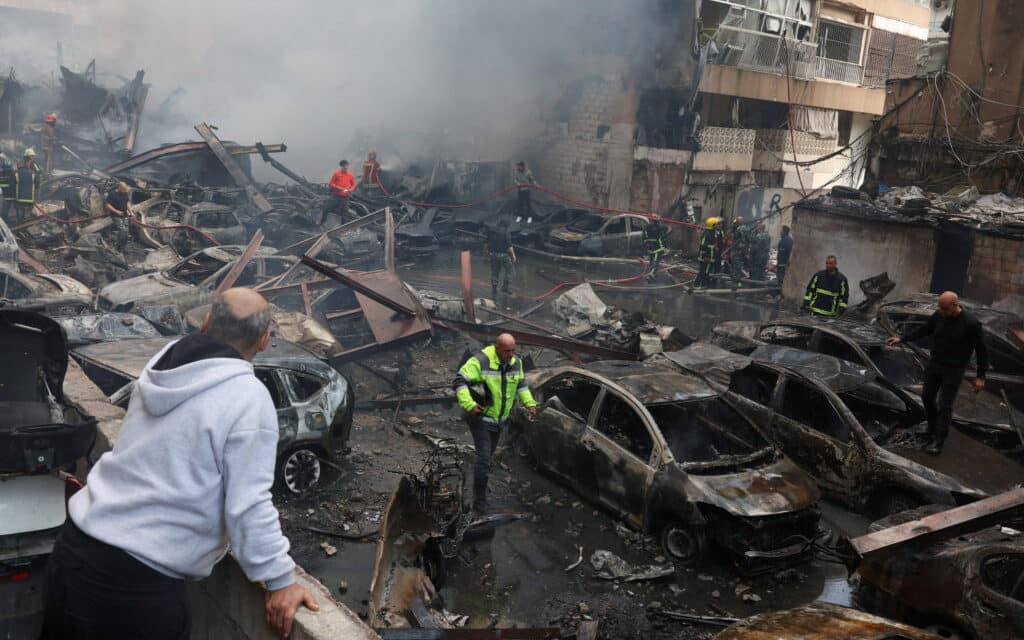
Rescuers work at the site of an Israeli strike on Beirut, Lebanon, April 8, 2026 (Mohamed Azakir/Reuters)
EA on International Outlets: A Fragile US-Iran Ceasefire
The ceasefire in the Middle East is on shaky ground. Israel continued its bombardment of Lebanon on Wednesday, claiming its activities there are not part of the deal with Iran. These attacks killed at least 254 people across Lebanon and injured at least 837 in what was Israel’s largest mass killing of the war.
Iran responded by reaffirming its closure of the Strait of Hormuz and threatening a “regret-inducing response” if the strikes continue. Donald Trump subsequently warned that US strikes on Iran would resume if it did not comply with the ceasefire.
The Conversation UK spoke with Scott Lucas, an expert in Middle East politics at University College Dublin:
1. Why is there confusion about whether Lebanon was included in the ceasefire?
Part of the problem is the nature of diplomacy in 2026. Both the Trump camp and Pakistan’s Prime Minister, Shahbaz Sharif — a key mediator between the US and Iran since the start of the war — issued statements on social media instead of coordinating the release of an agreed text.
That said, there should be no confusion. Sharif’s social media post made clear that the ceasefire also applies to Israel’s campaign in Lebanon. He wrote: “I am pleased to announce that the Islamic Republic of Iran and the United States of America, along with their allies, have agreed to an immediate ceasefire everywhere including Lebanon and elsewhere, EFFECTIVE IMMEDIATELY.”
Trump also accepted that later peace talks in Pakistan would be based on Iran’s 10-point plan, which he described as a “workable basis on which to negotiate”. One of Iran’s demands is for “an end to attacks on Iran and its allies”. This includes the Israeli strikes against Hezbollah in Lebanon.
2. Why then is Israel still attacking Lebanon?
Israel’s Prime Minister, Benjamin Netanyahu, does not have an interest in ending the war until he establishes something he can claim as a “victory”. Israel’s objective in Iran is regime change: at the start of the war, Netanyahu announced that the “goal of the operation is to put an end to the threat from the Ayatollah regime in Iran”.
Trump’s goals in Iran are less clear. He entered the war pledging to prevent Iran from obtaining a nuclear weapon, destroy its missile capability, break its regional proxies, eliminate its navy and create an opening for regime change. But Iran’s regime is still in place and the Trump camp now appears willing to enter into negotiations with it.
So Netanyahu’s focus shifts to Lebanon and expansion of the Israeli occupation in the south of the country. Attacks will continue until that is achieved. The situation is similar to Gaza, where Israel now occupies 53% of the territory after its two years of attacks.
By presenting a victory over the threat of Hezbollah, pushing the group further from the Israeli border, Netanyahu can try to bolster his support at home despite any disappointment over the inconclusive outcome of the war in Iran.
3. Will Israel’s actions push the Gulf states closer to Iran?
For the first time since the start of the US-Israel War on February 28, the Iranian and Saudi Arabian Foreign Ministers have spoken by phone.
The Saudi Foreign Ministry said, “They reviewed the latest developments and discussed ways to reduce tensions to restore security and stability in the region.”
However, this is only a tentative beginning to repair the damage of the past six weeks. Gulf States are unhappy that the US exposed them to Iran’s retaliation by embarking upon the war, but that does not erase their anger with Tehran over the extent of the damage, including to energy infrastructure.
Saudi Arabia and the UAE were even pressing the Trump camp to “finish the job” with ground operations to vanquish the regime. That option appears to have been paused. However, it is not off the table if the US-Iran negotiations collapse.
4. Where does all of this leave Donald Trump?
Angry, frustrated, and uncertain what to do next. Trump’s bluster on Monday that “a whole civilization will die tonight”, unless Iran reached a deal, was always an expression of weakness rather than strength. The Plan A for regime surrender, with the killing of the Supreme Leader and dozens of commanders and officials, did not have a Plan B when the remaining leaders refused to concede and instead struck back.
With Iran controlling the Strait of Hormuz and choking off shipping, including of oil and gas, the Trump camp was reduced to either ground operations or talks. Trump snatched at the later amid military advice of the difficulties of a ground assault, domestic opinion largely opposed to the escalation, the further economic shocks, and Vice President J.D. Vance averse to the war.
But he did so by handing Iran the diplomatic initiative. Now the White House is trying to pull it back, including by giving Israel the green light to continue its assault in Lebanon. The US is now denying that Lebanon was ever included in the ceasefire deal, with Trump calling it a “separate skirmish”.
5. Can the US restrain Israel?
It could — remember that Trump forced Netanyahu to halt the 12-day War on Iran last June — but it won’t, at least for now in Lebanon.
If the Trump camp no longer needs Israel for its approach to Iran, then it can push away Netanyahu’s demand for regime change. The Israelis can continue with targeted assassinations, but they cannot pursue wider military operations without the Americans.
The situation is different in Lebanon. As was the case with Gaza, Israel can press its assault without the likelihood of American intervention to force a limit, let alone a halt. Netanyahu cannot afford that halt, given the political and legal predicament that would ensure amid elections later this year and his trial on bribery charges.
So this is the possible landing point. Israel confirms its occupation of 15% of Lebanon, up to the Litani River 30 km from the border. The Trump Administration then sweeps in and proclaims its brokering of a ceasefire — just like it did in Gaza with Israel’s indefinite occupatino of most of the area
Everyone’s a winner. The Iranian regime survives, Netanyahu has his Greater Israel, and Trump returns to being “President of the Board of Peace”.
Everyone’s a winner. That is, except for the Iranians, the Lebanese, and other populaces who have been slain, injured, or displaced by this war and political maneuvers.