
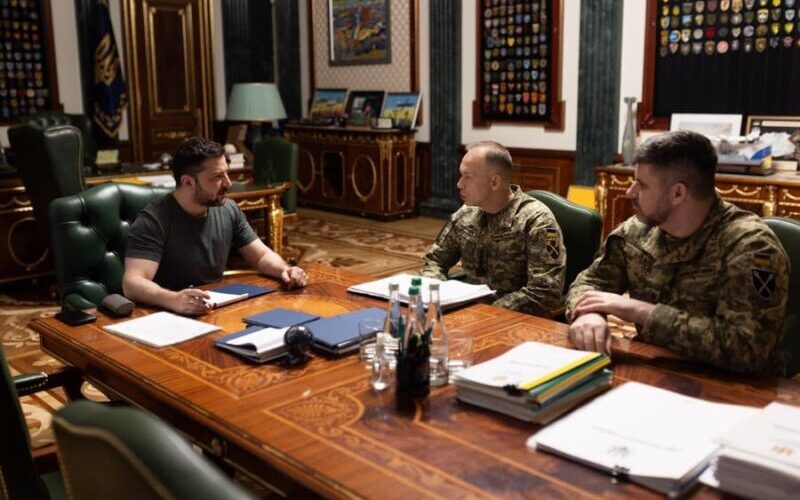
Ukraine President Volodymyr Zelensky with military commanders, Kyiv, March 22, 2026
Sunday’s Coverage: “Constructive” Ukraine-US Talks In Florida
UPDATE 1521 GMT:
Ukraine’s military says it has struck one of Russia’s largest Baltic Sea oil terminals at Primorsk in the Leningrad region.
The Primorsk port handles around 60 million tons of crude oil per year as the endpoint of the Baltic Pipeline System.
The military claimed a large fire was set, but the “results of the strike are currently being clarified”.
It added that special units struck the “Bashneft-Ufaneftekhim” oil refinery in the city of Ufa.
The facility’s primary processing capacity is around 8.2 million tons of oil per year.
UPDATE 0935 GMT:
The European Union has begun limiting Hungary’s participation in confidential meetings because of concerns that Budapest could leak classified information to Russia, say “informed sources”.
The sources said “a significant portion of European diplomacy” is now in small group formats instead of meetings with all 27 EU member states. Negotiations are currently taking place in the E3 (France, Germany, and the UK); the E4 (the same countries plus Italy); the Weimar Triangle (Germany, Poland, and France); the NB8 (the eight Nordic and Baltic countries); and other groups.
European officials have noted that Hungarian Foreign Minister Péter Szijjártó used breaks during meetings with representatives of other EU member states to call Russian Foreign Minister Sergey Lavrov.
Polish Prime Minister Donald Tusk has posted that representatives of Hungarian Prime Minister Viktor Orbán “informed Moscow in detail about EU Council meetings”: “We have long had suspicions about this. This is one of the reasons why I only speak when absolutely necessary and only say as much as necessary.”
UPDATE 0756 GMT:
Ukraine’s top negotiators and Donald Trump’s envoys concluded two days of talks in Florida on Sunday.
In his nightly address to the nation, Ukraine President Volodymyr Zelensky respectfully addressed the Trump camp.
I am very grateful to American society for its clear support for a normal, dignified peace for Ukraine. It is important that none of us is forced to return to war in a few months or years, which means that security guarantees for Ukraine and for all of Europe must be sufficient for a reliable peace.
He gave no details of the talks because, as he awaited the return of the negotiating team, these “cannot be safely discussed over the phone”.
However, he said, “There are signals that further exchanges may be possible, and this would be good news and confirmation that diplomacy is working.”
Today, I received a report from our negotiating team following the second day of their meetings in America with envoys of the President of the United States.
I am very grateful to American society for its clear support for a normal, dignified peace for Ukraine. It is important… pic.twitter.com/wwtzPYPdtH
— Volodymyr Zelenskyy / Володимир Зеленський (@ZelenskyyUa) March 22, 2026
Trump envoy and real estate developed Steve Witkoff posted, “We remain encouraged by the continued, substantive engagement”:
Today in Florida, delegations from the United States and Ukraine reconvened for a second day of discussions as part of the ongoing, US-led mediation efforts toward establishing a lasting and comprehensive peace agreement to the war.
The constructive talks built on yesterday’s…
— Special Envoy Steve Witkoff (@SEPeaceMissions) March 22, 2026
ORIGINAL ENTRY: Russia has launched its spring offensive trying to seize territory in eastern Ukraine, but is reportedly taking heavy casualties.
After a net loss on the frontlines in February, with a Ukrainian counter-offensive in the south regaining up to 450 square km (174 square miles), the Russians are attacking in the Donetsk region.
Ukraine President Volodymyr Zelensky posted, after a meeting with with Commander-in-Chief Oleksandr Syrskyi and Chief of the General Staff Andrii Hnatov, “The only tangible outcome for the Russian army has been an increase in their losses – more than 8,000 killed and seriously wounded Russian soldiers in just these seven days.”
In the Donetsk region, our positions have not significantly changed over the past week. In the Kharkiv region and in border communities of the Sumy region, we are observing attempts by the occupier to advance from the border – Russian units carrying out these attempts are being destroyed.
Zelensky claimed that the Russian command was finally recognizing the scale of the losses, “where their units are actually located on the frontline and how this differs from the official reports submitted up the chain of command”. Some brigade-level commanders were replaced as punishment for false reporting, he asserted.
Ukraine holds around 20% of Donetsk, a “Fortress Belt” preventing the Russians from advancing further into the country. Moscow’s forces have stepped up operations in the direction of Slovynask, at the northern tip of the Belt.
With the Russians around 20 km from Slovyansk, Ukrainian authorities ordered children to be evacuated from the area in anticipation of an assault.
A Ukrainian military spokesperson said Russian forces are attacking from various direction, in an attempt to distract Ukraine’s drone-based defenses. They added that Russian forces are also launching, more KAB-3000 guided glide bombs, Lancet loitering munitions, and Molniya fixed-wing drone strikes in the direction of the hub of Lyman.
The US-based Institute for the Study of War assesses, “Russian forces are unlikely to seize the Fortress Belt in 2026 but will likely make some tactical gains at a significant cost.”
The ISW noted a report that the Russians suffered 405 casualties out of more than 500 personnel involved in a battalion-sized mechanized assault last Thursday: “Such a casualty rate is unsustainable and would likely degrade the Russian ability to wage such large assaults in the mid- to long-term.”
Zelensky: US Easing of Sanctions “Gives Russia A Sense Of Impunity”
Zelensky posted on Sunday about the scale of Russia’s aerial assault, aided by US relaxation of sanctions on Moscow:
Revenues give Russia a sense of impunity and the ability to continue the war. That is why pressure must continue and sanctions must work.
He called on European partners to step up confiscation of vessels of the Russian “shadow fleet”.
Over the past week, Russia launched nearly 1,550 attack drones against Ukraine, more than 1,260 guided aerial bombs, and two missiles. Over that same week, due to the easing of sanctions, Russia increased its crude oil sales to finance its war.
Revenues give Russia a sense of… pic.twitter.com/tFSFirlybe
— Volodymyr Zelenskyy / Володимир Зеленський (@ZelenskyyUa) March 22, 2026
The Russian Government’s oil revenues fell by 47% in January and February because of US sanctions on Russia’s top oil companies and their international customers.
However, in the US-Israel War on Iran, the Trump Administration is under pressure from a surge in global oil prices. So it has given all countries a waiver until April 11 for purchases of Russian oil which is at sea.
Treasury Secretary Scott Bessent again defended the relaxation in an interview on Sunday, offering a convoluted explanation.
WELKER: If the point of sanctions was to stop funding the Russian war machine, why is the administration effectively rewarding Russia now?
BESSENT: Again Kristen, you're missing the point
WELKER: They wouldn't have gotten any money with sanctions in place
BESSENT: Kristen,… pic.twitter.com/C6y4BrCXaF
— Aaron Rupar (@atrupar) March 22, 2026

The article is bias