
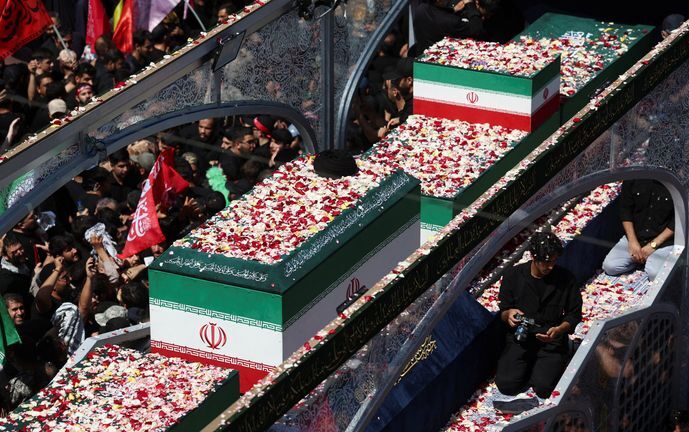
The coffin of Iran’s assassinated Supreme Leader Ali Khamenei during a procession in Iran’s holy city of Qom, July 7, 2026 (Sky)
EA on WION: What Now For Iran After Funeral of Supreme Leader?
EA on International Media: Trump “TACOs” Over US Strikes on Iran
In early July, more than four months after Ali Khamenei was assassinated in a US-Israeli strike on February 28, the Islamic Republic finally buried its long-serving Supreme Leader.
The State funeral developed into a week-long political spectacle stretching from Tehran to Qom in Iran; from Najaf to Karbala in Iraq; and finally to Iran’s second city Mashhad. Their extraordinary duration, geographical scope, and carefully choreographed symbolism were not just the commemoration of a deceased ruler. This was the Islamic Republic’s attempt to navigate one of the most precarious moments in its history.
State funerals are normally organized within days. In Khamenei’s case, this was more than four months when the Islamic Republic remained at war, its political future appeared uncertain, and Mojtaba Khamenei — appointed Supreme Leader only days after his father’s death — remained almost entirely absent from public view. His prolonged disappearance fuelled speculation about his whereabouts, his health, and the extent to which he had actually consolidated power.
In this context, the funeral assumed a significance that extended far beyond the burial of Khamenei, the Islamic Republic’s second Supreme Leader. It offered the new leadership an opportunity to demonstrate that the political system remained functional despite war, assassination, and an opaque transfer of power. Religious ritual, state ceremony, military symbolism, diplomatic protocol, and extensive media coverage were combined into a carefully stage-managed performance designed to project continuity, institutional resilience, and political authority at a moment when all three appeared under pressure.
These ceremonies were directed less towards commemorating Ali Khamenei himself than towards stabilizing the post-Khamenei order. They constituted the first major public performance of the new leadership and sought to transform a potentially destabilizing succession into a demonstration of institutional continuity. The end of Ali Khamenei’s rule was the carefully-orchestrated political inauguration of his successor.
The Death of Ali Khamenei and the Delayed Burial
The delay between Khamenei’s death and funeral contrasted with the rapid appointment of his son. On March 9, the Assembly of Experts announced that Mojtaba Khamenei, the second son of the deceased Leader, had been elected. Official media claimed the speedy process as a demonstration that the political system had prevented any leadership vacuum.
The formal transfer of power did not dispel political uncertainty. Mojtaba Khamenei disappeared almost completely from public view after his appointment. Conflicting reports circulated concerning his whereabouts, his physical condition, and the extent to which he had assumed the responsibilities of office. No official explanation was offered for his prolonged absence.
Initially, the authorities appeared determined to organize the funeral without delay. On March 4, the Coordination Council for Islamic Propaganda announced that Tehran’s Imam Khomeini Mosalla would open later in the evening for citizens to pay their respects. The traffic police published detailed regulations in preparation for large crowds.
Hours later, the plans were abruptly abandoned. State news agency IRNA announced that the public farewell ceremonies had been postponed “to a later date”. No explanation was provided, and none was issued subsequently.
The security situation provides the most plausible explanation for the delay. During the first weeks after the assassination, the possibility of targeted killings by airstrikes remained. A State funeral would have assembled much of the Islamic Republic’s political, military, and religious leadership in a single location, together with enormous crowds of mourners.
The delay served political purposes as well. It gave the new leadership valuable time to prepare an event of extraordinary organizational and symbolic complexity. By July, the funeral had evolved into a spectacle far more ambitious than the ceremonies originally envisaged in early March.
However, the unusually long interval encouraged speculation about the circumstances of Khamenei’s death and the condition of his remains. No independently verifiable information was ever released regarding the exact cause of death, the recovery and identification of the body, or its preservation. Claims that he died beneath the rubble, from blast injuries, or from shrapnel wounds could not be established on the basis of publicly available evidence.
The ceremonies needed to be effective enough in demonstrating the orderly transfer of supreme authority to overcome questions which would not or could not be answered.
Organizing A Funeral
The funeral’s preparations were coordinated by a National Headquarters for the Farewell and Mourning Ceremonies, under the leadership of Deputy Interior Minister Ali-Akbar Pourjamshidian. Ministries, provincial administrations, municipalities, police forces, the Islamic Revolutionary Guard Corps (IRGC), the Basij militia, emergency services, the Red Crescent Society, transportation authorities, and religious institutions all participated in planning and implementation.
At a moment when the death of the Supreme Leader could have exposed institutional fragility, the authorities instead displayed an administrative apparatus functioning across every level of government. Civilian administration, security organizations, religious institutions, and local authorities were components of a single coordinated system. The funeral became a demonstration not only of political continuity but also of bureaucratic competence.
Ceremonies in Iraq followed the same pattern with extensive cooperation between Iran and Iraqi authorities, including the Prime Minister’s Office, provincial administrations, security forces, and the Popular Mobilization Forces (al-Hashd al-Shaabi). The funeral suggested a continuity beyond the borders of the Islamic Republic.
Security preparations reflected the exceptional circumstances. The authorities had to manage enormous crowds while simultaneously protecting much of the country’s political, military, and religious leadership against the possibility of renewed attacks. Tehran’s traffic police established multiple traffic-control zones across the capital, while additional security perimeters surrounded the principal prayer complex. Visitors arriving from outside Tehran were directed to large parking areas before continuing by metro or bus through carefully regulated routes. Public transport operated free of charge throughout the ceremonies.
Accommodation was organized on a similarly remarkable scale. Schools, universities, mosques, sports halls, public buildings, parks, temporary camps, and specially-designated reception centers were prepared to receive visitors from across the country. Capacities ranged from around one million to more than three million people in Tehran alone. Comparable preparations were announced in the holy city of Qom.
Along the procession routes, hundreds of mokebs provided food, water, medical assistance, and logistical support. Thousands of emergency personnel, ambulances, helicopters, and mobile medical facilities were on standby throughout Tehran, Qom, and Mashhad.
Officials repeatedly referred to planning scenarios for up to 15 million participants in Tehran. Whether the figures reflected realistic expectations is secondary. The funeral was conceived as an event whose scale would carry political meaning as one of the largest public mobilizations in the history of the Islamic Republic. Long before the first procession began, the funeral was a demonstration of state capacity during wartime.
The Choreography of Succession
The public ceremonies unfolded over an entire week, beginning with official tributes in Tehran on July 3 and ending with Ali Khamenei’s burial in Mashhad during the early hours of July 10’f. Although each stage possessed its own religious significance, the sequence followed a carefully-constructed political logic. The continuous narrative linked political authority, religious legitimacy, and regional influence.
The ceremonies began in Tehran, the political center of the Islamic Republic; continued to Qom, the country’s principal center of Shi’a scholarship; extended to Najaf and Karbala in Iraq, the two most important holy cities of Twelver Shi’ism, and concluded in Mashhad at the shrine of Imam Reza.
The opening ceremony on July 3 established the narrative. Senior representatives of the executive, Parliament, judiciary, armed forces, Revolutionary Guards, and the clerical establishment were joined by foreign delegations from allied governments and organizations. State TV devoted extensive coverage to the orderly reception of these guests as they approached the coffins of Ali Khamenei and members of his family.
Diplomatic protocol became part of the funeral’s political language. The visible presence of regional partners suggested that the Islamic Republic’s alliances had survived the assassination of its Supreme Leader. At a moment when external observers might have expected uncertainty or fragmentation, the leadership instead presented an image of continuity extending well beyond borders.
When Tehran’s principal prayer complex opened to the public on July 4, official coverage shifted its emphasis from political elites to mass participation. Broadcasts showed long queues, densely-packed crowds, and emotionally charged scenes of mourning. These images undoubtedly reflected genuine grief. At the same time, they conveyed the message that the relationship between the Islamic Republic and significant sections of society remained intact despite war and political transition.
The funeral prayer on July 5 was the symbolic center of the ceremonies. Grand Ayatollah Ja’far Sobhani presided with President Masoud Pezeshkian, Parliament Speaker Mohammad Baqer Qalibaf, Chief Justice Gholamhossein Mohseni Eje’i, senior military commanders, and leading clerics in attendance. Three of Ali Khamenei’s sons also appeared.
Despite having served as Supreme Leader for almost four months, Mojtaba Khamenei did not attend the funeral. No official explanation was ever offered. Speculation about security concerns, injuries sustained during the February attack, or deliberate political calculation circulated widely. None of these interpretations were substantiated.
Ordinarily, the funeral of a head of state allows the successor to embody continuity in public. Here, the opposite occurred. The individual whose authority the ceremonies were expected to reinforce remained invisible throughout the event. As a consequence, responsibility for demonstrating continuity shifted from the new Supreme Leader to the institutions surrounding him. Government ministries, military organisations, clerics, municipalities, and foreign allies collectively performed stability. The Islamic Republic derived its strength not from a single leader but from the political system that survived him.
Public Mobilization and the Politics of Participation
In authoritarian systems, state funerals rarely function as acts of remembrance alone. They also test the state’s capacity to mobilize society and to display that mobilization as evidence of legitimacy.
Preparations for the funeral reflected this objective. Provincial administrations, municipalities, the Revolutionary Guards, the paramilitary Basij, religious organizations, universities, and other public institutions coordinated
transportation to Tehran and later to Qom and Mashhad. Across the country, buses were organised to bring participants to the ceremonies, while Tehran’s transport network operated at exceptional capacity, remaining free throughout the week. Accommodation, food distribution, and medical services substantially reduced the practical obstacles to participation.
These measures did not by themselves determine the character of participation. To the contrary, the extensive involvement of public institutions prompted persistent questions about the extent to which attendance was spontaneous mobilization or administrative organization.
The available evidence does not permit a simple distinction. State institutions unquestionably facilitated participation. Yet no reliable evidence has emerged to demonstrate a nationwide policy of compulsory attendance. Religious conviction, political loyalty, institutional encouragement, and practical organization almost certainly overlapped. Rather than being mutually exclusive categories, they were different motivations within the same mass event.
The debate over participation soon shifted to numbers. Tehran’s mayor referred to planning assumptions of 15 million participants. During the ceremonies, government representatives repeated similar estimates while acknowledging that no precise statistics were available. After the funeral, official and semi-official media expanded the narrative by referring to cumulative participation exceeding 40 million people across all ceremonies in Iran and Iraq.
No comprehensive aerial imagery, anonymized mobile-phone data, transparent crowd-density calculations, or independently verifiable methodology was released to support the claims. Analyses based on the dimensions of Tehran’s streets demonstrate that such figures are not inherently impossible, but they cannot be confirmed. The same uncertainty applies to estimates for Qom, Mashhad, Najaf, and Karbala.
The cumulative figure of 40 million presents an additional problem. Many participants attended several stages of the funeral. Those present at the public farewell, funeral prayer, and procession in Tehran may also have travelled to Qom or Mashhad. Without transparent methods distinguishing cumulative attendance from unique individuals, such totals remain impossible to verify.
Yet statistical precision was never the principal issue. The attendance figures performed a political function irrespective of their accuracy. They reinforced the broader claim that the Islamic Republic remained capable of mobilizing society on an extraordinary scale despite war, assassination, and succession. The numbers themselves became part of the funeral’s symbolic language, projecting an image of overwhelming public support even where exact measurement proved impossible.
The crowds were not simply participants in the political performance; they became one of its principal messages. Whether observers accepted the official estimates or questioned them, public debate revolved around the scale of mobilization. In that sense, the authorities largely succeeded in shifting attention away from the uncertainties surrounding the succession towards the visible capacity of the state to fill streets, organize mass gatherings, and present an image of continued political vitality.
Religious Symbolism and Political Communication
Administrative organization and mass mobilization alone could not provide the legitimacy that the leadership sought to project. The funeral therefore relied upon a dense network of religious symbols that situated the succession within the sacred history of Shi’a Islam. Throughout the ceremonies, ritual and politics remained inseparable. Constitutional succession was presented not merely as a legal process but as the continuation of a divinely sanctioned political order.
As representatives of allied governments and movements approached the coffins, carefully selected Qur’anic verses accompanied each delegation. Rather than relying upon a small number of familiar passages, the organizers chose verses addressing themes such as perseverance, divine assistance, sacrifice, loyalty, forgiveness, and ultimate victory. Whether every individual pairing reflected a deliberate political decision cannot be demonstrated conclusively. However, taken together they displayed a remarkable consistency.
The Saudi delegation was greeted with the recitation of Qur’an 3:13, a verse traditionally associated with the Battle of Badr, where a numerically inferior Muslim community prevailed through divine support. Read in the context of the funeral, the passage suggested that military superiority alone does not determine political outcomes. Ali Khamenei’s assassination could be interpreted not as evidence of defeat but as another stage in a longer struggle sustained by faith and endurance.
The verse selected for the Qatari delegation carried a different set of associations. Traditionally linked to reconciliation and the consolidation of authority following conflict, it seemed appropriate for a country that has repeatedly acted as an intermediary between Tehran and Washington.
Other messages accompanied delegations from Turkey, Hezbollah, Hamas, and regional partners. Rather than employing explicit political statements, the organizers relied upon scriptural language capable of conveying political meanings indirectly while preserving the religious character of the proceedings.
This indirect mode of communication has long been characteristic of the Islamic Republic. Since 1979, Qur’anic references have been used to interpret military conflicts, legitimize political decisions, and frame diplomatic relationships within a sacred narrative. Scripture functioned not simply as religious ornamentation but as a language through which political authority could be expressed with particular force.
The funeral’s symbolism extended far beyond the Qur’anic recitations. Throughout the processions, black mourning banners, red flags associated with martyrdom and vengeance, portraits of Ali Khamenei, Qur’anic inscriptions, and references to resistance against the US and Israel framed the Supreme Leader’s death within the established ideological vocabulary of the Islamic Republic. Even the specially constructed vehicle carrying the coffin, modelled on the zarih surrounding Shi’a shrines, transformed the procession into a moving sacred space.
Linking Tehran with Qom, Najaf, Karbala, and Mashhad, the authorities embedded the succession within the principal
centers of Twelver Shi’a religious memory. The transfer of the coffin across this landscape associated Khamenei with the tradition of Shi’a martyrdom while locating the new political order within the sacred geography.
Funeral As Political Theater
To describe the ceremonies as political theater is not to question the sincerity of those who mourned Ali Khamenei. Nor does the concept diminish the importance of Shi’a ritual. Rather, the description recognises that public ceremonies of this scale simultaneously perform political functions.
The constitutional succession had formally been completed within days of Khamenei’s assassination. However, legal continuity could not by itself dispel uncertainty. Authority also must be visible. The funeral offered the first occasion on which the new leadership could demonstrate — not merely claim — that the political system continued to function.
The four-month delay fundamentally altered the character of the funeral. What initially appeared to be a postponed burial evolved into a carefully prepared demonstration of political continuity. The additional time enabled the leadership to organize an event whose geographical reach, symbolic complexity, and organisational scale far exceeded that of a conventional state funeral. Religious ritual, administrative capacity, military organisation, diplomatic participation, and extensive media coverage were combined into a single performance intended to reassure audiences inside and outside the Islamic Republic that the state remained stable despite assassination and war.
Viewed individually, the principal elements of the ceremonies are diverse: unprecedented logistical preparations; mass mobilization; carefully selected Qur’anic recitations; a procession linking Tehran with Qom, Najaf, Karbala, and Mashhad; and the participation of regional allies. Taken together, however, they reveal a coherent political strategy. Each sought to demonstrate that succession had not interrupted the functioning of the Islamic Republic’s institutions.
The media completed this process. State TV and official news agencies did more than document the funeral; they shaped the framework through which it would be understood. Continuous broadcasts emphasized vast crowds, orderly processions, disciplined security forces, emotional scenes of mourning, and the participation of foreign delegations. In contrast, unresolved questions surrounding the four-month delay, the circumstances of Khamenei’s death, contradictory official statements, and Mojtaba Khamenei’s absence remained largely outside the official narrative.
This political theater did not fabricate reality so much as organize attention. The regime’s desired narrative was brought to the foreground while others receded. The funeral sought less to eliminate uncertainty than to define which aspects of uncertainty would dominate public discussion.
A Post-Khamenei Success?
At the same time, the funeral exposed the limits of the regime narrative. The prolonged postponement, the absence of transparent explanations concerning Khamenei’s death, contradictory official statements, and above all Mojtaba Khamenei’s complete absence from every public ceremony prevented the authorities from exercising complete control over political interpretation. The succession had formally been completed, yet the individual expected to personify it remained invisible.
This paradox became the defining feature of the funeral. Unable to present the new Supreme Leader as the public face of continuity, the leadership shifted attention towards the durability of the state itself. The ceremonies asked observers to place their confidence less in Mojtaba Khamenei as an individual than in the institutions surrounding him. Continuity was represented not through a successor but through the collective performance of the Islamic Republic’s political, military, religious, and administrative apparatus.
Whether that strategy ultimately succeeds will be seen a question through future developments rather than the funeral itself. What can be seen, however, is that the ceremonies represented far more than the conclusion of Ali Khamenei’s rule. They marked the first attempt to define the political meaning of the era that followed. The funeral was therefore directed less towards the memory of the deceased Supreme Leader than towards the future of the political order he left behind.
This was the opening act of the post-Khamenei Islamic Republic rather than the closing chapter of the previous one.

what a detailed precise yet useful exploration of Khamenaei’s burial in the context of IRI’s political, institutional, bureaucratic, cultural performances and preferences being established. As the author notes it is not about the past but what the post-Khamenaei /post-War policy preferences are being institutionalised.
Excellent and comprehensive analysis. The author convincingly show how the four-month delay transformed Khamenei’s burial into a state-orchestrated demonstration of continuity – logistical, military, religious and diplomatic – precisely because legal succession alone could not dispel uncertainty, especially with Mojtaba Khamenei’s complete absence from public view. The discussion of mass mobilization, unverifiable crowd figures, and Qur’anic symbolism as political language is particularly valuable. We learn about what concept of legitimacy this performance was meant to enact, and on the significance of extending the ritual to Najaf and Karbala.