
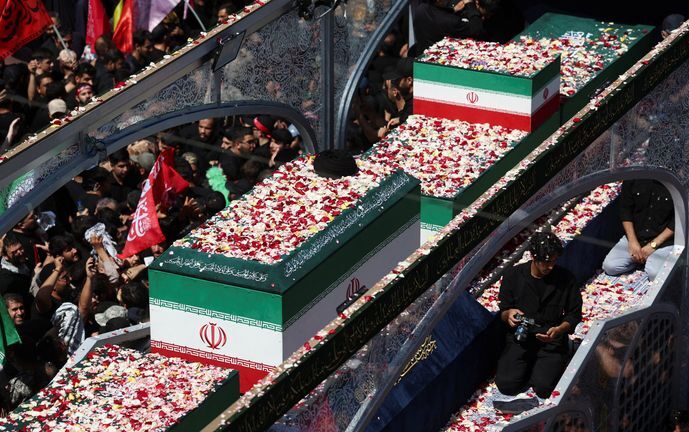
The coffin of Iran’s assassinated Supreme Leader Ali Khamenei during a procession in Iran’s holy city of Qom, July 7, 2026 (Sky)
UPDATES: US-Israel Wars, Day 135 — Clashes Resume Between Iran and US
Amid the latest clashes between Iran and the US in and near the Strait of Hormuz and the stalled talks to end the US-Israel War, I answered the questions of The Conversation’s Jonathan Este on Friday.
Q: Why has Iran started this confict up again? Wasn’t the 14-point deal generally thought of as a victory for them?
The clashes arise from the quest for control of the Strait of Hormuz, the waterway through which around 20% of the world’s maritime oil and gas passes. Iran established that control within days of the US-Israel War. The Trump camp needs to break it; otherwise, they have to negotiate a deal based largely on Iranian terms.
We have had several rounds of clashes since the ceasefire was declared on April 7. Iran attacks a few vessels trying to cross the Strait without Tehran’s permission, preventing the US from establishing a corridor off the Omani coast outside Iranian control. The US military responds with strikes on Iranian military sites on islands and on the southern coast. After 48-72 hours, each side pulls back.
There is one twist in the latest cycle. The US hit not only military targets but also civilian bridges, two from the capital Tehran to the second city Mashhad.
I think that may have been symbolic rather than a substantive escalation — the assassinated Supreme Leader Ali Khamenei was being buried in Mashhad on Thursday — but it is worth watching, just in case the Trump camp are thinking of renewing strikes on civilian infrastructure.
The funeral of Ayatollah Khamenei has beamed images of a defiant and united Iran around the world — how much has that played into Tehran’s thinking?
The regime wanted to display internal legitimacy as well as its defiance of the US-Israel attempts for change and/or surrender.
Some among the millions who turned out are supporters of the regime. But many were coming out not for the leadership but for a nation which is under indefinite attack.
So in part, this was a show. However, it was a show with a sharp point. Two months, the regime was in serious trouble, having to kill thousands of demonstrators to quell nationwide protests. Now, as long as the US and Israel War continues, those who want reform or even removal of the regime will not be able or willing to express those desires.
What role are the Gulf states playing and how are they aligning?
Iran’s retaliation reinforces the message that the regime sent after it survived the initial US-Israel strikes, despite the assassination of the Supreme Leader and dozens of officers and commanders.
In June 2025, during Israel’s 12-day war, Tehran refrained from strikes on the Gulf States. This time, it made clear the gloves were off, with serious damage and effects on the political and economic position of the six countries.
That set off a chain of consequences, including a split among those countries. The UAE is moving closer to Israel and the Trump camp.
Saudi Arabia was angered about the lack of US protection but want the Trumpists to “finish the job” with ground troops forcing the capitulation of the Iranian regime. Once that did not happen, the Saudis switched to playing both sides: they are the power behind Pakistan’s mediation while continuing to encourage US action which could weaken the regime.
Qatar has established itself as a mediator alongside — and possibly beyond — Pakistan. Oman is now maneuvering between Iran and Trumpist demands over the Strait. Bahrain always follows the Saudi lead, and Kuwait just wants the conflict to stop.
Q: How much damage are the US strikes on Iran’s military installations actually doing? Is there any prospect of crippling Iran militarily (enough to curtail its ability to control the Strait of Hormuz)?
The US-Israel strikes killed political and military leaders. They blasted military sites, obliterated the Iranian navy, and disabled some missile launchers and drone production facilities.
But much of Iran’s power lies in mobile capability, from drones to missiles to the small boats and mines of the Revolutionary Guards. US intelligence estimated in May that Iran still possessed around 70% of its pre-war stock of missiles and 70% of its missile launchers. According to the same assessments, only three Iranian missile sites along the strait were inaccessible.
Not only was that sufficient to control the Strait, it enabled Iran to maintain its ability to retaliate against Israel and the Gulf States. And the Trump camp — which may have tried to seize stocks of enriched uranium this spring — has learned that this task may be impossible.
Q: Who is more resilient right now: Iran under renewed sanctions or the Trump administration facing elections in four months?
The Iranian regime has been struck but it survives. It is in a stronger political position than it was on February 26, during the last talks with the Trump camp before the war.
However, its economy was in serious trouble then, sparking January’s nationwide protests, and it will be in serious economic trouble again unless there is a protracted ceasefire and the chance to rebuild. Despite the potential lifting of sanctions and unfreezing of assets, it faces costs of more than $270 billion in war-related damage, much of it to essential infrastructure.
But for now, it can rely on the priority of its show of defiance. The Strait of Hormuz, with free passage for all vessels up to February 28, is now in the hands of the Iranians. That has made global economic shocks more significant than Tehran’s difficulties.
Before the war, Iran was ready for limits on its uranium enrichment and a renewal of the International Atomic Energy Agency’s inspections, disrupted by the 2025 Israeli war. Now that issue is relegated behind a resolution of the Strait.
And for that resolution — unless the US military can force open the waterway — Iran gets benefits that were not assured before February 28: lifting of some US sanctions, unfreezing of some Iranian assets, and potentially a private investment and reconstruction fund of up to $300 billion.
There is no upside for the Trump camp now. None. It has failed to get regime surrender. It has handed the initiative to its foe. Its military strength has been superseded by political ineptitude and failure. It is fighting a war which is widely disliked at home, and more so because of the self-inflicted economic pain for Americans.
Having sought a display of dominance abroad, the Trumpists wear the badge of loss. And having sought a victory for dominance at home, they now face defeat in elections despite trying to manipulate them into assured Congressional majorities.