
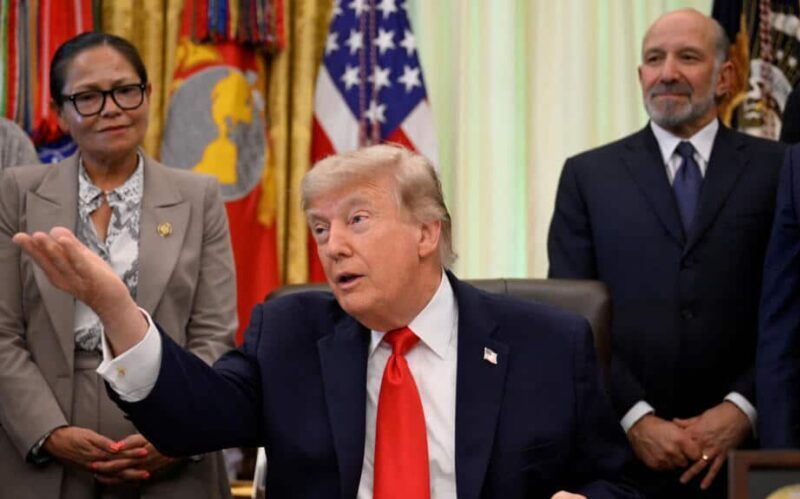
Donald Trump in the Oval Office of the White House, Washington, D.C., June 11, 2026 (Daniel Heuer/Reuters)
EA on TVP World: Deal or No Deal to End US War on Iran?
UPDATE 1025 GMT:
I spoke with RTE 1’s PrimeTime on Tuesday night about the draft 14-point Memorandum of Understanding, assessing it as an “Iranian wish list” and analyzing why the Trump Administration might be willing to accept it.
Watch Discussion from 3:47
UPDATE, JUNE 17:
I joined a panel on India’s News 9 on Tuesday to evaluate Donald Trump’s failed war on Iran.
I detail the US-Iran “framework deal” that is still not a deal. I highlight how Tehran is in a better political position, despite suffering economic damage and assassination of its leaders, than just before the war. And I consider the effect on the Trump Administration at home and abroad.
The other panellists are Ambassador Veena Sukri, Maj. Gen. Sudhakar Jee, and Prof. Swaran Singh.
Watch from 4:22:
UPDATE 1220 GMT:
Alongside Iranian-Israeli analyst Meir Javedanfar, I joined India’s WION to examine the Israel dimension of the proposed framework deal to end the US war on Iran.
We consider whether the Netanyahu Government will try to undermine the agreement. We examine if Israel will continue attacks across southern Lebanon, and even renew them on Beirut’s southern suburbs, as it establishes a zone of occupation.
ORIGINAL ENTRY: In a half-hour special, I joined DW News’s Alex Forest Whiting on Monday to explain why the “framework deal” to end the US war on Iran is not even a deal, let alone a comprehensive agreement.
I welcome the 60-day extension of a ceasefire. However, I note that there is no confirmation of resolution on any of the main issues. Instead, Iran and the US differ on their presentation of:
- Status and management of the Strait of Hormuz;
- Gradual easing of US sanctions and unfreezing of around $24 billion in Iranian assets;
- Iran’s nuclear program.
- Ceasefire in Lebanon.
Meanwhile, I note how the Iranian regime has not only refused to surrender
but is in a better political position than on February 26, during talks with the US two days before the launch of the war.
DW’s correspondent in Jerusalem, Tania Kraemer, and I also analyze the response of the Netanyahu Government, including whether Israel will continue its attacks pursuing occupation in southern Lebanon.

US intel assesses Iran can shut down the Strait of Hormuz at will from now on: https://edition.cnn.com/2026/06/16/politics/us-intel-assessment-iran-shut-strait-hormuz
“US intelligence agencies have recently assessed that Iran can effectively shut down access to the Strait of Hormuz at will from now on, meaning the country’s regime has acquired a powerful new ability to hurt the global economy as a result of the war, according to three sources familiar with the findings. Regardless of the framework agreement that is due to be formally signed on Friday to open the key waterway as a prelude to nuclear talks, Iran proved it can shut off access to the strait during the current conflict and US intelligence assessments suggest that could happen again. “We have now handed Iran de facto control over the strait – a weapon more powerful than any nuke,” one of the sources familiar with the US intelligence assessments told CNN, emphasizing how the war has fundamentally altered Tehran’s thinking about leveraging similar tactics in the future.”
Iran’s government thinks it has won the war: https://www.ft.com/content/6f4f1dc3-14aa-4189-9408-178d8d64f97b?syn-25a6b1a6=1
“Within the highest ranks of the Islamic republic, nobody would deny Iran is nursing devastating losses. US and Israeli strikes destroyed crucial infrastructure, took the lives of about 3,500 civilians, and killed supreme leader Ayatollah Ali Khamenei and several senior military commanders. But regime insiders, Iranian analysts and western diplomats in Tehran agree on one thing: the war failed to bring the radical transformation sought by Iran’s enemies. In fact, the regime, which at the start of the year appeared to be at its most vulnerable, seems more confident than before the war began in February. “The US made a big mistake. It awakened the sleeping dragon,” said a regime insider. “We paid a huge price, but we activated capacities that we had previously hesitated to use.”
Below is the text of the 14-point draft memorandum, as seen by Bloomberg News (it made me cringe at how lop-sided it is to Iran and how short): https://x.com/Rory_Johnston/status/2067034413846745354
1. The Islamic Republic of Iran and the United States, together with their allies in the current war, declare upon the signing of this Memorandum of Understanding an immediate and permanent end to the war on all fronts, including Lebanon, and undertake that from now on they will not launch any hostile action against each other, and will refrain from the threat or use of force against each other. The final agreement will confirm the provisions of this Article and the remaining Articles.
2. The Islamic Republic of Iran and the United States undertake to respect each other’s sovereignty and territorial integrity, and to refrain from interfering in each other’s internal affairs.
3. The Islamic Republic of Iran and the United States undertake to negotiate and reach a final agreement within a maximum period of 60 days, extendable by mutual consent.
4. Immediately upon the signing of this Memorandum of Understanding, the United States Lift the naval blockade and prevent any interference or obstruction against the Islamic Republic of Iran, and restore traffic within a maximum of 30 days to its full capacity; the traffic of ships shall be proportional to the pre-war volume of traffic on the part of the Islamic Republic of Iran. The United States also undertakes to withdraw its forces from the surrounding areas within 30 days after the final agreement.
5. Upon signing this Memorandum of Understanding, the Islamic Republic of Iran will immediately take steps to ensure that the movement of merchant ships from the Persian Gulf to the Sea of Oman and vice versa is resumed within 30 days to the pre-war volume, taking into account the need for the removal of technical obstacles and the neutralization of mines by Iran.
6. The United States undertakes, together with its regional partners, to create a comprehensive plan agreed upon by both parties for the rehabilitation and economic development of the Islamic Republic of Iran, While ensuring financing of at least $300 billion. The implementation mechanism of this plan, as part of the final agreement, will be formulated within 60 days.
7. The United States commits to ending, on a schedule to be agreed upon as part of the final agreement, all types of sanctions currently facing the Islamic Republic of Iran, including resolutions of the United Nations Security Council and the Board of Governors of the International Atomic Energy Agency (IAEA), and all unilateral U.S. sanctions, both primary and secondary.
8. The Islamic Republic of Iran reiterates that it will never produce nuclear weapons. The Islamic Republic of Iran and the United States have agreed that the fate of enriched material and the fate of all other mutually agreed nuclear-related issues, including Iran’s nuclear needs, will be adequately addressed in a final agreement; the final agreement will confirm the provisions of this Article.
9. The Islamic Republic of Iran and the United States agree that, pending a final agreement, they will maintain the status quo: Iran will maintain the status quo on its nuclear program, and the United States will not impose new sanctions on Iran or strengthen its forces in the region.
10. The United States undertakes that immediately after the signing of this Memorandum of Understanding, and until the date of the lifting of sanctions, the United States Treasury Department will issue waivers for exports of Iranian crude oil, petrochemical products and their derivatives, and all related services, including banking, insurance, transportation, and the like.
11. The United States undertakes that, in light of the progress of negotiations towards a final agreement, frozen or restricted funds and assets of the Islamic Republic of Iran will be released and made fully available. These funds, whether held in the master account or transferred, will be used for any final beneficiary payment determined by the Central Bank of the Islamic Republic of Iran and will be fully available for use. The United States undertakes to issue all necessary permits and licenses on this basis.
12. The Islamic Republic of Iran and the United States agree that an implementation mechanism will be established to oversee the successful implementation of and future commitment to the Final Agreement.
13. Following the signing of this Memorandum of Understanding, and upon receipt of assurances regarding the commencement of implementation of Articles 4, 5, 10, and 11 of this Memorandum of Understanding, and the continued implementation of these steps, the Islamic Republic of Iran and the United States will enter into negotiations for a Final Agreement solely with respect to the remaining Articles.
14. The final agreement will be approved through a binding resolution of the UN Security Council.
“Meanwhile, I note how the Iranian regime has not only surrendered but is in a better political position than on February 26, during talks with the US two days before the launch of the war.”
not only *not* surrendered.