
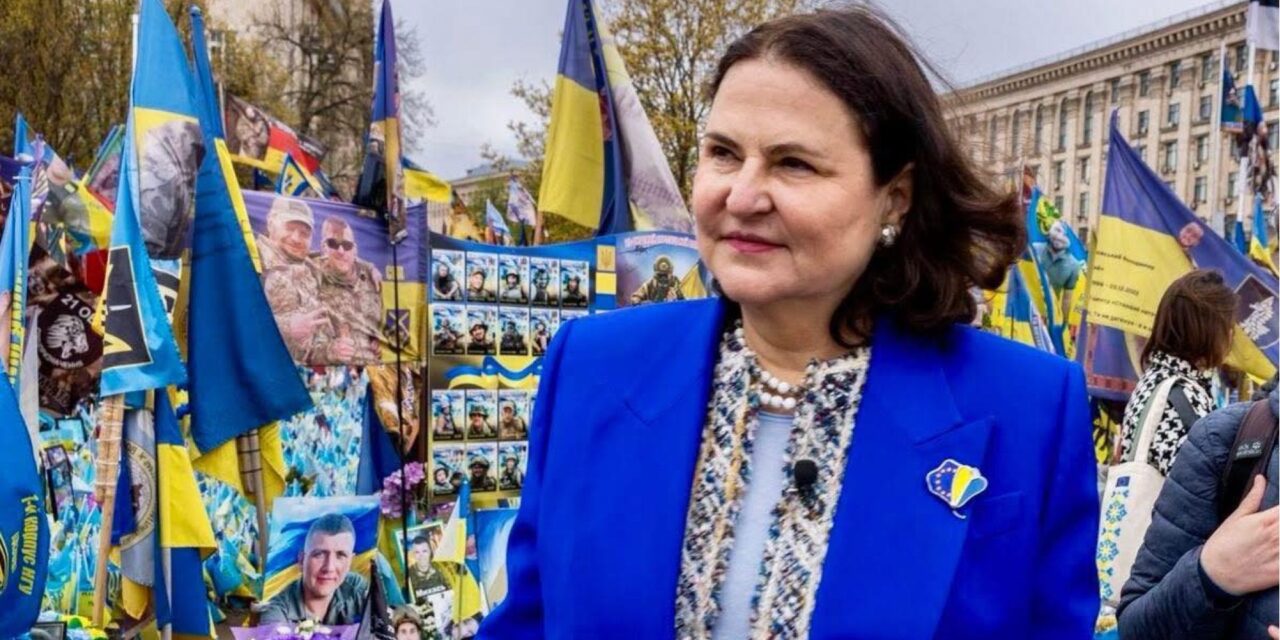
The European Union’s Ambassador to Ukraine, Katarina Mathernova
Tuesday’s Coverage: Russia Threatens More Strikes on Kyiv’s Civilians
UPDATE 1833 GMT:
Ukraine President Volodymyr Zelensky has sent a letter to Trump warning of Kyiv’s worsening shortage of air defense systems, particularly anti-ballistic missile capabilities.
“When it comes to air defense against missiles, we rely on our friends,” Zelensky wrote. “When it comes to defending against ballistic missiles, we rely almost exclusively on the United States.”
Ukrainian officials are concerned about the country’s limited supply of Patriot interceptors and other Western-provided systems. “It’s really tough when it comes to anti-ballistic defense,” one person familiar with the matter said.
Ukraine’s Ambassador to the United States, Olha Stefanishyna, has also sent the letter to House Speaker Mike Johnson and other members of Congress.
UPDATE 1005 GMT:
Interfax says Russia is considering limits on diesel and jet fuel, as oil refinery output falls to its lowest level in years.
Companies were advised to curb sales of oil products in a Tuesday meeting with Deputy Prime Minister Alexander Novak, said “several people familiar with the situation”.
One source said a decision to ban exports is at an advanced stage, but the date has not been set.
UPDATE 0752 GMT:
The number of countries participating in a Czech-led initiative to buy ammunition for Ukraine has fallen from 18 to 9.
Czech President Petr Pavel said, “The initiative is still working, but the new difficulty is that only about nine member states are contributing financially. This initiative has been delivering up to 50% of all large caliber ammunition to the Ukrainians, so in this sense it cannot be replaced easily by anything else.”
Since 2024 Prague has overseen the supply of more than 4 million large-calibre artillery shells to Kyiv. The initiative has contracts to deliver around a million rounds in 2026, after around 1.5 million rounds in 2024 and 1.8 million last year.
Czech Prime Minister Andrej Babis and his partners threatened to cancel the project when they entered government in December 2024, but Babis relented under pressure from foreign allies.
However, a “western military official” said that while Germany and some Nordic nations remain among the participants, “some countries now feel that it is strange to pay for something that is not even properly supported by the ruling politicians of the lead country”.
Pavel said the initiative’s future should be among the issues discussed at the NATO summit in Ankara in July.
UPDATE 0635 GMT:
The Kremlin has told Russian banks, including the Federal Reserve, that they should shoot down Ukrainian drones and pay for the costs.
The Russian Parliament passed a law allowing the banks and other financial institutions to operate defense systems and arm staff.
Alexander Shokhin, head of Russia’s leading business lobby, told Vladimir Putin that companies are prepared to buy heavier weapons and electronic systems to defend themselves.
ORIGINAL ENTRY: Europe’s leaders have rebuffed Russia’s threats against their embassies in Ukraine’s capital Kyiv.
On Monday, Russia promised more mass missile and drone strikes on civilians in the capital, saying there will be attacks on Ukraine’s “decision-making centers and command posts”. The Foreign Ministry called on foreign citizens, including diplomats, to leave.
The European Union summoned Russia’s top diplomat in Brussels. Foreign policy spokesperson Anitta Hipper posted:
threat to foreign citizens & diplomats to leave Kyiv is an unacceptable escalation. @eu_eeas summoned the Chargé d'Affairs, calling to stop hitting civilians & to engage in genuine peace talks starting with a full and unconditional ceasefire. @EUDelegationUA stays in Kyiv.
— Anitta Hipper (@ExtSpoxEU) May 26, 2026
Hipper said at the daily press briefing, “This shows once more…that Russia is absolutely not interested in any peace and has a total disregard for all the efforts towards the peace.”
Germany, the Netherlands, and Norway summoned the Russian ambassadors in their countries.
At the UN, almost 50 countries issued a joint statement denouncing the “threats by Russia to diplomatic institutions and embassies in Kyiv”: “This is something which we cannot accept.”
Baltic States Condemn “Aggressive Russian Rhetoric”
Alongside European Commission President Ursula von der Leyen in Lithuania’s capital Vilnius, heads of Baltic States called out the Kremlin’s threats against their countries.
Lithuanian president Gitanas Nausėda condemned the “increasingly aggressive Russian rhetoric”, including “coordinated disinformation campaign and attempts to spread false accusations against the Baltic States and other NATO allies”.
I want to state very clearly the Baltic States have not allowed and will not allow their territory or airspace to be used for attacks against other countries.
All Kremlin attempts to shift the responsibility on to others are cynical propaganda designed to divert attention from the fundamental fact that it was Russia that launched a brutal and illegal war against Ukraine.
He said the recent fall of Ukrainian drones on Lithuanian territory were “a direct consequence of Russia’s aggression against Ukraine; yet another reminder of how close the war is to us”.
Noting that “the skies above the Baltic states are not sufficiently secure today”, Nausėda called on the EU to step up protection.
Von der Leyen said Baltic States “have been experiencing what many believed belonged to another era”.
Air raid alerts, families sheltering, schools closing, transport interrupted. This is the reality on Europe’s eastern border in 2026.
Today it is here. Tomorrow it will be elsewhere along the eastern border….
This is a deliberate strategy from Russia trying to destabilize our democratic societies.