
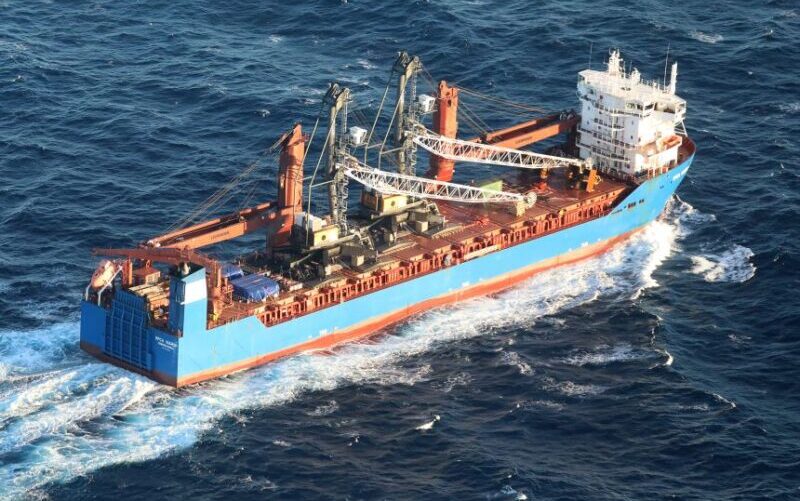
The Russian cargo ship Ursa Major in Portuguese waters in December 2024
Tuesday’s Coverage: EU Sanctions Russians Who Abducted Ukrainian Children
UPDATE 1615 GMT:
At least six civilians and dozens injured, including children, by more than 800 drones fired by Russia during Wednesday.
Ukraine President Volodymyr Zelensky posted about “one of the longest massive Russian attacks against Ukraine”, trying to “spoil the overall political atmosphere” during Donald Trump’s visit to China.
It certainly cannot be called a coincidence that one of the longest massive Russian attacks against Ukraine takes place precisely at the time when the President of the United States arrived for a visit to China – a visit from which much is expected. In this difficult geopolitical… pic.twitter.com/lggXvoAJtS
— Volodymyr Zelenskyy / Володимир Зеленський (@ZelenskyyUa) May 13, 2026
Another nine civilians were slain and 37 injured in the previous 24 hours by Russian attacks, including by 139 drones overnight.
UPDATE 1329 GMT:
Vladimir Putin has grown increasingly fixated on capturing all of the Donetsk and Luhansk regions in eastern Ukraine, according to “two people who speak to him”.
“I have been pushing him to end at the current front lines. But he keeps saying, ‘No, I can’t compromise on this’,” one source said.
Russia has seized almost of Luhansk. However, Ukraine holds around 20% of Donetsk, known as the “Fortress Belt”.
Kyiv has resisted pressure from Donald Trump’s envoy, real estate Steve Witkoff, to give up the vital area. Trump insiders reportedly have said that US security guarantees are conditional on Russia getting Donetsk.
A Ukrainian official said, “There has been zero progress secured by the American side from Russia. Everything which could be negotiated has already been done.”
UPDATE 1321 GMT:
Russia’s oil export revenues increased slightly in April, with US sanctions waivers and a surging global price offset by the effects of Ukrainian attacks on refineries, terminals, and ports.
The International Energy Agency reported that revenues from crude and petroleum shipments rose to $19.18 billion in April from $19 billion in March.
Russia’s total oil output fell by 460,000 barrels per day compared to a year ago, averaging 8.8 million bpd in April. Total oil and petroleum product exports dropped by 90,000 bpd to an average of 7.03 million bpd.
Refined petroleum product exports plunged to 2.15 million bpd last month because of a Government embargo on gasolines export embargo and reduced refinery throughput. The figure is was the lowest on record for Russia.
UPDATE 1155 GMT:
Two people have been murdered and four wounded by Russian attacks on civilian infrastructure, including a residential building, in the Rivne region in western Ukraine.
UPDATE 1144 GMT:
Ukraine’s drones have struck oil shipping infrastructure in Krasnodar Krai in southwest Russia.
Videos showed large plumes of smoke rising from a nearby port in the village of Volna. Krasnodar Krai Operational Headquarters reported a fire in “one of the premises”.
NASA’s fire monitoring system showed a fire at an oil storage facility near the port.
UPDATE 1130 GMT:
Ukraine President Volodymyr Zelensky is in Bucharest for the summit of the Bucharest Nine: Bulgaria, the Czech Republic, Estonia, Hungary, Latvia, Lithuania, Poland, Romania and Slovakia.
Representatives of Nordic States are also attending.
Arrived in Romania together with the First Lady @ZelenskaUA.
The Bucharest Nine Summit is taking place here today, with the participation of Northern European countries. Important meetings are planned on the sidelines of the summit. All of us in the world need joint decisions… pic.twitter.com/35NdpABFg7
— Volodymyr Zelenskyy / Володимир Зеленський (@ZelenskyyUa) May 13, 2026
UPDATE 1008 GMT:
Ukraine military intelligence says Russia is carrying out a rare daytime mass drone attack.
Air raid alerts began just after 11:00 a.m. At least one air alert tracker reported around 200 Iran-type attack drones in Ukrainian airspace. As of 12:10 p.m., the Ukrainian Air Force detected eight groups of drones still in the air, including a fresh squadron coming in from the Black Sea.
Nine civilians were injured by a strike on a minibus in Kherson city in southern Ukraine.
At least three people were moderately injured by intense drone attacks on the city of Khmelnytskyi in central Ukraine.
In Odesa in the south, a drone strike injured at least two people and sparked a blaze in a courtyard, setting several cars on fire.
UPDATE 0955 GMT:
Two civilians were murdered and four injured, including a 9-month-old girl in critical condition, by Russian attacks on Kryvyi Rih in south-central Ukraine on Tuesday night.
A 65-year-old woman and a 43-year-old man were slain. A 23-year-old woman is in moderate condition.
Ukraine President Volodymyr Zelensky, a native of Kryvyi Rih, posted:
Russia continues to kill and maim Ukrainians. So pressure on Russia must not be eased in any way. Only firm joint pressure and the strengthening of Ukraine, including the reinforcement of our air defense, can compel the aggressor to diplomacy for a reliable peace and an end to the killings.
A cynical Russian drone strike targeted an ordinary residential building in Kryvyi Rih, with no military purpose whatsoever. As of now, two older people have been reported killed. Their 9-month-old granddaughter is in hospital with serious injuries. Our doctors are doing… pic.twitter.com/LeaegaxNCJ
— Volodymyr Zelenskyy / Володимир Зеленський (@ZelenskyyUa) May 12, 2026
Zelensky followed up on Wednesday morning
Yesterday, 14 regions came under attack throughout the day. Overnight, strikes targeted residential and railway infrastructure in the Dnipro and Kharkiv regions, port infrastructure in the Odesa region, and energy facilities in the Poltava region….
It is important to repel every attack with resilience. It is important to support Ukraine and not remain silent about Russia’s war. Every time the war disappears from the top of the news, it encourages Russia to become even more savage.
There are currently more than a hundred Russian drones in our skies, and there may be more waves of drone attacks throughout the day. Russia continues its strikes and is doing so brazenly – deliberately targeting our railway infrastructure and civilian sites in our cities.… pic.twitter.com/0ZtOraERyz
— Volodymyr Zelenskyy / Володимир Зеленський (@ZelenskyyUa) May 13, 2026
ORIGINAL ENTRY: A Russian cargo ship, beset by mysterious explosions, that sank off the southeast coast of Spain in December 2024 may have been carrying nuclear submarine reactors for North Korea, officials say.
The 142 meter-long Ursa Major, owned by the State-linked Oboronlogistics company, was supposedly sailing from St Petersburg to Vladivostok in the far east of Russia when it sank 62 nautical miles off the coast of Murcia at 11:20 p.m. on December 23, 2024.
The ship had put out a distress call 11 hours earlier, prompted Spain’s dispath of a helicopter, a fast rescue boat, and a tugboat. Crew were abandoning the badly-listing vessel after three explosions in the engine room. A 50cm by 50cm hole was later found in the vessel’s hull, with the damaged metal facing inwards, indicating a strike by a super-fast, supercavitating torpedo — believed to be held only by the US, Russia, and Iran.
A Russian warship arrived at 8:07 p.m. and took over the rescue operations, ordering the two Spanish boats to withdraw two nautical miles. The warship launched flares, possibly to blind the infrared sensors of intelligence satellites monitoring the incident.
Just after the flares were fired, “four similar seismic signatures…the pattern of which resembled underwater mines or overground quarry blasts” were heard.
The Ursa Major sank within three hours to a depth of 2,500 meters. Two crew were killed in the initial explosions, while 14 were rescued.
The vessel was officially transporting “non-dangerous merchandise”, including 129 shipping containers, two cranes, and two large maintenance hole covers. However, the captain told Spanish investigators that the “manhole covers” were “nuclear reactor components similar to those used by submarines”, although no nuclear fuel was being transported.
Investigators noticed two huge blue containers, each estimated to weigh about 65 tons, on the ship’s stern in satellite photographs. Noting that the loads would be almost impossible to transport by road between ports used by the Ursa Major, they assessed that this might have prompted the voyage of more than 15,000 km (9,320 miles) by sea between St Petersburg and Vladivostok.
A “source familiar with the investigation” said Russian captain believed he would be diverted to the North Korean port of Rason to deliver the two reactors.
Russia has reportedly provided military and nuclear assistance, among billions of dollars in aid, in return for North Korea’s provision of around 20,000 troops, missiles, and millions of artillery shells for Moscow’s invasion of Ukraine.