
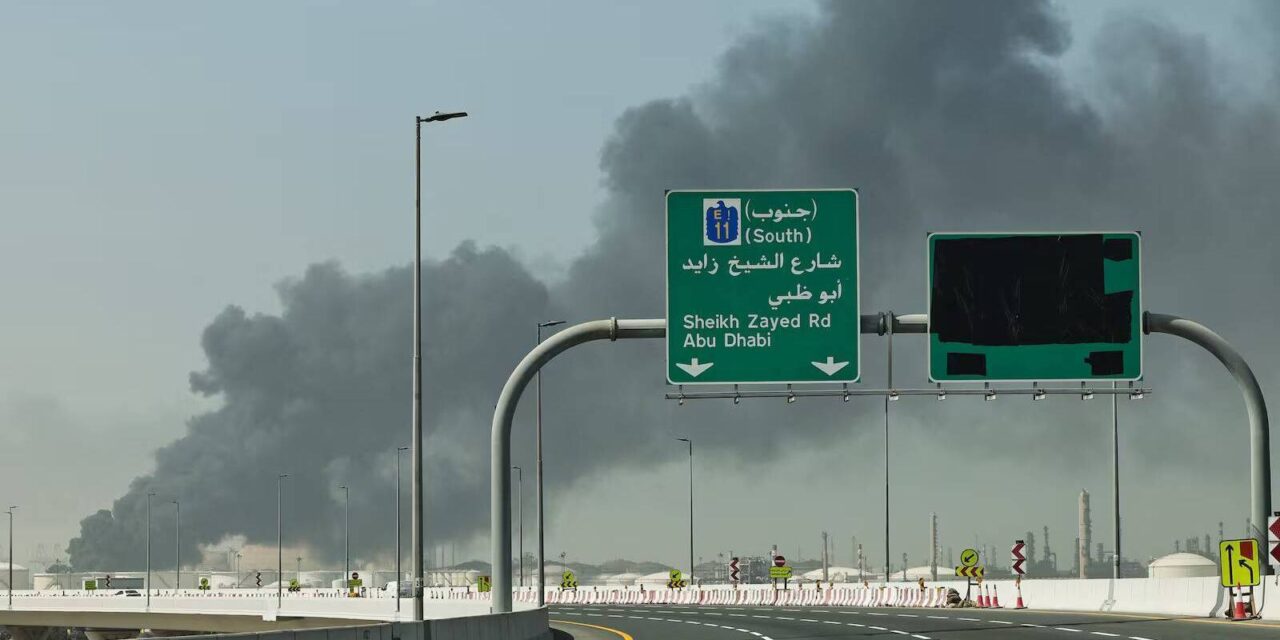
A plume of smoke rises from the port of Jebel Ali after an Iranian strike on Dubai, March 8, 2026 (Fadel Senna/AFP/Getty)
Why the UK is Involved in the US-Israel War on Iran
The morning of February 28 began normally for Aleena Poly, who has been living in Abu Dhabi in the UAE for the last 25 years. She was visiting a friend in Sharjah, and they planned to head to the Ramadan district near the Museum of the Future in Dubai in that evening.
Just after noon, a loud noise and an explosion, from air defenses intercepting munitions, reported near Abu Dhabi.
When I heard it, my first thought was about my family back home in Abu Dhabi, I was scared for them.
But almost immediately there was this feeling that things would be okay, because it’s the UAE and they take care of us.
By Tuesday, as the US and Israel tried to break Iran’s regime, the UAE Ministry of Defence reported Tehran’s retaliation with 812 drones, of which 755 were intercepted and 57 evaded air defenses. Three civilians were killed, with 58 injured from the fall of debris and shrapnel.
Yet residents describe a far different reality from the tension portrayed by observers outside the UAE.
“Friends and family have been calling in to check up on me, but we’re really okay and carrying on as usual,” says Poly matter-of-factly.
Residents sometimes receive phone alerts before or during an interception, followed minutes later by a message stating that the situation is under control. “My parents said they heard a loud boom noise around 3 am today early morning,” Poly recounts, “but I slept through the night and didn’t hear anything.”
Another resident, who lives in Dubai Production City, set outs a similar emotional arc. Initially, seeing interceptions live and hearing the loud booms was stressful, but that fear gradually subsided.
I was scared, as all of this is very unusual here and unexpected, and seeing the interceptions live from my windows isn’t particularly pleasant, but deep down there is a feeling of calm. We trust the government.
The country largely carries on with a sense of normalcy. Most offices in Dubai and Abu Dhabi have issued “work from home” notices for employees. Other sectors, particularly healthcare, continue operations as usual.
The “Lovin’ Dubai” Instagram handle reposts stories from residents affirming that they are safe and at peace amid the unrest.
“A Certain Kind of Trust In This Place”
For many, the conflict is experienced primarily through screens within the safety of their homes. The greatest disruptions are exposure to loud noises and occasional tremors that subside within minutes.
Safa Shams, a graphic designer who lives in the Nad Al Hamar area of Dubai, says:
Being born and raised here, you grow up with a certain kind of trust in this place. Hearing the alerts and the sounds of interceptions was quite scary and enough to make your heart race for a moment, but somehow, it never really shook my sense of security.
I’ve seen how this country handle tough situations, especially during COVID, and the way everything was managed with such calm and precision. That experience stayed with me. So even while things sounded chaotic, deep down I felt protected.
It’s a strange feeling to hear the noise and still feel completely safe at the same time.
The country’s advanced air defense systems such as the THAAD and strategic readiness have led to the interception of most missiles and drones, minimizing casualties and damage while reinforcing public confidence in national security. Government agencies such as the National Emergency Crisis and Disaster Management Authority regularly reassure residents that the situation remains under control with continuous monitoring.
The sense of stability is mirrored in the UAE’s ability to keep goods and commerce moving. Andre Fernandes, freight forwarder at a Dubai-based logistics company, says,“In terms of changes in demand or shipping patterns, we have not really observed a significant decline in the international trade of commodities into or out of the country.”
Fernandez describes the preparations made to avert a ciris in shipping:
There have been concerns that shippers or consignees may forfeit their goods if these movements are caught in the line of fire due to the current situation. So as a precautionary measure, the market initially agreed to implement a partial pause on all shipments. Industry players simultaneously assessed alternative routing options, identifying ports in Sharjah, Fujairah, and Khorfakkan as viable substitutes should disruption escalate.
That being said, we can now confirm that port Jebel Ali is fully operational and will be handling cargo as usual.
A Rising Concern
Economic concerns are beginning to surface, particularly around the rising cost of living amid the 30% increase in oil prices in a week. Investors are reassessing the risk to energy supplies with traffic down up to 90% in the Strait of Hormuz, a critical route for global oil shipments.
Higher energy costs ripple through supply chains, pushing up the price of transport, freight, and imported goods — particuarly affecting the UAE which relies heavily on foreign supplies. Residents shoppers have reported notable increases at the supermarket. The price of onions reportedly jumped from 1.95 Dhs per kg to 8 Dhs per kg within just two days of the conflict, according to a resident in Sharjah.
The UAE Government says it is closely monitoring supply chains and pricing. During a media briefing, officials said authorities have carried out more than 420 inspection drives and on-site visits over several days. They asserte that to maintain price stability, they are ready to intervene.
Schools and universities have extended online classes. The Ministry of Education and the Ministry of Higher Education and Scientific Research said the situation will be assessed in light of evolving security concerns, with updates communicated through official channels.
Some residents say the growing uncertainty is starting to affect their sense of security. “Things may be escalating. The drone attack on the US Embassy in Bur Dubai was quite unexpected, and it makes us feel like things might be getting serious,” said a resident who asked to remain anonymous.
The UAE continues to function with visible calm, but it is in an increasingly volatile region. A prolonged escalation of the US-Israel war could carry implications not only for oil markets and shipping corridors, but also for regional diplomatic alignments and economic confidence.
For now, daily life is largely uninterrupted. Alerts are issued, interceptions of missiles and drones are carried, markets are monitored, and classrooms shift online when necessary. The coming weeks will test whether this equilibrium can be sustained.
Aleena Poly says:
We still go to work, meet friends, and carry on. But moments like this remind us that the region around us can change very quickly.

Trump Advisers Urge Him to Find Iran Exit Ramp, Fearing Political Backlash: https://www.wsj.com/world/middle-east/trump-advisers-urge-him-to-find-iran-exit-ramp-fearing-political-backlash-562fef1e?gaa_at=eafs&gaa_n=AWEtsqdiwtnlK-D6jpUgueJupYe26oxTW8WwWr44uXeBl5SqBNCfBjjgsDIOwpsTxeM%3D&gaa_ts=69af6ca1&gaa_sig=37VK21SwMF2oJrUDfe9qOfVvIpRl9io-8THKctjQg3bxJC6luAj7msNNQUjW-HU-k6TUzARelVXC5e7rov0qUQ%3D%3D
“President Trump said he was eyeing a quick end to the war in Iran, as some of his advisers privately urged him to look for an exit plan amid spiking oil prices and concerns that a lengthy conflict could spark political backlash.”
There is already going to be a political backlash even if he stopped the bombing tomorrow. He campaigned on ending wars. Not starting wars. It’s not popular. Most people would rather focus on our own problems. Israel and the Saudis have tried to get every President since Clinton to attack Iran. Trump was the only one who took the bait. It’s widely perceived as fighting Israel’s battles for them.
There is a reason why Trump wants to bring the conflict to an end. Iran has destroyed most of the US’s radar and early warning systems, blinding them to Iranian drone and missile attacks: https://militarywatchmagazine.com/article/iranian-strikes-destroyed-antimissile-radars
The extent of the destruction (not fully confirmed) is astonishing: https://x.com/HamidRezaAz/status/2030652725260673187
AN/TPY-2 (THAAD) Radars
— Muwaffaq Salti Air Base: 1 unit
— Prince Sultan Air Base: 1 unit
— Al-Ruwais Base, United Arab Emirates: 2 units
AN/FPS-132 Block 5 Early-Warning Radar
— Al Udeid Air Base: 1 unit
AN/MPQ-65 Radar System (PAC-3)
— Ali Al Salem Air Base: 1 unit
Patriot PAC-3 Engagement Control Station (ECS)
— Ali Al Salem Air Base: 1 unit
AN/GSC-52B Satellite Communications Terminals
— Bahrain: 2 units
Unidentified Radomes
— Camp Arifjan, Kuwait: 6 units
— Headquarters of the United States Fifth Fleet, Bahrain: 1 unit
The U.S and Israel have also had many advanced drones shot down over Iran which limits the ability to detect and target launch sites in Iran.
They’re not going to win this militarily unless Trump is dumb enough to put boots on the ground. Iran’s air defenses are gone. He wants to wrap it up because it’s very unpopular at home.