
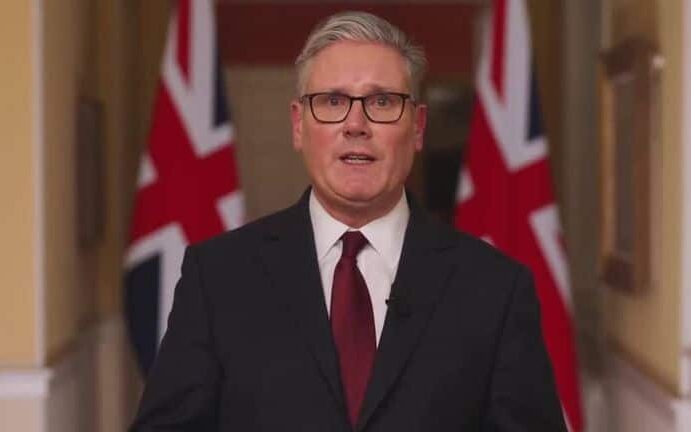
UK Prime Minister Keir Starmer at a press conference on the US-Israel war v. Iran, March 6, 2026 (Sky)
Manufacturing Consent: Trump’s Iran 2026 Is A Sequel To Iraq 2003
In the early hours of February 28, the US and Israel launched airstrikes on Iran. They killed the Supreme Leader, Ayatollah Ali Khamenei and dozens of senior political and military figures.
Khamenei was not just a head of state He was a figure of religious authority for millions of Shia Muslims. Relying on that, Iran carried out a swift, wide-ranging retaliation with ballistic missiles were fired towards Israel and across the Gulf, including Bahrain, Qatar, the UAE, Saudi Arabia, Kuwait, and Iraq. Drones headed towards RAF Akrotiri in Cyprus, drawing the UK directly into the conflict. Airspace was closed and commercial flights cancelled. Energy infrastructure was placed on alert with threats to oil and gas refineries and key waterways.
The escalation has now moved beyond threat to reality. Iran has declared closure of the Strait of Hormuz, one of the world’s critical energy arteries. Qatar has suspended LNG production, and Saudi Arabia has shut one of its refineries following drone attacks. Global energy prices are spiking, including oil by 30% in less than a week. Should Iran proceed to lay mines in the Strait, disruption could extend well beyond the immediate challenges for 25% of the world’s maritime oil traffic and 20% of maritime gas.
For Britain, this is no longer an abstract war. Rising energy prices will feed fuel, food, transport and household costs. The cost-of-living crisis, already deeply felt, will further intensify.
Hundreds of thousands of British nationals live and work across the Gulf. Their livelihoods depend on regional stability. Any serious deterioration in security could require large-scale evacuation operations, placing further strain on already stretched corporate and Government resources.
The Contest for Regional Hegemony
This confrontation is not only about retaliation. It is about regional hegemony.
In his book The Tragedy of Great Power Politics, John Mearsheimer sets out what he calls offensive realism, the idea that great powers seek to dominate their own regions to maximize their security. States feel safest when no rival can challenge them close to home. They are most secure not when power is evenly shared, but when they are the dominant force in their own region.
In the Middle East, two regional powers have long been in tension: Israel, backed by the US, and Iran. For Israel, constraining Iran’s reach is seen as essential to its security. For Iran, projecting power through allied groups across Lebanon, Syria, Iraq and Yemen has been a means of deterrence and leverage.
The US has operated in this environment through what is often described as offshore balancing. Rather than permanent occupation of a region, an offshore balancer supports local allies to prevent any single power from domination. It remains over the horizon, intervening directly when the balance appears to be tipping too far in another country’s direction. This approach reduces the need for large-scale deployments while preserving influence.
But offshore balancing carries risks. When support for one regional actor becomes deep and overt, it appears less like balancing and more like alignment. The distinction matters, because it shapes how other powers respond.
While the USA may have greater capacity to absorb deeper involvement, Europe faces a far more delicate position. The UK and other European states have signalled defensive involvement. The UK has aircraft in the air intercepting missiles and drones, and has granted the US permission to use bases in operations against Iran. Though framed as defensive measures, in the eyes of Tehran and others, this amounts to tacit participation by Britain.
Europe can ill afford to open another front. The war in Ukraine continues, and the risk of further escalation with Russia remains real. Diverting assets from Europe’s eastern flank to a widening Middle Eastern conflict would introduce strategic vulnerability. If European forces are stretched thin, Moscow will take note.
China, Russia, and the Great Chessboard
China is a critical variable. A substantial portion of its energy imports pass through the Strait of Hormuz, and it maintains close economic ties with Iran. Beyond that, Beijing’s long-term objective is regional dominance in East Asia: any conflict that draws US attention and resources away from that theater alters the strategic equation.
China has historically avoided direct military intervention beyond its borders, but it has a clear interest in preventing the US from consolidating control in another critical region. Indirect involvement — through arms transfers, intelligence support or diplomatic backing — would allow Beijing to complicate US strategy without risking direct confrontation.
There is also the Taiwan question. In moments of global distraction, strategic opportunism becomes more attractive. If US and allied assets are heavily engaged in the Gulf, pressure in East Asia could increase. Even heightened military activity around Taiwan would force Washington to divide its attention further.
Russia will observe closely. Should European states divert meaningful capacity away from Ukraine, Moscow may assess that as an opportunity.
The Middle East, Eastern Europe and the Western Pacific are linked not by coincidence, but by the logic of great powers competing for influence. Actions in one theater reverberate in the others.
Britain at a Strategic Crossroads
All of this leaves Britain in a precarious position. The rules-based international order, already weakened by selective enforcement and eroded norms, is at risk of further decay. Assassinations of senior leaders, missile exchanges across sovereign states, and the closure of critical maritime corridors chip away at the guardrails that once constrained escalation.
The importance of the Middle East for the UK is not the issue. The question is how far London allows itself to be drawn into a confrontation that weakens rather than protects the British position. The lasting costs of past wars is a caution against stepping into another conflict that could spiral beyond control.
Much of the UK media has wrongly framed this as a call for indifference to allies or a retreat from global responsibility. Instead, it is the need for strategic discipline at a time of limited resources and mounting risks. With armed forces already under strain and Europe’s security environment volatile, deeper entanglement in the Gulf would be a grave decision.
Escalation is no longer theoretical, but happening in real time. The UK must tread carefully, clear-eyed about its interests and honest about its limits. In a world already stretched by conflict, the margin for error is thin.
