
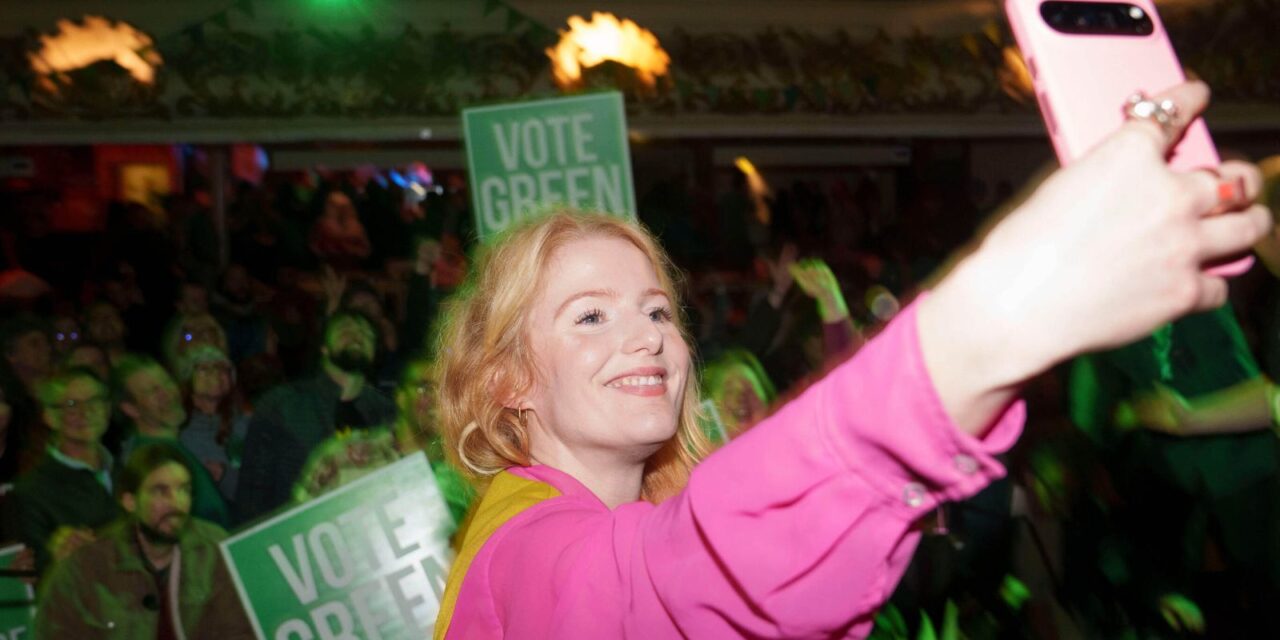
The Green Party’s Hannah Spencer takes a selfie after winning the Gorton and Denton by-election in northwest England, February 26, 2026
Last week, Hannah Spencer — “Hannah the Plumber” and the Green Party candidate — triumphed in the by-election in Gorton and Denton, near Manchester in northwest England.
This is the rare political moment where I am genuinely happy to eat my words in public. Last November, I wrote that the community-rooted and unapologetic progressive politics associated with New York Mayor Zohran Mamdani might simply beyond Britain’s tired, managerial party system. Our politics had become too poll-driven, too cautious and too obsessed with respectability to allow community to break through.
This by-election shattered that assumption. Under the right leadership, with the right candidate and real organizing behind them, the UK is not just open to that politics. There is an appetite for it that I have not seen in years.
Gorton and Denton was more than a by-election. It was an awakening.
From Mamdani’s New York to Hannah’s Manchester
My attention to Mamdani was not just about ideology. It was about
political method: reject triangulation, center community, organize relentlessly and speak with moral clarity instead of managerial caution.
UK political culture has been dominated by focus groups and technocratic figures with risk-averse messaging that felt polished. This is why Nigel Farage and his Reform Party were on the rise, doing exactly the opposite with a message of fear, blame and hate.
Gorton and Denton answered that approach. Hannah Spencer — plumber, Green councillor, and working-class woman — walked into what had long been treated as a Labour Party fortress, faced down both Labour and Reform, and left with a commanding majority. This was not a protest vote. It was a mandate built on trust, visibility, and hard graft.
Authenticity, Community, and Lived Experience
Spencer’s campaign did not originate in a spin doctor’s strategy deck. It was built on the streets of Gorton and Denton, in WhatsApp groups, around kitchen tables, and in thousands of conversations with people being crushed by the cost-of-living crisis.
Her message was simple: people are being squeezed dry, and they are tired of working harder only to fall further behind. All were affected, without attribution of blame to any minority group. Her campaign resonated because it came from someone who shared the reality of construction, rather than from Reform’s GB “News” studios in designer clothing.
“Hannah the Plumber” was not branding. It was Spencer’s biography, a working-class Mancunian woman with lived experiences and possible solutions to problems. Voters instinctively recognized the difference between a genuine candidate who fixes boilers, a Reform hopeful who was afraid, and a Labour candidate with no
message.
Some Labour activists thought the Greens could not get organized. But Spencer combined old-fashioned door knocking with digital initiatives that made people feel involved rather than managed. She offered something that British politics rarely delivers these days: a credible promise that someone has ordinary people’s backs.
The digital strategy worked because it was rooted in community and not ego. Her social media content had human stories, humor, and a sense of hope. She even spoke in Urdu and Bengali, echoing Mamdani’s approach in New York, and promoted hyper-local videos which were amplified over and over. This was sincere rather than staged: the Green Party persisted despite ridicule because they were speaking with communities, not at them.
By contrast, Reform UK’s online push was centered on leader Nigel Farage’s personality and standard dog-whistle politics rather than their candidate Matthew Goodwin. The Labour Party defaulted to safe, generic messaging that looked polished but felt distant and transactional.
Spencer courted the white working-class vote by leaning into her identity and profession, emphasizing how people “like me doing jobs like mine” had been ignored and dismissed as “thick” and “uneducated” by mainstream politics. She pledged to lower bills and give those on the margins a real seat at the table.
Organization Versus Museum Politics
If Spencer was the face of the victory, the infrastructure was constructed by Zack Polanski. Under his leadership, the Green Party treated the contest as winnable and deployed resources accordingly. Thousands of volunteers were mobilised, messaging was disciplined, and Spencer became a trusted local figure in weeks.
Labour’s campaign felt like a museum exhibit from another era. It relied on staged photos with gatekeepers, national figures parachuted into the constituency, and the assumption that historic loyalty combined with fear of Reform would automatically deliver votes.
Gorton and Denton has a 30% Muslim population, so Labour again used middle-aged men from the Muslim community as managers who only succeded in losing the dressing room. Young British Muslims are more politically literate and will not be told how to vote, whether through a mosque or an iftar. As I wrote in Byline Times in 2024:
Labour has relied on community leaders and mosque
networks… sing Biradri (clan) systems to secure votes from Pakistani constituents. The local elections demonstrated that these methods are no longer effective.
And now those methods are burdened by Labour’s policy on the genocide in Gaza and on recent laws punishing refugees and asylum seekers.
Reform’s Politics of Fear and A Moment of Pushback
The Reform Party invested heavily in the contest, seeing a chance to humiliate Labour and block the Greens. Their tactics were familiar: grievance, cultural anxiety, and recycled Brexit-era rhetoric.
They finished ahead of Labour but failed to win as Spencer’s victory speech captured the political moment: “This community has shown that hope beats hate. We will not let fear-mongers decide who belongs.” She delivered a pointed dig at Reform candidate Goodwin and the politics of demographic panic, making clear that communities are not passive subjects of decline narratives but active builders of solidarity.
For me, as a British Muslim, the moment mattered. It is rare to hear a politician reject scapegoating so directly while affirming belonging so clearly. For the first time in a long while, a politician had stood up and defended people like me without hesitation. When I heard that line, I shed a tear.
We need more Hannahs in public life and far fewer voices normalizing division.
Labour’s Failed Strategy
This result also exposes the collapse of Labour’s electoral strategy under Morgan McSweeney and the leadership of his boss, Prime Minister Keir Starmer. Their approach was straightforward: move right on immigration and culture-war rhetoric, neutralise Reform’s appeal, and assume progressive voters would “hold their noses” to keep out the hard right.
Gorton and Denton exposed the failure of that calculation. Trying to out-Reform Reform does not win over voters – it legitimizes the hard right’s framing while demoralizing Labour’s base. Fear alone no longer guarantees turnout, and communities increasingly refuse to support parties that echo narratives targeting them.
Labour will engage in soul-searching. But as a voter, I know where my interests lie: with politics that shows up and treats communities as partners rather than assets. It is telling that one of Labour’s few figures with enduring cross-community credibility, Manchester Mayor Andy Burnham, was blocked as their candidate.
A Crack of Hope – and What Comes Next
Hannah Spencer has done more than win a parliamentary seat. She has cracked open a possibility many believed had closed: British politics can still produce campaigns rooted in trust, presence, and lived experience.
Her victory shows that gatekeeper politics is fading, that communities cannot be taken for granted, and that voters are ready to rally behind candidates who are real. It demonstrates that people are not only rejecting fear but are actively searching for hope.
Under Polanski’s Green Party, this moment is not an endpoint but a beginning. The infrastructure, volunteer energy, and credibility built here can be replicated elsewhere. If the party continues to invest in local organizing, grounded candidates and moral clarity, this will not be an isolated upset but a pattern.
Gorton and Denton sets a standard. When politics moves from managing communities to standing alongside them, when it replaces calculation with conviction and offers solidarity instead of scapegoating, people respond.






There’s a lot of parallels with the Caerphilly by-election four months ago. Reform get hyped to win in a longtime Labour stronghold, then a progressive alternative wins, and by a similar margin.
Conventional political logic is that you need to aim for the centre between the left and right, and if Labour move to the left, they would alienate the valuable centrist voters. Conventional political logic has long been good at predicting elections, but now there are new factors at play, mainly that people are not merely disillusioned with ‘politics as usual’. They’re disgusted. As my local Green councillor put it, “We’ve realised we’re being BS-ed.”