
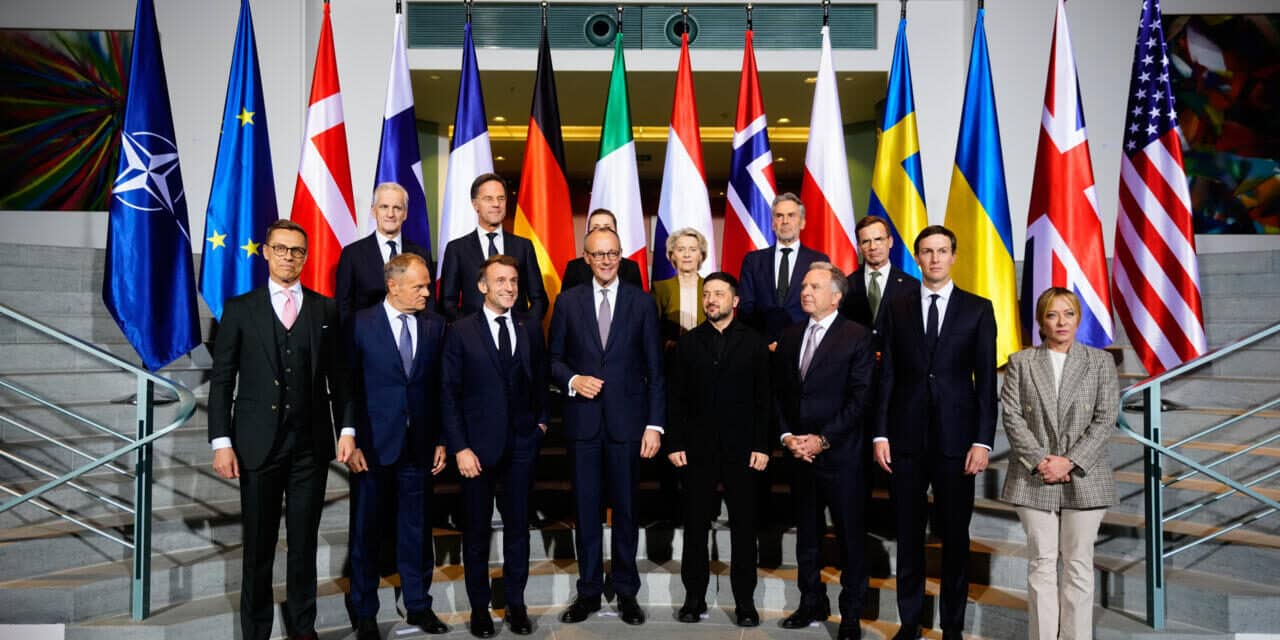
Ukraine President Volodymyr Zelensky, European leaders, and Donald Trump’s envoys Steve Witkoff and Jared Kushner, December 15, 2025
EA on International Outlets: Zelensky-Europe Face Trump’s Envoys in Berlin
Monday’s Coverage: Zelensky-Europe Talks With Trump Camp Into 2nd Day
UPDATE 1918 GMT:
Russia’s monthly oil prices are at their lowest level since the beginning of Moscow’s full-scale invasion of Ukraine.
Prices dropped to just over $40 per barrel for Russian crude shipped from the Baltic Sea, the Black Sea, and the Kozmino port in the Far East, according to Argus Media data. The trading price has fallen by 28% over the past three months.
Revenues in 2025 are expected to be almost half of last year’s value, the lowest since 2020.
Oil and gas revenues account for around of 1/3rd of the revenues for Russia’s federal budget.
UPDATE 1617 GMT:
The UK is investing £600 million ($805 million) to strengthen Ukraine’s air defenses.
Defense Minister John Healey said the funds will purchase “thousands of air defense systems, missiles, and automated turrets to shoot down drones”. Deliveries have commenced and will continue through 2026.
Healey confirmed that Britain will soon begin production of new Octopus interceptor drones for Ukraine.
“Ukrainians continue to fight with huge courage — military and civilians alike,” he said.
Also speaking at the 32nd meeting of the Ukraine Defense Contact Group, German Defense Minister Boris Pistorius said Berlin will “transfer a significant number of AIM-9 Sidewinder missiles” to Ukraine next year.
The Sidewinder is an air-to-air missile that can be used by helicopters and fighter jets. Ukraine has been repurposing them for use on ground-based platforms.
UPDATE 1329 GMT:
Russian Deputy Foreign Minister Sergey Ryabkov says Moscow will not negotiate over occupied Ukrainian territory.
Ryabkov also implied that the Kremlin will not compromise on its demand for the 22% of the Donetsk region held by Ukraine.
Since 2022, the Donbass region [the Donetsk and Luhansk region] — the two republics located there — have become integral parts of the Russian Federation as a result of the referendums that were held there….
Similar things happened in Zaporizhia and Kherson. Thus, at present, we have four subjects that are integral parts of the Russian Federation.
I’m not talking about Crimea. This is a story that dates back to 2014….
We cannot compromise on this issue in any form, because this would, in our opinion, be a revision of one of the fundamental elements of our statehood, enshrined in our Constitution.
Kremlin spokesman Dmitry Peskov rejected Ukraine President Volodymyr Zelensky’s proposal of a Christmas ceasefire.
Peskov said the truce would give Ukraine time to recover from heavy fighting and — in a perversion of reality — blamed Kyiv for continuing a war against another sovereign country.
In April, an Easter truce declared by Vladimir Putin was violated almost 3,000 times by Russian forces.
UPDATE 1217 GMT:
European leaders have signed the treaty establishing the International Claims Commission of Ukraine.
Ukraine President Volodymyr Zelensky told the ceremony:
All pressure on Russia must remain in place for as long as occupation of our land continue.
As long as our people remain in Russian captivity and until the Ukrainian children abducted by Russia are brought home, sanctions must limit Russia, until it shows respect for peaceful for peaceful life and the rights of its neighbours. And of course, of course, every Russian war crime must have consequences for those who committed them.
Diplomatic Conference for the Adoption of the Convention Establishing an International Claims Commission for Ukraine – I took part and addressed the participants. Today – and this year – things are being created for Ukraine that should have started a long time ago – at least back… pic.twitter.com/EMQ7IArp8n
— Volodymyr Zelenskyy / Володимир Зеленський (@ZelenskyyUa) December 16, 2025
European Union foreign policy head Kaja Kallas said, “If you start a war, you will be held to account.”
UPDATE 1049 GMT:
Addressing the Dutch Parliament, Ukraine President Volodymyr Zelensky has spoken of “the most intense and focused negotiations for peace since the beginning of this war”.
“We are working closely with partners to finally end this Russian war against Ukraine,” he say, but Ukraine needs “the same strong political support” that it has had during Russia’s full-scale invasion.
He notes that Russia has repeatedly chosen violence over peace – from Chechnya to the Balkans, from Moldova to Syria, from central Africa to Ukraine.
They always blame others and always try to explain their wars through someone else’s actions, as if the reason for the aggression is never, never in Moscow, but always in their neighbors.
And Russians always say that they somehow are not guilty….[Others are] expected to make concessions so that Russia might stop the bloodshed.
Rejecting Russia’s demands for Ukraine to “give up parts of our land they haven’t even managed to conquer” or to “accept limits on our right to join alliances and our sovereignty”, he notes:
It’s not enough to force Russia into a deal. It’s not enough to make it stop killing.
We must make Russia accept that there are rules in the world and that it cannot deceive everyone. This is the path to lasting peace.
The President urged the European Union to overcome Belgium’s objections and approve a “reparations loan”, drawn from frozen Russian assets, to cover Ukraine’s financial needs through 2027.
“A strong decision on Russian money is needed, and these funds must work to defend against Russia,” he explains.
Zelensky says, “It cannot be that those who kill[ed] are suddenly treated as respectable partners,” and concludes:
I truly hope that the next time I address your parliament it will be with gratitude for a peace that has been achieved.
ORIGINAL ENTRY: In two days of talks with Donald Trump’s envoys, Ukraine President Volodymyr Zelensky and European partners have regained the political initiative over Russia’s invasion and demands for Kyiv’s surrender.
In the discussions in Berlin, Zelensky and the Europeans were facing real estate developer Steve Witkoff and Trump’s son-in-law Jared Kushner, who had collaborated with the Kremlin on a proposal for Russia’s seizure of more territory and restrictions on Ukraine’s sovereignty and military.
But by Monday night, in a statement hailing “significant progress”, the Europeans indicated the demand for Ukraine’s withdrawal from all of the strategic Donetsk region had been rebuffed.
“International borders must not be changed by force,” the statement emphasized. Any decisions must be taken by the people of Ukraine, and only once “robust security guarantees are in place”.
They pointed to progress on those security guarantees. “Sustained and significant support” would be provided “for Ukraine to build its armed forces” — at a peacetime level of 800,000 soldiers rather than the 600,000 in the initial Kremlin-Witkoff-Kushner proposal — “to be able to deter conflict and defend Ukraine’s territory”.
“A European-led Multinational Force Ukraine” would be involved “inside Ukraine” in “assisting in the regeneration of Ukraine’s forces, securing Ukraine’s skies, and supporting safer seas”. The US would participate by leading a “ceasefire monitoring and verification mechanism with international participation” which would “provide early warning of any future attack”.
“A legally binding commitment” would “take measures to restore peace and security in the case of a future armed attack”, through the use of armed forces, intelligence, and logistical, economic, and diplomatic actions.
The Europeans pledged their “investing in the future prosperity of Ukraine” and support of Kyiv’s accession to the European Union.
Further established their position, they emphasized, “Nothing is agreed until everything is agreed and that all parties must work intensively towards a solution that could assure a lasting end to the fighting.”
“90%” Agreement
Both US officials and German Chancellor Friedrich Merz said “90%” of the issues were resolved.
The American added that there is still a “final decision on territory” to be made. Significantly, they said this will “be up to Ukraine”.
A “senior US official” said:
The basis of that agreement is basically to have really, really strong guarantees, [NATO] Article 5-like.
Those guarantees will not be on the table forever. Those guarantees are on the table right now if there’s a conclusion that’s reached in a good way.
Alongside Zelensky at a joint press conference, Merz rebuffed the demand for Ukrainian withdrawal from the Donetsk region. “It is the Ukrainian people who have defended their territory for almost four years,” he noted, and only they can decide on any changes.
Zelensky said he felt “that our partners hear Ukraine and are ready to help”. But he emphasized security guarantees must be workable, and Ukraine needs a clear understanding on what they are before it takes any “painful” decisions on frontlines and territories.
Zelensky: “Destructive” Demands No Longer in Proposal
The President later indicated on social media that Russia’s demands have been removed from the proposals to end the invasion.
It is very important that our counterparts from the United States of America heard all the details regarding the war. If these meetings had taken place earlier, the progress would have been even greater. But I am grateful that we truly worked very well together.
There are some things that, in my view, are destructive and would definitely not help us. It is important that they are no longer present in the new versions of the documents. This matters, because dignity matters.
He told reporters, “I think America will apply sanctions pressure and give us more weapons if [Vladimir Putin] rejects everything.” He called for a ceasefire, in particular on strikes against energy infrastructure, during the Christmas period.
“The path is definitely not easy, because the war is complicated,” Zelensky said. “The Americans want a quick end. For us, quality is important in this speed. If speed and quality coincide, we support that fully.”
He reiterated, “Any format of Donbas” — the Donetsk and Luhansk regions in eastern Ukraine — “under Russian control is unacceptable to me. Neither de jure nor de facto will we recognize Donbas as Russian.”
We continue the second day of intensive diplomacy in Berlin. Thank you to everyone who stands with Ukraine! pic.twitter.com/nSOISLDrdS
— Volodymyr Zelenskyy / Володимир Зеленський (@ZelenskyyUa) December 15, 2025
Europe Cheers US Response as Kremlin Fumes
At the White House, Donald Trump said vaguely after a call to the dinner of Zelensky and the Europeans: “We’re trying to get it done. We had numerous conversations with President Putin of Russia, and I think we’re closer now than we have been ever and we’ll see what we can do.”
Polish President Donald Tusk was more specific:
Today I had the feeling for the first time … that everyone was behaving like allies from one camp….
For the first time I heard from the mouths of American negotiators…that America would engage in security guarantees for Ukraine in such a way that the Russians would have no doubt that the American response would be military if the Russians attacked Ukraine again.
Swedish Prime Minister Ulf Kristersson said security guarantees had become “clearer and more credible. However, “many difficult questions remain, not least about territories and whether Russia wants peace at all”.
Russian Foreign Minister Sergey Lavrov betrayed his concern in an interview with Iranian State TV and radio.
He snapped, “Regrettably, Europe is again trying to dictate its will and conditions linked to the Ukrainian crisis”.
One of the most significant threats, if not the biggest one, [is] the actions of the European Union, or rather, its elite who have seized power in Brussels and are seeking to subjugate national governments.
It is not the first time when Europe becomes the source of all troubles, the root of the most profound crises.