
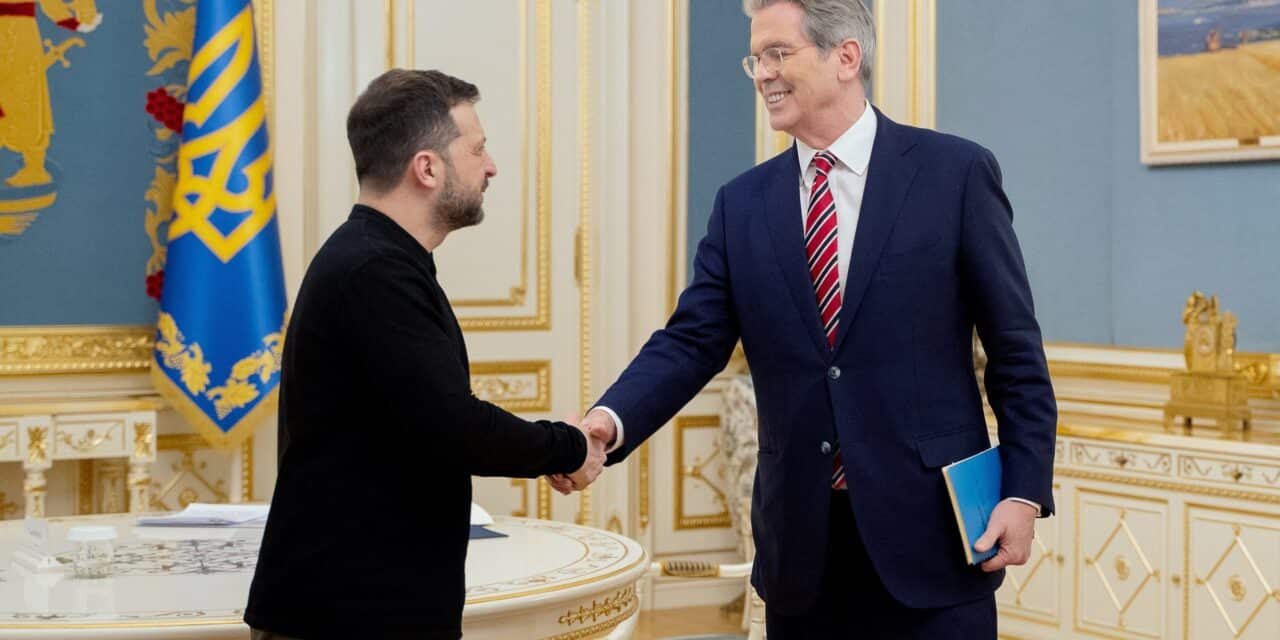
Ukraine President Volodymyr Zelensky greets US Treasury Secretary Scott Bessent, February 12, 2025 (Tetiana Dzhefarova/AFP/Getty)
EA-Times Radio VideoCast: Trump Camp’s Far-Right Threat to Europe and Ukraine
Wednesday’s Coverage: Zelensky Calls Trump’s Bluff on Elections
UPDATE 1614 GMT:
The Trump Administration is pushing Ukraine to withdraw its troops from the Donbas — the Donetsk and Luhansk regions in eastern Ukraine — and to create a “free economic zone” in the parts of the region which Kyiv now controls, President Volodymyr Zelensky says.
Zelensky said the Administration had suggested that Ukraine hand over the territory to Russia. Now it is proposing that Ukrainian troops withdraw, but Russian troops would not advance.
That matches leaks from US officials to the Washington Post that a revised proposal includes a 30-km (19-mile) demilitarized zone.
Zelensky said the proposal was not viable without guarantees that Russian troops would not take over the zone after a Ukrainian withdrawal. Ukrainian elections or a referendum would be needed for ratification.
Who will govern this territory, which they are calling a ‘free economic zone’ or a ‘demilitarised zone’, they don’t know.
If one side’s troops have to retreat and the other side stays where they are, then what will hold back these other troops, the Russians? Or what will stop them disguising themselves as civilians and taking over this free economic zone? This is all very serious. It’s not a fact that Ukraine would agree to it, but if you are talking about a compromise then it has to be a fair compromise.
The President posted about a discussion with senior Trump officials and commanders over security guarantees for Ukraine.
We greatly value the active engagement of the American side at all levels – not only in working to end the war, but also in ensuring Ukraine’s security and preventing a new Russian invasion. This reflects the seriousness of America’s intentions and its clear focus on achieving outcomes.
Security guarantees are among the most critical elements for all subsequent steps.
Today, we have had a constructive and in-depth discussion with the American team on one of the three documents we are currently working on – the one on security guarantees. The U.S. was represented by Secretary Marco Rubio @SecRubio, Secretary Pete Hegseth @SecWar, @SteveWitkoff,… pic.twitter.com/gztUJHBOqn
— Volodymyr Zelenskyy / Володимир Зеленський (@ZelenskyyUa) December 11, 2025
UPDATE 1308 GMT:
Russia’s oil exports in November fell to their lowest level in recent years.
Exports were around 2 million barrels, 21% below the 2016-2024 average for the month. The decline was driven by US sanctions on Russia’s leading oil companies Lukoil and Rosneft and by Ukrainian attacks on energy infrastructure.
UPDATE 1156 GMT:
Ukraine has struck facilities supporting the Russian invasion overnight.
The Vladimir Filanovsky field in the Caspian Sea was hit for the first time with four long-range drones, halting oil and gas production from more than 20 wells, said the Ukraine State security service SBU.
The field the largest in the Caspian. One of the biggest exploration sites, owned by a subsidiary of Lukoil, was struck.
A drone attack set afire the PJSC Acron chemical plant in Veliky Novgorod, 180 km (118 miles) south of St. Petersburg.
Acron produces a wide range of industrial chemicals and fertilizers. Some of its materials have dual-use applications, including components used in the manufacturing of explosives.
Moscow’s four airports were temporarily closed as at least 32 drones reportedly approached the capital.
UPDATE 1044 GMT:
German Chancellor Freidrich Merz has pushed back the Trump Administration’s National Security Strategy portraying Europe as a threat.
Alongside NATO Secretary General Mark Rutte, Merz said the US document confirms that Germany was right to focus on strengthening the European pillar of NATO and on Berlin’s security, migration, and economy policy.
“We are doing this out of our own conviction, not because anyone is pressuring us,” he says.
Noting that Europe “can stand firmly on its own feet”, he said, “We will…not allow anything or anyone to divide us.”
Merz balanced his message with the declaration of “a very detailed conversation” between European leaders and Trump on Wednesday.
He said the “constructive call” with “mutual respect” focused on “what territorial concessions Ukraine is prepared to make”, but “it was a question that…the Ukrainian President and the Ukrainian people must answer”.
If talks progressed, he expected further calls with US officials over the weekend, and then “possibly a meeting here in Berlin beginning of next week,”.
He maintained that Trump gave the impression that “he is prepared to go down this path with us” and “knows that the Europeans must also be heard”.
UPDATE 1029 GMT:
The US House of Representatives has passed a $900 billion defense policy bill which includes a guarantee of $400 million for each of the next two years to manufacture weapons to be sent to Ukraine.
The bill also bars US troop levels in Europe from falling below 76,000 for more than 45 days, and it blocks the removal of major equipment.
In East Asia, the bill limits any reduction of the 28,500 US troops in South Korea.
UPDATE 1020 GMT:
The maternal mortality rate in Ukraine rose by 37% from 2023 to 2024, assesses the UN Population Fund.
Florence Bauer, the Fund’s director for Eastern Europe summarizes, “More women [are] at risk of dying and more pregnancies ending in life-threatening complications. These are not abstract statistics – they are people and families living under unbearable stress and reflect a health system under attack.”
Dr. Heintz, an obstetrician in Kyiv, explains, “Many of the women coming here are under immense stress. The fear, the uncertainty, the travel – all of it contributes to complications in pregnancy.”
The doctor, who has been displaced from his home in the Donetsk region in eastern Ukraine, says, “We’ve seen a rise in premature births, and these babies depend on ventilators, on drugs that help them breathe, and on the staff who stay even during shelling.”
Frequent electricity cuts, infrastructure damage, and shortages of supplies and equipment are contributing factors to the mortality rate. Many premature babies rely on humanitarian supplies and equipment from the UN and humanitarian organizations.
“It’s the difference between life and death in some cases,” explained Dr. Heintz. “When the shelling starts, we just keep going.”
UPDATE 0725 GMT:
Ukrainian naval drones have critically damaged another vessel of the Russian “shadow fleet” transporting oil in defiance of international sanctions.
The “Sea Baby” drones hit the Dashan, flying under the flag of the Comoro Islands and heading to the Russian Black Sea port of Novorossiisk.
The attack, carrying out by Ukraine’s Navy and the State security service SBU, is the third sea drone strike in two weeks on “shadow fleet” vessels.
The Dashan, sanctioned by the European Union and the UK, was sailing at maximum speed with its transponders off when the drones hit its stern.
“The SBU continues to take active measures to reduce petrodollar revenues to the Russian budget,” said an official.
ORIGINAL ENTRY: Trying to take the diplomatic initiative, Ukraine President Volodymyr Zelensky and his team have spoken with Donald Trump’s advisors, discussing economic aspects of the European proposal to end Russia’s invasion.
Zelensky spoke on Wednesday with US Treasury Secretary Scott Bessent, Trump’s son-in-law Jared Kushner, and Larry Fink, the Chairman and CEO of the Blackrock investment firm.
Zelensky said the meeting “discussed key elements for recovery, various mechanisms, and visions for reconstruction”: “There are many ideas that, with the right approach, could succeed in Ukraine.”
The meeting also discussed the European-Kyiv counter-proposal to end the Russian invasion. That begins with a ceasefire on the current frontlines and details measures to guarantee Ukraine’s security against another Russian assault.
“It is overall security that will determine economic security and underpin safe business environment,” Zelensky summarized.
“We have also agreed on the next contacts between our teams,” the President announced without giving details.
In his nightly address to the nation, Zelensky emphasize that the Europe-Ukraine proposal is the “fundamental document” and “key steps…must be doable.
He added that additional documents will cover security guarantees with the US, reconstruction, and joint investment.
The principles of the economic document are absolutely clear, and we are fully aligned with the American side on this. Thank you. An economic action plan will follow. Europe will also be involved in reconstruction.
The 20 points for ending the war form a fundamental document. We are actively working on the key steps – they must be doable. From this fundamental document, we are developing at least two additional ones. The first is on security – regarding security guarantees with the United… pic.twitter.com/uQVG4myA6Z
— Volodymyr Zelenskyy / Володимир Зеленський (@ZelenskyyUa) December 10, 2025
European Leaders Call Trump
Zelensky will confer with his partners in the international Coalition of the Willing in a video call on Thursday.
Three of those leaders — Germany’s Friedrich Merz, France’s Emmanuel Macron, and the UK’s Keir Starmer — spoke for 40 minutes by phone with Donald Trump on Wednesday, two days after they conferred with Zelensky in London.
A British readout summarized:
The leaders discussed the latest on the ongoing US-led peace talks, welcoming their efforts to achieve a just and lasting peace for Ukraine, and to see an end to the killing.
Intensive work on the peace plan is continuing and will continue in the coming days.
They agreed that this was a critical moment – for Ukraine, its people and for shared security across the Euro-Atlantic region.
Trump continued to chide the Europeans, “We discussed Ukraine in pretty strong words.” He rambled:
I think we had some little disputes about people, and we’re going to see how it turns out. And we said, before we go to a meeting, we want to know some things.
They would like us to go to a meeting over the weekend in Europe, and we’ll make a determination depending on what they come back with. We don’t want to be wasting time.