
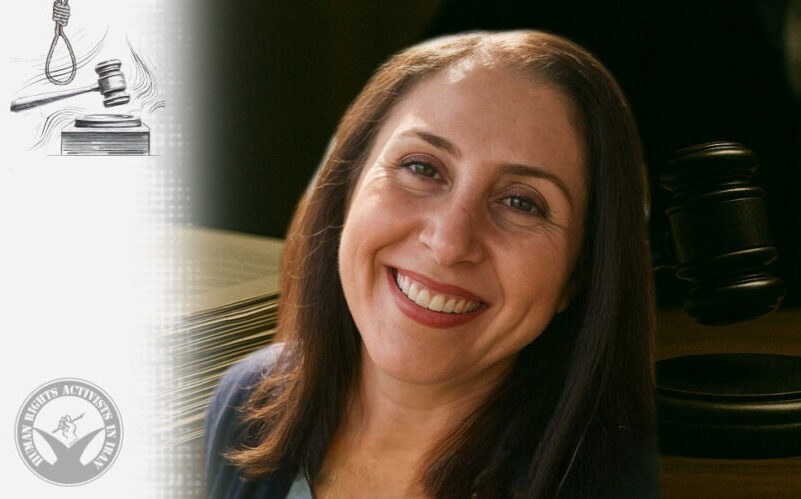
UPDATE, DEC 29:
UN experts have called for an immediate halt to the planned execution of Zahra Shahbaz Tabari (pictured), the 67-year-old electrical engineer detained in Lakan Prison in Rasht in northern Iran.
The severe procedural violations in this case —including the unlawful deprivation of her liberty, the denial of effective legal representation, the extraordinarily brief trial, the lack of adequate time to prepare a defence, and the use of evidence that appears insufficient to support a charge of baghi [rebellion against Islamic rulers] — render any resulting conviction unsafe….
Ms. Tabari’s case shows a pattern of serious violations of international human rights law regarding fair trial guarantees and the inappropriate use of capital punishment for broad and ill-defined national security offenses.
The experts noted that Tabari is among at least 52 individuals facing the death penalty for “national security” offenses, including baghi, moharebeh [waging war against God], corruption on earth, and espionage.
Iran leads the world in executions on a per capita basis. In 2024, 975 people were put to death, and human rights activists verified at least 1,500 executions in 2025 through the start of December.
ORIGINAL ENTRY, NOV 12: Iranian authorities have sentenced to death Zahra Shahbaz Tabari, a 67-year-old retired electrical engineer, after a 10-minute trial.
The evidence against her consisted of a piece of fabric with the slogan “Women, Life, Freedom” — the slogan for mass protests in autumn 2022 — and an audio recording stored on her phone that was never sent to anyone.
Tabari was arrested on April 17 when five security agents raided her home in Rasht in northern Iran without a warrant. They took her away as they confiscated phones, computers, tablets, and other electronic devices.
She spent a month in solitary confinement under interrogation before Israel’s 12-day war in June delayed proceedings.
After last month’s 10-minute video conference trial, plagued by audio problems, she was sentenced to death on charges of “armed rebellion through membership in the terrorist group Monafeqin”.
Tabari wrote her family:
In court, I faced sound disruption. When I objected, I was connected to the court by a desk phone. The judge asked only one question: “What is your final defense?”
I answered, but it wasn’t recorded correctly in the case. The whole thing took less than 10 minutes before he issued a death sentence.
Tabari worked for more than 30 years as an electrical engineer and sustainable energy specialist for the Gilan Electricity Administration. She retired a few years ago.
She has two children: a daughter in her late 20s who lives in Iran and a 35-year-old son, Soroush Samak, who lives in Sweden.
The engineer was first arrested in May 2022 and detained for three months on charges of “propaganda against the Islamic Republic”. She was released and wore an electronic ankle monitor for a year.
Tabari had no appointed defense attorney. She says her death sentence was actually issued on October 4, three days before she received court documents to review.
She immediately wrote objections on the case file, but the sentence had been confirmed at 9:20 that morning.
Soroush Samak said his mother endured psychological torture during interrogations: “They told her they’d cause problems for her children if she didn’t confess. My sister still goes everywhere with my father.”
He added, “My sister said [our mother] has lost weight, her strength has decreased, and her face has become thinner.”
Samak finally spoke with his mother on October 31, “As soon as she heard my voice, she burst into tears.” He noted:
When they come for a 67-year-old woman who isn’t a political activist or member of any organization, you realize that all Iranians are in the execution queue and one day the noose will fall around all our necks….
My mother is one drop in this sea of blood that the Islamic Republic has created.

1′”
1
Deaths reported in Qom, one by a home-made grenade exploding prematurely: https://www.tabnak.ir/fa/news/1349652
https://www.independent.co.uk/bulletin/news/iran-protests-2026-burning-vehicles-video-b2893878.html
“Eyewitness video shows cars burning and overturned outside a police station in Azna, Iran.”
Mike Pompeo declares that Mossad agents are stoking the unrest in Iran: https://www.moneycontrol.com/europe/?url=https://www.moneycontrol.com/world/happy-new-year-to-iranians-in-the-streets-and-mossad-agents-beside-them-mike-pompeo-fuels-iran-firestorm-article-13755046.html
““Happy New Year to Iranians in the streets and Mossad agents beside them”
[Editor’s Note: Mehr is a semi-official outlet reflecting the line of the Iranian regime[
A look at recent protests inside Iran: https://en.mehrnews.com/news/240389/A-look-at-recent-protests-inside-Iran
“During Iran’s recent protests, despite widespread public dissatisfaction over rising prices and economic instability, street participation has been noticeably lower compared to previous periods of unrest. This trend has emerged even as the right to protest and express grievances remains a natural and legitimate right of the Iranian people, as it is in other countries around the world.”
Detailed Report on the Sixth Day of Protests: https://www.en-hrana.org/detailed-report-on-the-sixth-day-of-protests-violence-by-security-forces-and-an-increase-in-the-arrest-of-protesters/
“According to verified reports up to the time of publication, a total of 113 protests have been recorded over the past six days in 46 cities across 22 provinces. Fifteen student gatherings at 13 universities are also included in this figure.”
A “city” in Iran can mean a town of 1,000 to a metropolis like Tehran. There are 1,200 cities across Iran.
“”
Trump warns Iran after protests turn deadly across several provinces: https://edition.cnn.com/2026/01/01/middleeast/iran-protests-deadly-clashes-latam-intl
“Dozens of protesters took to the streets across several of Iran’s provinces this week, with some demonstrations turning deadly Wednesday after clashes with police.”
For once I agree with CNN about the numbers. In actual fact, thousands have been on the streets – some to legitimately protest against currency depreciation and inflation and others (in smaller numbers) only intent on causing mayhem.
AI-manipulated image of Iran protests: https://www.bbc.co.uk/news/live/c87r0rr0qqzt
“One picture shared yesterday by the Israeli foreign ministry’s Persian-language account on X appears to show a police officer spraying water at two men standing close by. Google’s SynthID AI-watermark detector said the image was generated or edited using Google AI.”
Mossad backs Iran riots and now Trump threatens to intervene: https://www.ft.com/content/1aa432f5-1d01-4fcd-b6d9-c17d67d01ea5
[Editor’s Note: Latest claims from semi-official Iranian media….]
3 killed in the city of Azna trying to storm a police station: https://www.tabnak.ir/fa/news/1349366
Ringleader who organised riots in Khorramabad has been arrested: https://www.mehrnews.com/news/6709921
Iran replaces central bank governor in effort to contain cost-of-living protests: https://www.ft.com/content/406c8beb-170d-4db0-8b3c-e368249b0c2f
“Hemmati promised to restore “economic stability”, adding that “the main responsibility of the central bank is to curb inflation and control the banks, and to dismantle the multi-tier exchange rate system which causes corruption”.
That would be a good move as the official v free market rate allows approved traders to make huge profits. Also the new CBI governor must:
1. Get rid of the four zeroes on the dollar exchange. This will have a psychological impact.
2. Pump gold and foreign exchange into the free market – Iran recently acquired $2bn in hitherto frozen assets.
3. Insist that the budget deficit is reduced through reduced spending. Investor will respond positively to this.
4. Work with the police and judiciary to crack down on currency speculators and hoarders – some of whom may work with foreign intel.
Two killed in Lordegan following violent attacks on police and government buildings: https://www.didarnews.ir/fa/news/193818
Lordegan is a small city in the remote mountainous province of Chaharmahal va Bakhtiyari
[Editor’s Note: A claim from semi-official outlet Tasnim….]
First fatality of the protests – a teenage Baseeji has been killed in Kohdasht: https://www.tasnimnews.com/fa/news/1404/10/11/3485309
Amir Hesam Khodayari is the named victim. More than a dozen members were injured.
Iran security force member killed during protests, officials say: https://www.bbc.co.uk/news/articles/c2d7g8krj2po
“A member of Iran’s security forces was killed during a fourth day of protests in the country, which have been sparked by a currency collapse, officials have said. Citing regional chief justice Saeed Shahvari, Iran’s judiciary-affiliated Mizan news agency said Amir Hessam Khodayari Fard was killed in the city of Kouhdasht, in the western Lorestan province, on Thursday.”
Clashes were reported also in Asadabad, Nahavand (Hamedan province) and Fasa (Fars province). Police were reported to have used tear gas, water cannon and rubber pellets.
From markets to streets: Iran protests spread nationwide on day two
https://www.iranintl.com/en/202512291716
Strikes spread across Tehran markets as rial plunge fuels protests
https://www.iranintl.com/en/liveblog/202512283787
More news and videos…
https://www.radiofarda.com/a/33635370.html
Australia lists Iran’s Revolutionary Guard as state sponsor of terrorism
https://www.iranintl.com/en/202511276299
Iran Internet Ban: The Islamic Republic Filters for Millions of People, Not for Its Own
https://iranwire.com/en/features/146582-iran-internet-ban-the-islamic-republic-filters-for-millions-of-people-not-for-its-own/
Never been a huge fan of EM, but for once he does something that promotes transparency, and exposes the regime attempts in diverting their efforts
New X Feature Exposes Who In Iran Is Bypassing State For Unblocked Internet
https://www.rferl.org/a/iran-internet-censorship-x-twitter-vpn/33602370.html
Re-evaluating an ‘unresolved’ war between Iran and Israel: https://www.middleeastmonitor.com/20251117-the-dawn-that-never-broke-re-evaluating-an-unresolved-war-between-iran-and-israel/
“The dawn following 13 June 13 brought no victory for Israel. The twelve-day war between Iran and Israel did not culminate in an Israeli triumph or an “Iranian eclipse.” Instead, evidence suggests both sides concluded the first round in a strategic, fifty-fifty stalemate. This analysis examines four fundamental gaps in the “decisive Israeli victory” narrative: the nuclear programme data gap, the missile capacity optimism gap, the command structure recognition gap and the flawed social response data gap.”
To “re-evaluate”….meaning changing channel as you hopelessly try to do. Instead let your “ommaat” (herd of cattle) followers hear more relevant news.
“rahbareh farzaneh” is going to bark from his hiding hole again??? lets hear it!
https://www.iranintl.com/en/202511233504
https://www.radiofarda.com/a/33599639.html
The Commander’s Daughter: How a Viral Photo Exposed Iran’s Elite Hypocrisy
https://iranwire.com/en/features/146452-the-commanders-daughter-how-a-viral-photo-exposed-irans-elite-hypocrisy/
Iran’s Growing Missile Arsenal Is a Challenge for Israel: https://nationalinterest.org/blog/buzz/irans-growing-missile-arsenal-is-a-challenge-for-israel-mc-111625
“In October, European intelligence sources reported that Iran was indeed building up its ballistic missile program in the aftermath of the 12-day war. Despite the United Nations sanctions that prohibit arms sales to the regime, Tehran’s ballistic missile activity appears to be expanding. Specifically, reports indicate that multiple shipments of sodium perchlorate were delivered to the Iranian port of Bandar Abbas from China.”
Lets change the channel back from your bullshit attempts
https://www.instagram.com/reel/DRJzAnCDJtx/?igsh=MXF2ZjJxODJtM3Q4MA%3D%3D
Iran Tracks Dissidents in Hours, Can’t Find Missing Women in Months
https://iranwire.com/en/women/146367-iran-tracks-dissidents-in-hours-cant-find-missing-women-in-months/
A new trend in the regime savagery against women have been happening in recent week, a repeat really.
Bita Shafiei is only a teenager…
https://www.instagram.com/p/DRL6jGGjVqt/
Iran’s cloud-seeding efforts prove successful: https://www.thearabweekly.com/rainfall-causes-floods-parts-drought-stricken-iran-drought-persists-elsewhere
Heavy rain has caused floods in western Iran where the operation began. Higher temperatures may not allow rain to fall naturally.
‘We’ll Kidnap Your Daughter’: Iran’s New Intimidation Playbook
https://iranwire.com/en/features/146379-well-kidnap-your-daughter-irans-new-intimidation-playbook/
3 Years After Boy’s Death in Iran Protests, Family Faces Continued Persecution
https://iranwire.com/en/features/146313-3-years-after-boys-death-in-iran-protests-family-faces-continued-persecution/
Iranian Poll Shows 92% Public Dissatisfaction With Country’s Conditions
https://iranwire.com/en/news/146306-iranian-poll-shows-92-public-dissatisfaction-with-countrys-conditions/
Iranian Firefighter Sets Himself Ablaze Over Four Months of Unpaid Wages
https://iranwire.com/en/news/146282-iranian-firefighter-sets-himself-ablaze-over-four-months-of-unpaid-wages/
Soon people will realize…why not set mullahs on fire first, and then themselves.
Satellite Photos Reveal Extent Of Iran’s Drought Crisis
https://www.rferl.org/a/iran-drought-crisis-satellite-images/33587614.html
Iran Copies Saddam’s Desperate Turn to Ancient Glory
https://iranwire.com/en/features/146241-iran-copies-saddams-desperate-turn-to-ancient-glory/