
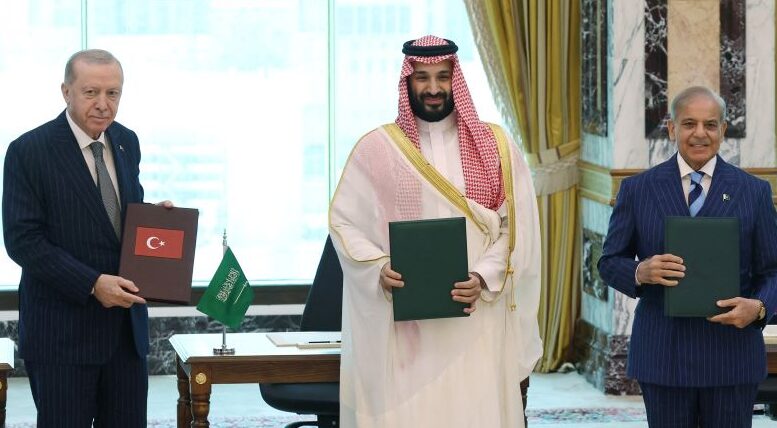
Turkish President Recep Tayyip Erdoğan, Saudi Crown Prince Mohammed bin Salman, and Pakistan Prime Minister Shehbaz Sharif after their signature of the Mecca Pact joint defense agreement in Mecca, Saudi Arabia, August 7, 2026
UPDATES: US War on Iran, Day 239 — Attacks on Shipping in Strait Of Hormuz Highest Since March
UPDATE 0559 GMT:
Israeli forces have shelled the towns of al-Mansouri and Majdal Zoun in southern Lebanon overnight.
The towns of Barashit and Kounine were also attacked. Heavy machine-gun fire was directed towards Beit Yahoun in Bint Jbeil district.
UPDATE, OCT 27:
The Saudi-led coalition in Yemen says it intercepted and destroyed three ballistic missiles launched by Yemen’s Houthis toward Saudi Arabia’s Eastern Region.
Saudi Civil Defense had issued early warning alerts for a potential hostile threat in the Eastern Region and in Kharj Governorate.
UPDATE 1707 GMT:
Iran and the three countries in the Mecca defense pact — Saudi Arabia, Pakistan and Turkey — have “agreed to continue discussions to strengthen cooperation…including on regional peace and security” after discussions in Tehran.
Iranian President Masoud Pezeshkian said, “I hope that the presence of representatives of important and influential Islamic countries at this meeting will help further consolidate regional unity and cohesion.” He urged Islamic countries to “stand together and adopt a coordinated position.”
UPDATE 1658 GMT:
The Israeli daily Haaretz says tensions are rising within the Mossad intelligence service of Prime Minister Benjamin Netanyahu’s pursuit of strikes on Iran before Tuesday’s Israeli elections.
Mossad director Roman Gofman, previously served as Netanyahu’s military secretary, supported the attacks. Senior Mossad officials have pushed back, raising concerns about the timing of such a strike and its possible impact on the election. They questioned Netanyahu’s judgement, cautioning that political considerations were being conflated with security ones.
UPDATE 1025 GMT:
Citing “two US officials and an Israeli security source”, CNN has echoed an earlier report that Israel’s Prime Minister Benjamin Netanyahu is pushing for a joint US-Israel strike on Iran. However, the Trump camp has asked that any potential action be delayed until the US is ready.
Officials said last week that Netanyahu wanted to strike across Iran on October 10, but Donald Trump told him to wait until after US mid-term elections on November 3.
“Netanyahu really wanted and tried to convince Trump for a joint attack in Iran before the elections, and Trump did not give a green light,” said CNN’s Israeli source.
Netanyahu’s office dismissed the report, calling it “fake news”.
Israel’s Channel 12 reported on Sunday night that Netanyahu and the Chief of Staff of the Israel Defense Forces, Lt. Gen Eyal Zamir, clashed recently over the Prime Minister’s command for military action. Defense officials believe this could lead to a swift confrontation with Iran shortly before the election.
UPDATE 0647 GMT:
The head of the International Energy Agency says he does not expect energy markets to return in 2027 to levels before the US-Israel War on late February.
IEA Executive Director Fatih Birol told the Singapore International Energy Week conference:
So therefore, we all need to get prepared, taking the energy security as a number one priority in our government, business world, but without forgetting what is the next chapter for the countries and for companies that are all here today.
UPDATE, OCT 26:
Iran will convene with the countries of the new Mecca Pact — Saudi Arabia, Turkey, and Pakistan — in Tehran today to discuss regional coordination, say “two people with knowledge of the matter”.
Saudi Arabia will be represented by Defence Minister Prince Khalid bin Salman, and Pakistan by army chief Field Marshal Asim Munir. Turkey is sending its head of intelligence Ibrahim Kalin.
The three countries signed the Mecca Pact for collective defense in August. Their meeting with Iran is the first since the escalation of attacks between Yemen’s Houthis and the Saudis last month.
Pakistan, alongside Qatar, has been the mediator for an end of the US War on Iran. However, contacts have stalled since the Trump camp rejected a Memorandum of Understanding, which had been signed by Donald Trump, this summer.
Ali Bagheri, the deputy secretary of Iran’s Supreme National Security Council, said the decision for a joint meeting was confirmed by Gen. Munir in a meeting with Iran’s top security official, Mohsen Rezaei, in Tehran last week.
Bagheri said, “Together with Iran, all three countries at this meeting can take an effective step towards building endogenous security, under Iran’s vision of regional security led by regional actors and drawing on Iran’s successful experience in building its own national security.”
UPDATE 0638 GMT:
Yemeni rights group Rasd says more than 1,400 patients – including 1,110 with kidney failure, 192 in intensive care, and 154 infants in incubators – face severe, life-threatening risks in the besieged city of Taiz amid fuel and medical supply shortages.
Houthi insurgents have cut off most routes to the city in southwest Yemen, as they try to overrun Government areas.
Rasd said 98 health facilities were partially operational or had gone completely out of service, and 42 healthcare centres were battling acute shortages of medical supplies and oxygen. Critical fuel deficits threaten to halt or scale back operations across 12 hospitals. Facilities are struggling to provide around 120 required daily dialysis sessions.
World Food Programme assistance is failing to reach approximately 600,000 residents in Taiz, as 800,000 people across Yemen face severe disruptions to humanitarian access.
UPDATE, OCT 25:
“Two senior Iranian officials”, one of them in the Revolutionary Guards, tell The New York Times that Tehran is preparing to target US diplomats and personnel.
Last week US Director of National Intelligence Jay Clayton informed Secretary of State Marco Rubio in a memorandum that Iran has “substantially increased” its efforts to target Americans in the Middle East and beyond.
The Iranian officials said the targeting of US counterparts is “fair game”, given the assassination of Iran’s personnel — including the Supreme Leaders and senior officials and commanders — by the US and Israel.
The State Department announced in recent days that it is reducing staff at the US Embassies in Jordan, Lebanon, Qatar and the UAE. Non-essential US embassy staff and their families have been ordered to leave Saudi Arabia.
ORIGINAL ENTRY, OCT 24: Oil has surged to its highest price since April amid the Trump camp’s threats to renew attacks on Iran after US midterm elections on November 3, and Iran’s promised retaliation against oil facilities, undersea cables, data centers, and AI facilities in the Gulf region.
Brent crude passed $117 per barrel at one point on Friday before settling at $116.72, more than 3% higher.
Before the US-Israel War began on February 28, Brent was around $72 per barrel. By the end of April, it reached $126 before plummeting to just over $70 in July with the possibility of a settlement based on a Memorandum of Understanding signed by Tehran and Donald Trump.
At a summit in Istanbul, European and Middle Eastern Foreign Ministers expressed their opposition to renewed attacks on Iran.
Turkish Foreign Minister Hakan Fidan said:
Military intervention in Iran is not any kind of solution. We agreed that a new military attack would spread the war and the conflict in the region. All the countries around the table do not want the war to spread even more, once again.
German Foreign Minister Johann Wadephul said Germany, France and the UK are ready to negotiate with Iran to rule out its acquisition of nuclear weapons.
Wadephul also called for support for Saudi Arabia and the Yemen Government to defend themselves and for concrete negotiations with Yemen’s Houthis to resume.
The Middle Eastern states were represented by Turkey, Pakistan, Saudi Arabia, and Egypt. The first three states declared the Makkah Alliance in August for mutual defense, a pact which the Egyptians may join.
The European side was represented by Germany, France, the UK, and Italy.