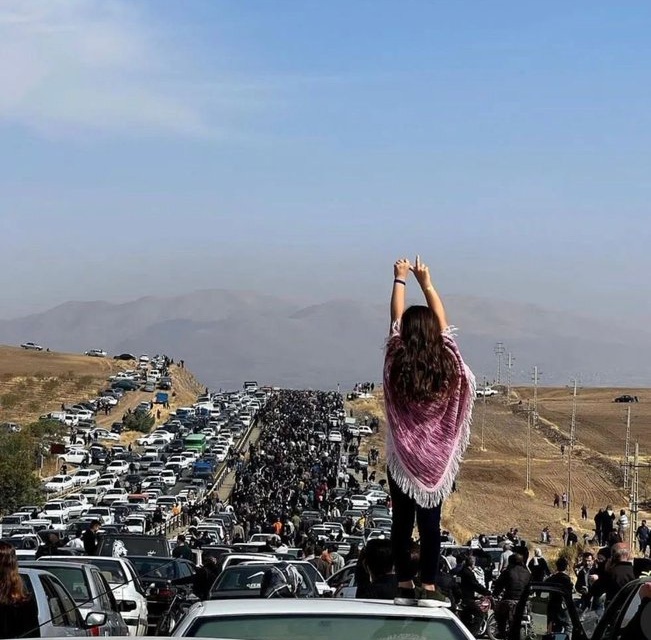
A woman stands on a car and salutes the crowd gathering for the 40th day ceremony for Mahsa Amini, who died in Iranian police custody on September 16, 2022
Four years after Jina Mahsa Amini was mortally injured in a beating by Iran’s “morality police”, the legacy of the Woman, Life, Freedom movement can be summed up in a paradox.
The Islamic Republic crushed the uprising of September 2022. It could not undo the social rupture which the uprising exposed. The balance of political power held, but Iranian society had already changed.
Nowhere is this paradox clearer than with compulsory hijab in public for women.
The laws remain in force. Police, the judiciary, and other state bodies can still pursue women, punish them, and exert economic pressure on them.
But women continue to appear unveiled in public. What was once a
visible marker of state authority has to be enforced again and again through surveillance, threats of punishment, and police intervention.
Hossein Taeb, head of the paramilitary Basij Organization, illustrated the political sensitivity of the issue days before the 4th anniversary of Amini’s death. Addressing Basij commanders in Tehran last Saturday, he warned that the US was seeking to exploit divisions among political forces inside the system. Hijab and other cultural disputes had to be handled without damaging “internal cohesion”, he said.
The Basij commander placing hijab within a warning about internal division says much about the change since 2022. The Islamic Republic can still coerce and punish women; however, it can no longer rely to the same degree on social compliance with its rules.
Mahsa and the Movement
Jina Mahsa Amini was 22 when she was seized by the “morality police” as she visited Tehran. She collapsed in police custody, fell into a coma, and perished three days later.
Mourners at her funeral in Saqqez’s Aichi cemetery chanted “Jin, Jiyan, Azadî”. The Kurdish phrase — Woman, Life, Freedom — spread across Iran.
The Islamic Republic had experienced nationwide protest movements, from the Green Movement after the disputed 2009 Presidential election to the demonstrations of 2017-18 and the bloodily-suppressed uprising of November 2019.
However, in autumn 2022, conflicts that had often been treated separately found a common political language: the status of women, individual freedom, social inequality, ethnic discrimination, and state violence.
Compulsory hijab became a symbol of the Islamic Republic’s claim to determine how people should dress and behave in public. At the same time, another idea receded: the belief that the system could be changed from within through elections, reformist presidents, and gradual liberalization.
While that process had begun long before 2022, protest in Woman, Life, Freedom increasingly moved beyond the question of which faction should govern within the Islamic Republic. The system itself became the issue.
The latest GAMAAN survey in June, a weighted sample of 31,450 respondents inside Iran, gives some indication of the extent of that shift. Only around 10% of respondents identified with gradual reform within the Islamic Republic. Around 47% saw regime change as a prerequisite for progress, and another 23% favored a transition away from the Islamic Republic.
Political contestation has moved a long way from the old divide between reformists and hardliners.
From Economic Protest to the Question of Power
When protests began around the Tehran Bazaar in late December 2025, the immediate grievances were the collapsing currency, inflation, high prices, and corruption. However, the demonstrations soon turned against the political system.
Both Mahsa’s death and economic hardship had led back to the question of political power. The language of protests had changed — monarchist slogans were more prominent in January 2026, with Reza Pahlavi playing a greater role in mobilization than in 2022 — but Woman, Life, Freedom was still an important dimension.
Among GAMAAN’s respondents who said they had taken part in the January protests, 71% cited dissatisfaction with the Islamic Republic as a motivation; 62% cited high prices, inflation, and corruption; and 55% cited Pahlavi’s call to protest.
Almost 80% supported the call of “Death to the dictator”, and 74% backed “Woman, Life, Freedom. There was more division around “Long live the Shah” — 54% support with 31% opposed — and “This is the final battle; Pahlavi will return” (50% v. 34%).
There is not a single political camp challenging the regime. Economic hardship, rejection of the Islamic Republic, nationalism, support for Pahlavi, and the language of 2022 coexist within the protest movement. Opposition to the Islamic Republic is broader than agreement on what should replace it.
The mass killing of January exposed the limit of this social shift. The Islamic Republic’s loss of legitimacy had not broken its command of the police, the Revolutionary Guards, the Basij militia, the judiciary, or the prison system. Four years after Woman, Life, Freedom, changes within society had yet to be translated into a comparable shift in political power.
The decentralized character of the 2022 uprising was initially an advantage. There was no single leadership whose arrest could bring the movement to an end. Local networks could continue mobilizing after protests elsewhere had been suppressed.
But when protest had to be converted into political power, decentralization was a weakness. A nationwide general strike requires coordination across universities, the bazaar, transport networks, and key industries. If parts of the state apparatus begin to waver, a challenger must be able to make decisions and potentially negotiate with sections of the bureaucracy or security forces. Thus, any transition has to answer a difficult question: who has the authority to speak for it?
The Islamic Republic works systematically to prevent organizations capable of doing this from emerging. Independent parties, trade unions, and media are restricted or suppressed. Political networking brings the risk of surveillance, arrest, and long prison sentences.
Repression does not fully explain the problem. Outside Iran, the opposition failed after 2022 to turn social mobilization into a durable political alliance. An attempt to create a common platform around Reza Pahlavi, Masih Alinejad, Hamed Esmaeilion, Shirin Ebadi, Nazanin Boniadi, Golshifteh Farahani, Ali Karimi, and Abdullah Mohtadi fell apart after only a few months in 2023. Once shared opposition to the Islamic Republic had to become a vision of what might follow it, substantive political disagreements came to the surface.
Republic v. monarchy is a key issue. The relationship between the central state and the regions is another. Different visions of Iran come into particularly sharp conflict over the political and linguistic rights of Kurds, Baluch, Azeris, and other groups. Some see decentralization or regional autonomy as safeguards against another concentration of power. Others regard them as threats to territorial integrity.
These arguments cannot be postponed until the day after a change of regime. They already shape the alliances which can be built.
Reza Pahlavi embodies much of this dilemma. He is the most visible individual opposition figure and commands a genuine following. Discounting his role in mobilizing the January 2026 protests would distort the picture. Treating that visibility as evidence of a social consensus for restoring the monarchy would distort it in the other direction.
The GAMAAN responses bear out the distinction. Asked about their preferred form of government, around 34% chose some form of monarchy and around 28% some form of republic. A large group did not clearly commit to either option.
The problem is larger than Pahlavi. An opposition united in rejecting the Islamic Republic also needs agreed rules for managing its own disagreements: over the form of government, the distribution of power, minority rights, and ultimately who makes decisions. Without those rules, social opposition lacks a clear route to becoming a political alternative.
Who Rallies Under External Pressure?
The US-Israel War on Iran has tested another long-standing claim of the Islamic Republic: foreign attack will rally the country around the political system.
The claim depends on treating defense of Iran and support for the Islamic Republic as if they were the same thing. They are not. A military attack can stir nationalism and deepen hostility towards Israel or the US without changing how people view those who rule them.
GAMAAN found a society deeply divided over the war. Around 42% described the US-Israeli military action as an attack on Iran, while an almost equal share rejected that description. At the same time, around 60% said they had viewed the weakening of the Islamic Republic during the war with satisfaction. Whatever national solidarity the war produced, it did not amount to a lasting social rally around the Islamic Republic.
The dynamic is different inside the apparatus of power. Competing factions fight over offices, resources, and political influence. But when the survival of the system itself is at stake, they have a common reason to put those conflicts aside.
Ideology is only part of the equation. Wealth, business networks, access to state resources, and personal security are bound up with the Islamic Republic. For sections of the political, military, and economic elite, its end could mean loss of power, confiscation, prosecution, or exile.
Basij commander Taeb made that logic unusually explicit on Saturday when he said internal differences, supposedly exploited by the US, had to be set aside. A mass exercise involving 313,000 Basij members was in Tehran for September 18. The judiciary announced the seizure of property belonging to people accused of activities against the nation and in support of “hostile states”: 143 properties and other assets were seized in Tehran while 240 assets were seized and 182 bank accounts frozen across the nation.
The campaign against Starlink points to another concern. Hossein Rahimi, head of the Economic Security Police, said in late August that 997 Starlink devices and related equipment were seized from late March to late July, with 163 people arrested in connection with their import or distribution.
Protest waves since 2019 have repeatedly demonstrated the importance of communications shutdowns to the state’s response — both in disrupting organization inside Iran and in restricting the flow of images and information to the outside world. War, espionage, communications, social conflict, and protest increasingly meet in the same security narrative.
That narrative gives the power apparatus reasons to close ranks and widen its means of control. It does not follow that society will close ranks with it.
Four Years Later, Back to Saqqez
Perhaps the clearest answer to whether Woman, Life, Freedom belongs to the past is found not in an opinion poll but in Saqqez, the home of Mahsa in mainly-Kurdish northwest Iran.
Since 2022 Aichi cemetery, Mahsa’s final resting place, has repeatedly been subjected to heightened security measures. On the third anniversary, Hengaw documented armed forces on the roads leading to the cemetery, pressure on Jina Mahsa Amini’s family, and a heavy security presence across the city. Businesses in Saqqez and Divandarreh closed in protest.
A cemetery is not placed under surveillance because it houses a military adversary. It is watched because memory can acquire political power.
The Islamic Republic is still in place with its courts, prisons, and security forces. The Revolutionary Guards and Basij militia retain the means to meet protest with violence. January 2026 demonstrated again that a loss of social legitimacy does not deprive a state of its capacity to act.
Yet Iranian society has not returned to where it stood before September 2022. Women have changed the public sphere. The reformist promise of gradual change through existing institutions has lost more of its credibility. And very different grievances can now lead back to the political system itself.
None of this makes a transfer of power inevitable or imminent. The past four years have exposed the distance between changing a society and acquiring the political power to change a state. The opposition has yet to bridge that distance. Disputes remain over a further political order: republic v. monarchy; the relationship between the center and the regions; ethnic and lingustic rights; and civilian control of the security forces.
Nor does war erase the underlying conflict. The strongest incentives to rally around the Islamic Republic lie among those whose power, economic interests, and personal security depend on its survival. Among the wider population, opposition to foreign attack and opposition to the political system can coexist.
Four years after Jina Mahsa Amini’s death, the Islamic Republic still has the means to crush an uprising. What it has been unable to restore are the social conditions that once allowed its authority to function with far greater compliance.
Woman, Life, Freedom did not decide who holds power. It ensured that the question of power would not go away.

Amnesty International lists 377 protesters allegedly killed in WLF protests: https://www.amnesty.org/en/documents/mde13/1349/2026/en/
The report attaches a name, photo, age and location of death to about three quarters of the list.
Iran Human Rights provides a list of 4,200 killed during the unrest in January: https://iranhr.net/media/files/EN-The_January_2026_Protest_Killings_in_Iran-.pdf
According to Chatgpt:
3,240 have full names, age, location and date of death.
518 have full names but lack either an age, location or date
263 have full names but lack two of the three other criteria
167 have only full names and no other information
31 have no full names
Iranian authorities reported 3,117 deaths but did not disclose age, location or dates although they did provide national identity numbers and father’s names.
West Azerbaijan and Kurdistan – at the epicentre of the WLF protests – reported just 9 protester deaths in the January unrest (among the lowest for the provinces).
A women-only 10 km long marathon was organised in the Velayat Park in Tehran: https://www.facebook.com/igr.media/videos/igr-a-women-only-10-km-long-marathon-was-organised-in-the-velayat-park-in-tehran/2295417417881715/
The women were not required to cover up for their run.